
Like the Russian filmmaker Andrei Zvyagintsev, I personally try to stay away from politics as much as possible. Yet when I saw the film Leviathan achieve a monstrous deal of both acclaim and criticism, I could not ignore this cinematic work when it finally reached Baltimore’s Charles Theatre.
Allow me to start with a small but relevant side note on one particular aspect of modern-day storytelling. I am a strong believer in positive thinking — a mental and emotional attitude that focuses on the bright side of life. The amount of negative and visually-extreme stories and horrific images being pushed to us through various media outlets is, at times, overwhelming. Some may argue that it is important to tell the visual side of every story. But more often than not, I feel this trend is driven on one hand by pure sensationalism favored by the news media and, on the other hand, by the strange popular addiction to seeing and watching the stories of crime, rape, murder and abuse.
The film Leviathan is a horrific story of how a mayor of a northern Russian town relentlessly abuses his power and tries to destroy a life of one local car mechanic. Audiences are unlikely to learn anything new for themselves about Russia as a result of watching the film: the plot revolves around the usual problems of corruption, a weak judicial system, alcohol abuse and the questionably-close relationship between the government and the church. In a recent interview, Zvyagintsev called the film “a story of human tragedy set against an everlasting and universal conflict between man and state.” Interestingly enough, although set in Russia, the initial idea for the film came from a real-life story of Marvin John Heemeyer from Grand Lake, Colorado.
“The ideas at the heart of [Leviathan] are relevant everywhere, but of course it’s a film about Russia. It’s a very Russian film,” notes Zvyagintsev in another interview. Having now seen the film, I personally would call Leviathan a very extreme portrayal of the challenges faced by the Russian society. Though I have lived outside of Russia for a long time, I still consider myself informed enough to say that the film’s portrayal of my home country is by no means complete. And yet, I do not think it was Zvyagintsev’s intention to paint a complete picture.
The name of the film — Leviathan — evokes the image of a biblical sea monster. According to recent Russian interview with Zvyagintsev, the name of the film was partially inspired by the literary work of the English philosopher Thomas Hobbes, who favored strong centralized government in society. I personally counted at least four instances where Leviathan symbolically appears before us in one form or another, which attests to Zvyagintsev’s suggestion of leaving room for multiple interpretations of the film by the audience.

The setting of the film is a small town on the outskirts of Russia. Similar to other northern communities (like Canada’s town of Pangnirtung depicted here), it struggles to reorient itself from a once-flourishing fishing community to a destination for eco-tourism and outdoor sports enthusiasts.
Being familiar with previous work of both the director and some of the actors of the film, I can say that Leviathan is a film worth seeing for its cinematography and superb acting that fully immerse the audience into the story. Using the Russian town of Teriberka on edge of the Barents Sea as the setting, the film creates striking images of a small Arctic community and its surrounding natural landscapes. Zvyagintsev skillfully uses the might of the sea as an allegorical depiction of political power and authority (denoted in Russian by the same word — “vlast”). The sea can at times be overwhelming and intimidating, it can shape the land and over the course of human history and swallow entire communities.
Having completed a lengthy study on perception of Russia in North America, looking specifically at print news media and correlating it with interviews of Canadian companies working in Russia, I witnessed an obvious bias towards negative topics in the media. From my review of approximately 250 articles published on Russia between 2000 and 2009 in three major newspapers and two business magazines, it was very evident that the image of Russia projected in the Canadian media was distorted. Having now seen Leviathan, I think the film will appeal to the vast majority of North American audiences as it reinforces the same polarized image of Russia that shines through the daily news headlines. It portrays the side of Russia audiences are most accustomed to seeing. As film reviewer Anthony Lane pointed out, the narrative is told through a lens of “clear liquor and tar-black humor.”
Leviathan leaves few simmering rays of hope, though the overall picture of the Russian society certainly appears very bleak. The film does not give us an answer or suggest any solutions for how current problems can be addressed, whether in places where corruption may have already deeply penetrated the fabric of the community, or in places that Leviathan has yet to reach. Perhaps the greater achievement of Zvyagintsev’s latest film is not necessarily the plot or portrayal of the country, but the film itself being Russia’s powerful self-criticism essay that will draw increased attention to the issues of corruption and abuse of power. Efforts to seek and implement solutions to these challenging problems should no doubt continue and be stepped up. Perhaps Russia’s newly launched nationwide social network designed to fight bribery and corruption will become another step in the right direction.
The February 27 premiere of the film in Baltimore coincided with the tragic killing of one of Russia’s most prominent political activists, Boris Nemtsov. This unacceptable human tragedy has resonated with many Russians. And I believe that the outpouring of flowers, emotions and people that have come out to honor Boris Nemtsov will no doubt bring positive change.
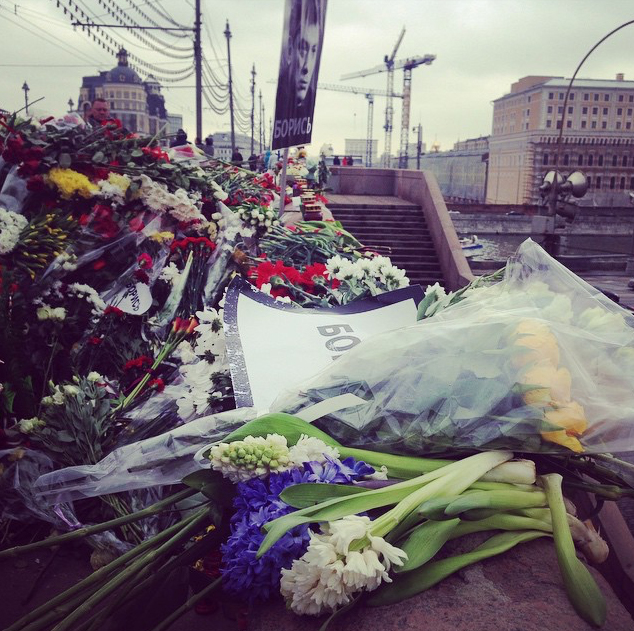
Moscow’s Bolshoy Moskvoretsky Bridge covered with mountains of flowers laid at the site where Russia’s political activist Boris Nemtsov was found dead on February 27. Photo by Varvara Gryaznova
The film Leviathan may not look beyond the news headlines in its portrayal of the Russian society, and the audience interested in gaining a deeper understanding of Russia may, in my opinion, be somewhat disappointed. If you ever get an opportunity to visit Russia, be assured that you will enjoy meeting its people first-hand much more than your chance encounter with the fictional characters of Leviathan. However, Zvyagintsev’s film certainly deserves to be celebrated as a powerful cinematic and theatrical achievement of Russian film making. And I congratulate the film on the numerous awards it has already received both at home and abroad.