When people talk about the intersection of arts and technology, it’s not always so literal as a group of technologists hacking a museum amidst Renaissance sculptures. But that’s exactly what happened last weekend at the Walters Museum “Art Bytes” Hackathon.

David Raynes, Nick Gauthier, and Bryan Connor
A hackathon is an event in which technologists, designers, and other professionals and community members collaborate to build software or hardware to achieve a specific goal. In this case, leaders of the Walters Museum invited hackers to build applications to enhance museum programs or address challenges related to art education and accessibility.
Last weekend, eight teams of software developers, designers, museum curators, students, teachers, and other museum employees competed for $5,000 in prize money from the Abell Foundation, awarded by a panel of judges including gaming legend Sid Meier.
Art Bytes is a neat supplement to the Public Property exhibit at The Walters, which opened on June 17 and runs through August 19. Public Property is a community-curated exhibit, evoking the spirit of museum founder Henry Walters, who bequeathed the core collection to the City of Baltimore “for the benefit of the public.” Art Bytes fits the mission of Public Property by encouraging community members to shape the museum experience through their own creations.
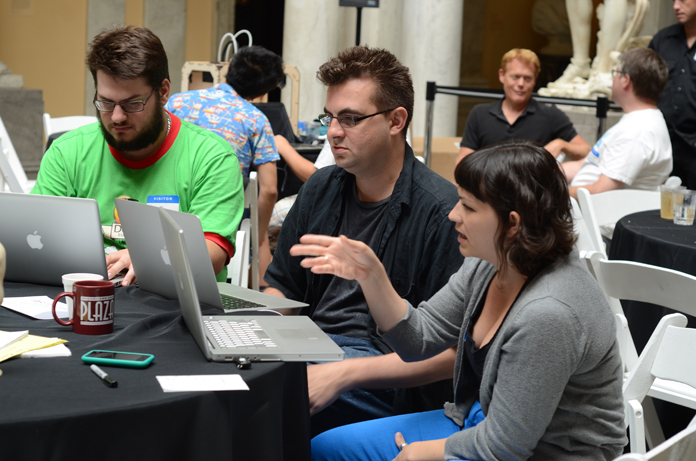
Jeremy Baron, Dylan Kinnett, Ashley Boycher
One of two first-place prizes went to Nick Gauthier, a freelance developer, and Bryan Connor, a designer and data visualization specialist, for their project Tanzaku, a digital messaging and commentary system. Tanzaku is inspired by the Japanese tradition of the same name, in which people write wishes or messages on small slips of decorative paper and hang them on bamboo. Gauthier and Connor developed the application to facilitate digital dialogue about works of art in the museum.
The other top prize of $1,000 was awarded to another designer/developer team, Andy Mangold and Jonathan Julian, who built Frame – a mobile app for providing historical context to gallery works. The application contextualizes the specific work of art by providing the major events, ideas, historical figures, music, and literature from the time of its creation.
Besides the two top winners, the hackathon spawned several brilliant and innovative products.
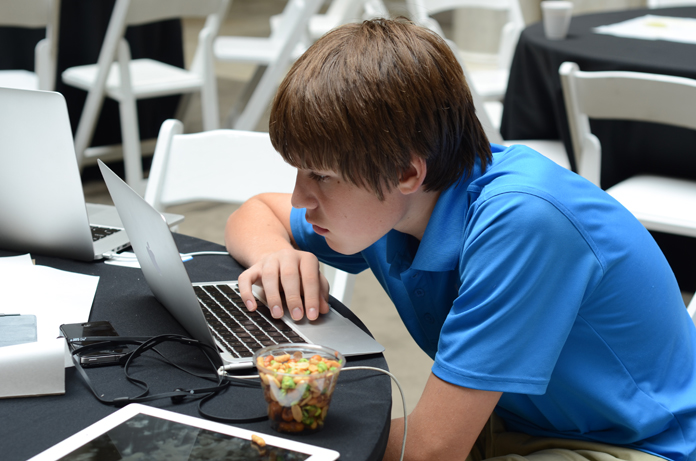
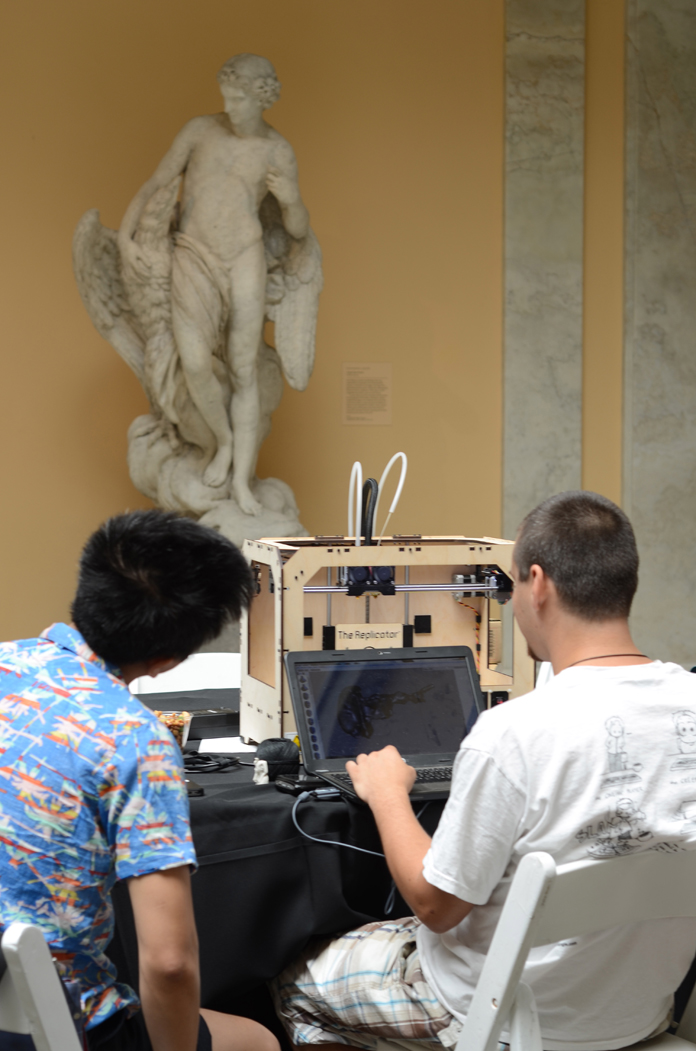
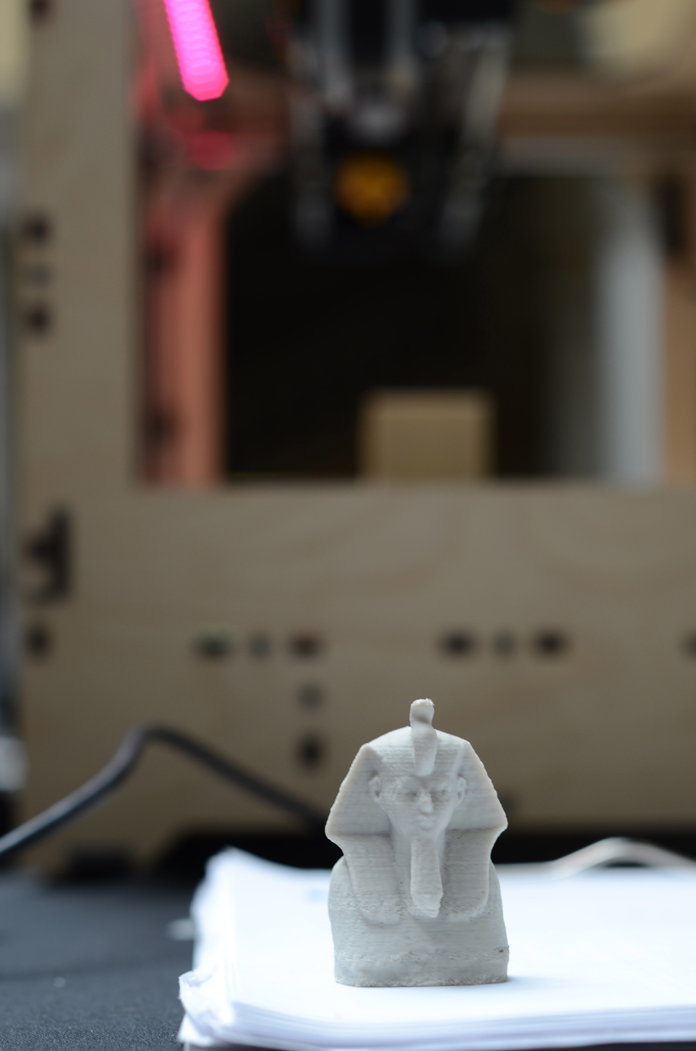
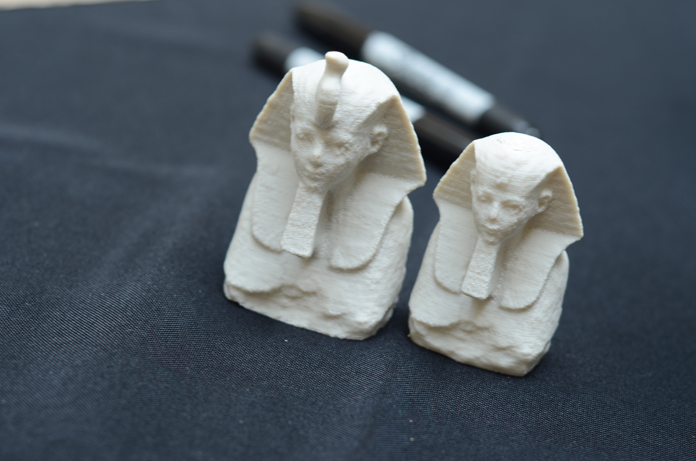
Todd Blatt, a 3D printing expert and enthusiast, brought his MakerBot Replicator, a personal 3D printer that retails for $1,749. He teamed up with entrepreneur David Troy and his 14 year old son, Thomas Troy, to make miniature 3D replicas of museum sculptures. With a basic digital camera, they took multi-angle shots of museum sculptures and used free software like Mesh Mixer and Autodesk 123D to create the 3D models. The printer uses a combination of materials to generate to physical model. Blatt made the figures below with a combination of ABS (the same polymer used to make Legos), and PLA (a biodegradable material made from corn).
Some of the Digital Harbor Foundation’s EdTech Fellows (Chris Fishpaw, Molly Adams, Ann Carberry and Jermaine Elliott) teamed up with Faith Harland, the dean of Ann Arundel Community College and Charlene Swoboda, an art teacher in Pennsylvania, to gamify the museum experience by designing an application in which students could earn digital badges, a trendy method of motivating and assessing students on academic challenges.
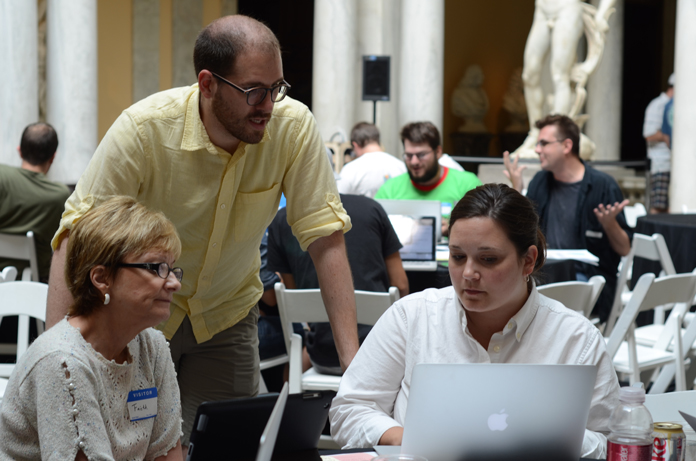 Andrew Coy, Executive Director of Digital Harbor Foundation, works with Faith Harland and Molly Adams on their badges app
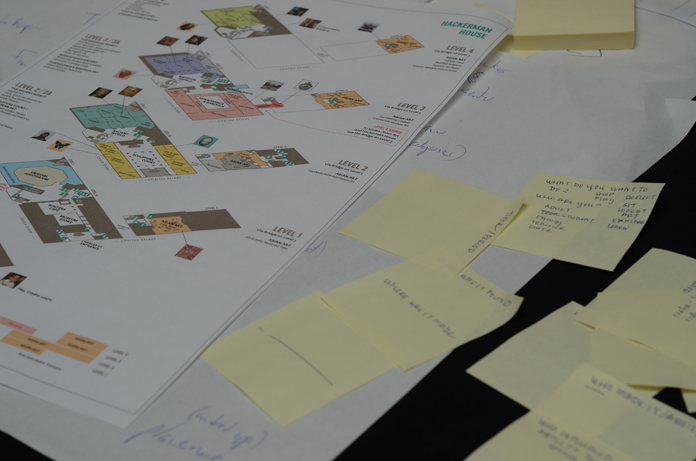
Mike Brenner and John Cutonilli teamed up with Walters employees Kate Blanch, Noah Opitzer, and Emily Blumenthal to create a wayfinding application for the museum. Opitzer pointed to a five-level map of the galleries, noting that it is “a bit of a maze” for visitors to navigate. The team used the newly released Google Maps Floor Plans to convert the floor plans to a digital, interactive indoor map. With further development, the app could use GPS technology to pinpoint your exact location in the museum, direct you to nearby works of art, and suggest other galleries in the vicinity.
 John Cutonilli, Mike Brenner, Noah Opitzer