Imagine the earth’s rotation has slowed. Each day there are 24 hours of scorching daylight, followed by 24 hours of freezing darkness. Dead birds fall from the sky. Dying whales wash up on the beaches. The Earth’s magnetic field shifts, disrupting our circadian rhythms and creating new mental and physical illnesses.
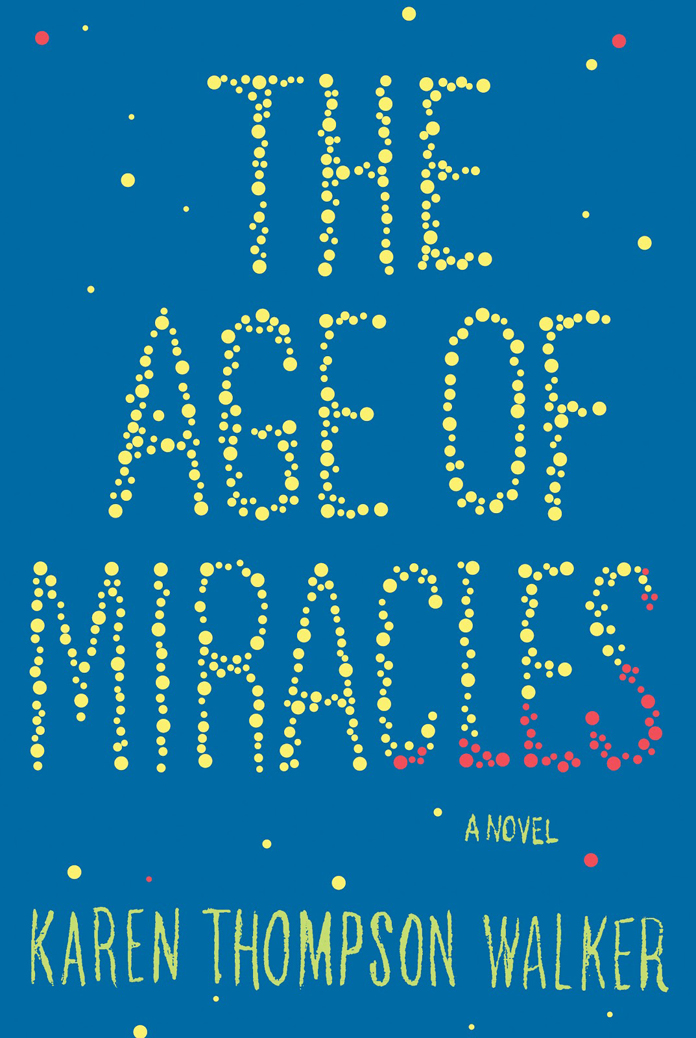
In The Age of Miracles, the remarkable debut novel by Karen Thompson Walker, such a future forms the backdrop for twelve-year-old Julia’s final year of middle school. Like P.D. James’ The Children of Men or Kazuo Ishiguro’s Never Let Me Go, The Age of Miracles sets readers deep into its miserable world. And like those novels, The Age of Miracles, ripe with details from Julia’s sensitive eyes, seems destined for cinema.
An only child, Julia is shy and solitary. While other girls are busy with parties, clothes, and boys, Julia learns to accept the loneliness and sadness, the cruelty and disappointment of adolescence. From the future vantage point of her young adulthood, Julia remembers a time when she appreciated the simple beauty of nature: “The smell of cut grass in high summer, the taste of oranges on our lips, the way sand felt beneath our feet, our definitions of love and friendship, our worries and our dreams, our mercies and our kindnesses and our lies.” This time of small wonders she calls the age of miracles.
Before the slowing of the earth’s rotation, Julia observes, most people were worried about the wrong things: the depletion of the ozone layer, asteroids colliding with our planet, extreme weather patterns, pollution of the oceans. At first, the slowing is scarcely noticed, but the lengthening of days increases at an alarming rate, and disasters quickly set in: power outages, crop failure, panic, hoarding of food, apocalyptic religious predictions, and suicide cults. Even at the story’s end (or as close as we get), the scientific community is still puzzled, unable to explain or correct the phenomenon that could eventually leave Earth as barren as Mars or Venus.
Early in The Age of Miracles, we see images and references to other planets and stars. When Julia’s father presents her with a telescope on her twelfth birthday, he tells her that some of the stars they can see no longer exist; they are looking at the past, at the origins of our universe, as seen from the vantage point of a distant future.
And against this vast cosmic backdrop Julia struggles with the small frustrations of everyday life: being snubbed by a girl who used to be her best friend; her unrequited attraction to a boy at school; her grandfather’s gradual dementia; her father’s secret affair with a neighbor. She wonders about the rules of cause and effect, about the difference between coincidence and fate. At the end she concludes that “Love frays and humans fail, time passes and eras end. The source of our suffering remains forever mysterious.”
This insight applies to Julia’s planet as well as ours. Through this small coming-of-age story amidst global disaster, Karen Thompson Walker has created a shrewd, startling, story for the times.
The Age of Wonders is by Karen Thompson Walker, Random House, 2012, 288 pages.