Life is uncertain.
We create habits and worldviews to soften the fear of the unknown.
What if we learned to drum and dance with our fear?
Will Redman and Trebien Pollard shared the wisdom their respective art forms have taught them in a program titled “Parallel Practice.”
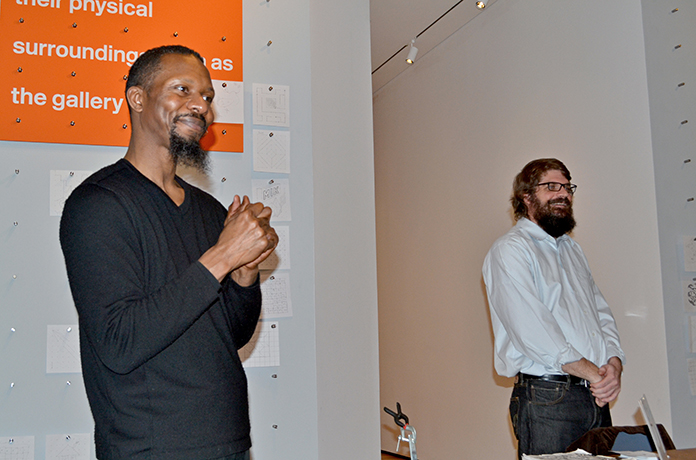
The two collaborated for February’s installment of The Big Table Connections, a free and interactive, monthly program at the Baltimore Museum of Art. The programs are held on the first Saturday of each month. The teaching artist draws inspiration from a particular piece on display in the newly redesigned Contemporary Wing.
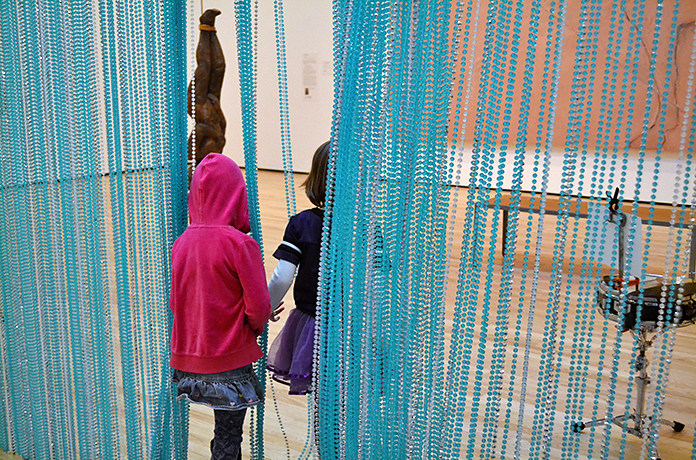
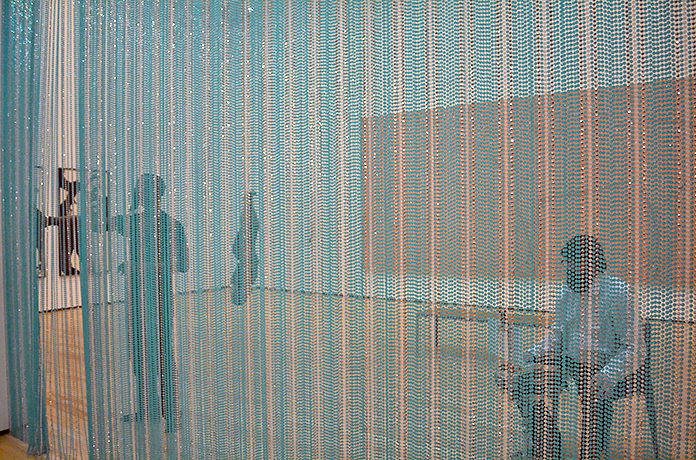
Parallel Practice began with an improvisational performance inspired by and performed behind “Untitled (Water)”, a display of hanging beads that create an oceanic entryway between two gallery spaces within the Wing.
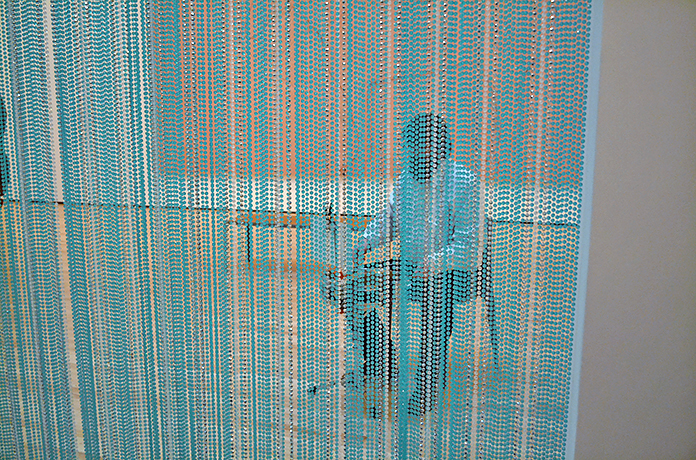
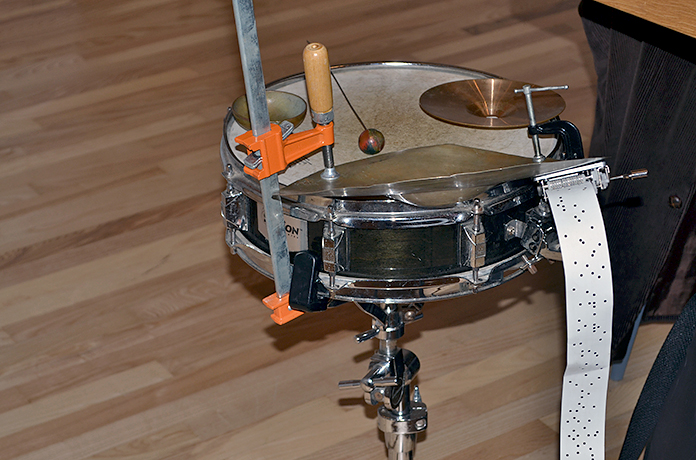
About 25 of us watched the meditative performance which Will and Trebien had only discussed briefly beforehand. Will’s toolkit of the day was centered around a small snare drum. Attached were a few small cymbals and a musicbox which he would crank at various tempos for dramatic effect.
Trebien’s body responded fluidly. As the music quickened, his movements would sharply rise and crash referencing waves of the ocean. Trebien figuratively pulled the audience in as his hands burst through the aqua beads, then gently swayed back and forth, transforming the strands of beads into a moving art installation.
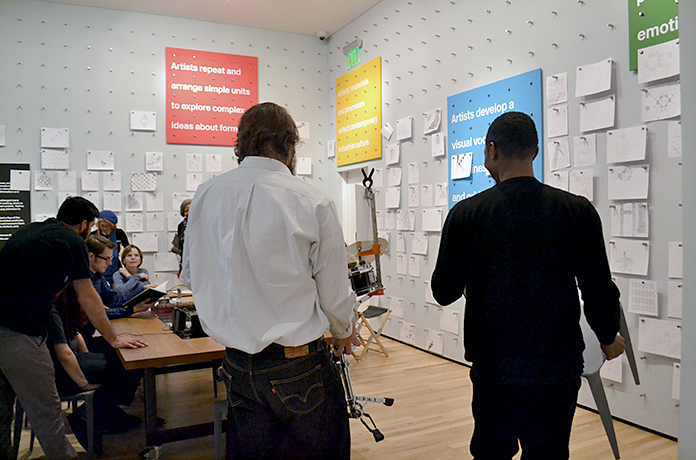
The performance came to an end when they intuitively felt it was time. The crowd applauded and we returned to The Big Table to dig deeper.
“Cacophony is beauty.” -Will Redman
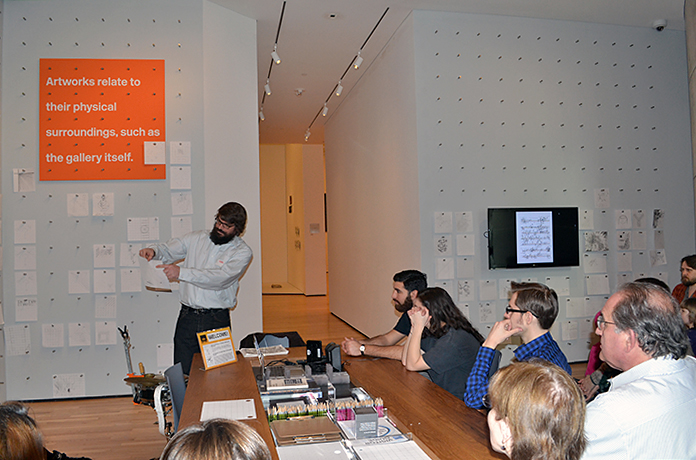
Will Redman has a music making philosophy in which anything is game—and it just begins with sound. He explained that his art is not just the audio produced, but the people, movements, awkward transitions or interactions all create the “theater” of the piece.
This was displayed best in a video Will shared of former students performing one of the pieces from his Ph.D. dissertation. He has helped push the art of music notation forward by allowing the musical script to be uniquely interpreted by the performer. This offers an exciting, guided improvisation.
Will, who is also a Towson University professor and well known throughout Baltimore’s music community as drummer of the experimental jazz trio Microkingdom, shared a fitting sentiment by composer John Cage. He paraphrased, “Why would I write the music I hear in my head, I already hear it.”
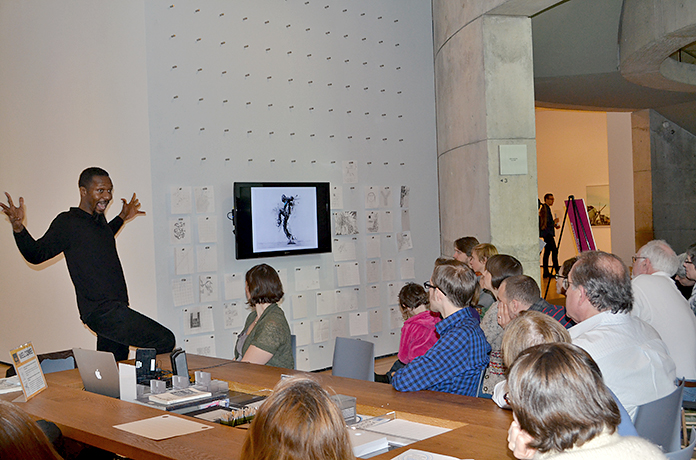
“I go to museums to watch the people look at the art.”- Trebien Pollard
Trebien Pollard has a similar dance philosophy in which every movement is game.
Trebien has spent most of his professional life in New York City, a canvas bursting with movement. He finds inspiration for his dance choreography in the “everydayness” of those around him. The passengers getting on and off the subway, the homeless guy on the bench and the exchange between a hot dog vendor and customer all make up the “dance” of city life.
This widening of the lens in regard to Trebien’s approach has paid off well. His choreography is performed all over the world. He’s currently finishing a teaching residency at Goucher College and will return to Manhattan later this year.
During Parallel Practice, Trebien facilitated the audience in pairs. We were asked to each act out an everyday, physical gesture in front of our partner. This helped us realize the “dance” in all of our movements, both as a solo performance and in duet with another.

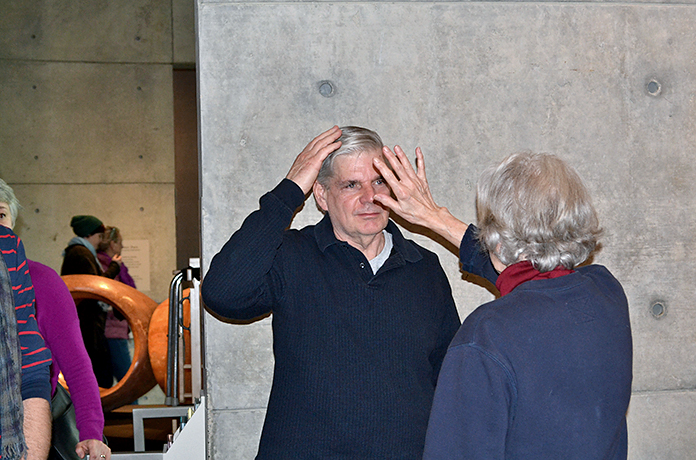
Will and Trebien find inspiration in the ordinary. To them, there is an art to be acknowledged in every moment. These lessons reminded us to meet life with a sense of wonder and curiosity; Open to unexpected turns which weave throughout endless possibilities.
On this day, drum and dance was the Parallel Practice. But more broadly, the true Parallel Practice lies within the relationship of the self and it’s environment.
When in the ocean, we cannot control the tides and crashing waves. But we can learn to dance with them.
The key is in allowing the connections to happen.