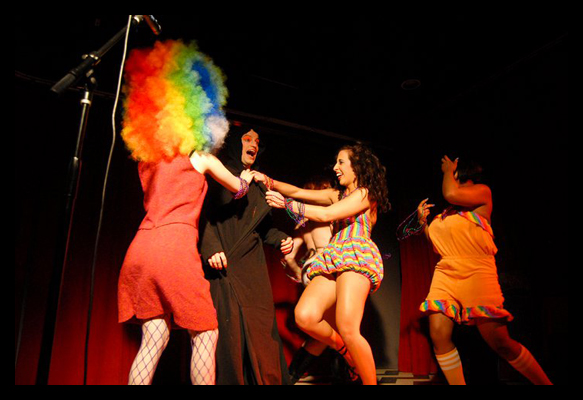
“If theatre is done right,” Yellow Sign Theatre co-founder and artistic director Craig Coletta is fond of saying, “it’s a blue collar job.”
He told me that during a break from cleaning the Yellow Sign performance space, located next door to Club Charles in Station North, but his statement isn’t an empty glorification of manual labor. Under his watch, Yellow Sign has produced 15 staged plays, a bi-monthly burlesque series, 4 short films (for 48 Hour Film Festival and 29 Days Later Film Festival, respectively), and hosts sporadic film nights curated for obscure/cult tastes. They’re prolific to the point of absurdity.
Born in Marshfield, Massachusetts, Coletta came to Baltimore in 1999. When asked what his job outside Yellow Sign is, he described himself as a folklorist and conflict mediator, specializing in cross communication.
Coletta began Yellow Sign in 2011, after a 20-year break from performing, when Club Charles owner Joy Martin asked him to put something together for Halloween. Never one to refuse a challenge, Coletta recruited some friends and threw a show together, intending for it to be a one-off project, but the ideas kept coming. Before he knew it, he was helming a theatre company.

Now, there’s no shortage of community theatre in Baltimore, and Yellow Sign is still establishing their identity, so the obvious question is: What sets them apart? While Coletta hates the concept of branding, he happily shared the three principles he had in mind when he started the company; anyone who’s seen a Yellow Sign show will recognize them immediately.
The first is to remind people that pop culture is more than 40 years old. Many Yellow Sign productions are inspired by the early-to-mid twentieth century; Darkspell is set in the 1920s, Horatio Dark’s Between The Lines is a radio play set in the 1950s, and This Bird’s Flown drew from Greek myth and the works of Mamet and Tarantino with equal enthusiasm. Even their dystopian Valentine’s Day show, titled +1 Or The Bearable Delightedness of Being Controlled, included elements of Space Race-era neo-futurism.
Those decisions are more purposeful remembrance than mere homage, though. Coletta wants to broaden his audience’s horizons and introduce them to things that might otherwise be left behind. When asked what he meant by that, he brought up The Princess Diaries‘ debt to Anthony Hope’s 1894 novel The Prisoner of Zenda, as well as modern horror’s beginnings in Paris’ Grand Guignol as another.
“I don’t care how jaded you are,” he said, referencing the latter example. “When the ripped-out eyeball lands in your lap, you’re going to react.”
Speaking of which, Yellow Sign’s second founding principle is to champion low art as a valuable mechanism for understanding the world, which is as Baltimore a way of thinking as I’ve ever heard. The separation between high and low art, according to Coletta, is that high art speaks to a culture’s aspirations, whereas low art speaks to day-to-day realities.
The interplay between those two ends of the artistic spectrum is a crucial element of Yellow Sign shows, which make liberal use of blood and guts, sexual innuendo, reimagined Vaudeville gags, and camp sensibilities without underestimating (or condescending to) their audiences. Even with all the gore, profanity, and salacious content—The Diary of Dan Franke was about someone accidentally burning down the Anne Frank House after hiding from the police in it—Yellow Sign’s shock value is of the ultimately good-natured, William Castle variety.
Relatedly, Coletta’s third principle is to resist the tendency of creative people to think of themselves as artists. This may sound counterintuitive for the head of a theatre company, but Coletta feels that “the job of determining if something is art should be left to the audience.” Creative people, in his opinion, should approach what they do as craftsmen first and foremost.
That said, Coletta thinks that “art is the most human thing we are capable of,” and that manipulating symbolic communication to create experiences for one another is ultimately what theatre should do, and what he feels Yellow Sign does.

“When people come to a Yellow Sign show,” Coletta said, “they see something that clarifies something for them.”
He also feels that Baltimore is the right place for this mission because the community is open to it, and willing to entertain their brand of William Castle-esque weirdness more than other cities would. To that end, he tries to rope one new person into the company with each show they produce. Many of Yellow Sign’s early shows were cast by Coletta badgering regulars at Club Charles, and more than a few of them have gone on to work with other theatre companies in town.
“I have to fight for my own company members’ time,” Coletta says, proudly.
Yellow Sign Theatre is keeping busy in the latter half of 2014, with a third iteration of Darkspell, a new installment of their Horror Host of Horror series, and a stage adaptation of the 1959 Roger Corman film A Bucket of Blood. Keep up with them via their Tumblr, and also on Facebook.
Check out more theatre in What Weekly here.