Baltimore is the girl who doesn’t know she’s pretty.
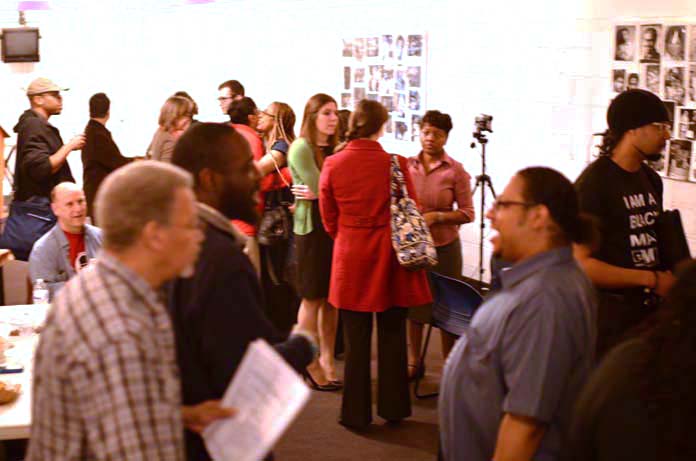
This thought flashed through my head as I sat surrounded by the city’s brightest, most fabulous and creative inhabitants at 2013’s Create Baltimore at John’s Hopkins University. We were in a large auditorium trying to put words together that answered the question, “why Baltimore?” What I noticed was a trend of passionate people, who all wanted to defend, praise, and protect the city they loved. It struck me, however, that the majority of these people, it seemed, were not actually from Baltimore. It made me wonder if some of us natives just did not realize our city’s worth and potential. It’s fantastic that so many people do realize these things, but what does Baltimore really think of itself? Is this the reason for the possible divide between “old Baltimore” and “new Baltimore?”
We’ve seen a dramatic transformation in our city in the last 20 or so years. It’s like Baltimore grew into her teeth and lost her baby fat over the summer and came back to school as a bombshell that everyone wanted to know, yet she still looks at herself as an awkward Rachel Leigh Cook from She’s All That.
What caused this transformation? Freddie Prinze, Jr. obviously.
Freddie Prinze, Jr. represents Baltimore’s “creative class.” Economist and urban studies theorist Richard Florida writes extensively on this idea of the “creative class” and defines them as, “technology workers, artists, musicians, lesbians and gay men, and ‘high bohemians.’” Yes, Baltimore has great hospitals and universities, a world champion football team and a rejuvenated baseball team (Go O’s!) However, Florida insists that it is not institutions such as iconic buildings, shopping centers or stadiums, but the level and degree of creativity within and among it’s people that drives a flourishing economy. It’s this creative class of Baltimoreans that fosters such an open, dynamic, personal and professional urban environment.
Observing and reporting, like a good little journalist in training, I watched how people struggled to put Baltimore’s “it” factor into words – what made Baltimore different and why it was special? Perhaps because they don’t realize it is precisely them who are the “it” factor of our city.
Another topic of discussion was this idea of “old Baltimore” vs. “new Baltimore.” The old locals, the families with generations and history here – are they on board with all the changes and upgrades their city has gone through? Does it affect them? Do they care? These are important things to consider. Someone raised the question, “who’s mission are we pushing?” Change can be hard for people, especially technological advancements, and some may choose to be, or worse, accidentally left behind.
My grandfather, for example, still fears my death when I go anywhere on or around North Ave. “There is nothing good there.” “What the hell is Station North? Is that a new jail?” “Roll up your windows and lock your doors!”
It’s today’s Generation Y, or millienials, and those non-native Baltimoreans who are coming in and seeing it’s potential for growth and new markets, but the old soul of the city is still essential for permanent change and wisdom. Baltimore needs to look in the mirror and realize it’s not an ugly duckling anymore, but as a creative class we need to work together to keep pruning our feathers and refine our culture.
———————————————————————————————————
I never thought I’d say this, but I’d like to think of myself as a Freddie Prinze Jr. I wasn’t born here, but I’d love to help transform this city. Createbaltimore seemed like a great place to start.
Throughout the day I had the opportunity to listen to a variety of ideas ranging from “Reinventing Transit” to “Urban Gardening and Farming” to “The Non Profit Industrial Complex”. I wish I could have attended all of the sessions, but there were five different sessions in each fifty-minute block. If I wanted to attend each session, that would be ten minutes per session. I didn’t do any stretches that morning and the coffee cups were small (and refillable so I don’t know what my excuse was).
One of the topics that struck me was “Evil Plans 2013: What’s Brewing in Baltimore?” mainly because it had the word “evil” in the title, “brewing” reminded me of beer, and “plans” are always nice too. I really didn’t know the agenda on the topic, and based on conversations around the room neither did the others “My poor husband thought this group was about the bad things going on in Baltimore.” a woman shouted out. Her poor husband.
The main purpose of this discussion was not to discuss the “evil” plans, but to discuss the “good” plans. Apparently the word evil can be used to unite the good people of this city. This was a way for innovators to pitch their ideas and perhaps collaborate further. During the session I heard a lot of wonderful ideas. After each person said his piece they gave sufficient follow up information making it easy to become inovolved. Here are just a few examples:
Operation Oliver: A plan to revitalize the Oliver neighborhood of Baltimore. With a team of over 200 volunteers Operation Oliver has removed 75 tons of garbage from streets and alleyways, painted murals, provided a free farmer’s Market, and enrolled residents in job training programs.
Luminous Intervention: Provides large-scale graphic design, video, and animated projections to groups in the community that don’t have a voice. Someone in our discussion pointed out that this is like “temporary graffiti”. The result is very effective without any damages to places that need transformed.
Sculptors Inc: A non-profit social group for sculptors.
The BNote: An effort to keep wealth local. The speaker made a good point. He asked, “who owns CVS?” The crickets chirped. He then pointed out that the owner probably doesn’t live in Baltimore. Thus our money spent at CVS isn’t going back to the community. The owner of Carma’s Café, however, lives right in Charles Village. Carma’s Café is among the 190 local businesses that accept the BNote. If we keep consumer spending local, we can create millions in economic activity and thousands of jobs.
I also had the opportunity to listen to Scott Williams speak about his Johns Hopkins research turning algae into a source of renewable fuel. Williams told us that one pound of algae today will turn into 50 pounds in a weeks time. Not only is algae highly productive, but it is environmentally friendly, and there is no competition with food. When was the last time you ate algae? I am sure as research progresses algae will have a significant impact on your day to day.
Zero Litter: I have always wanted to participate in a flash mob, but I think I am more intrigued by the concept of a trash mob because it does not involve a choreographed routine. Similar to a flash mob, a large group gets together in a dirty community and cleans it up in very little time. There are many projects in the works.
Gather Baltimore: A program that collects leftover food from retail sources and farmers markets to provide to those in need. Clean your plate, but don’t throw it away.
The Walters Enthusiast: Volunteer opportunities, special events, and educational activities designed to promote museum’s mission of “ bringing art and people together for enjoyment and discovery and learning.” You don’t have to be a member to participate.
As we wrapped up our session we discussed the idea of a hackathon to further collaborate. I could see everyone’s eyes light up at the idea. My eyes lit up too, but for different reasons. Were we going to get together and exploit the weaknesses in a computer network to further our causes? Was this the ultimate “Evil Plan”?
Luckily the answer was no. Apparently a hackathon is a burst of creative energy in which people work together intensely on the same project in a short period of time. This can range from design, product validation, making prototypes, or perhaps ideas to unite the “old Baltimore” and “New Baltimore”. Until then, Freddie Prinze will try his best. but Rachel Leigh Cook has to believe in herself.
Audits and Government Transparency: “Most effective companies or cities that have budgets the size of Baltimore’s audit their books regularly. This helps create a management environment of accountability, transparency and data driven leadership decisions. Baltimore hasn’t audited some agencies for decades and some say since Eisenhower was president.” – From Robert Wray’s blog. Read more of his CreateBaltimore recap here.
—————————————————————————————————-
After hacking into the delicious food from Charm City Gourmet, the next topic of conversation was something I knew everything and nothing about, “Art’s Patronage”. I started finger painting in the womb and I would like to say I have a general understanding of the arts. It’s the patronage that gets me. How do you get the word out to people that want to support your art? More importantly how do we cultivate a society that appreciates the arts?
I still don’t have the answer, but I have many strong leads. I guess you can start at the very beginning, the artist. Many artists have little business knowledge beyond the canvas and are not the best advocates of their own work.
There were two possible solutions. Either train the artists in business or bring in non-artist support. If we engage effective communicators we can gain buzz and bring the community to these shows.
Artist Helen Glazer pointed out that we have not had an art critic in the Baltimore Sun since John Dorsey retired over a decade and a half ago. The argument was that we always have social media. The retaliation was that although social media is a great tool it is often fragmented and doesn’t always yield the best results.
So what now? People have bought art in the past. We are not reinventing the wheel here. How do we take those models and apply them to today?
Someone pointed out that often the art word is perceived as people walking around with their noses in the air saying, “you just don’t get it”. We need to teach people how to be patrons and make it accessible. In a world where people are willing to give their left kidney or maybe a pinky toe….or spend a lot of money…for a nice set of blinds, there is hope for the arts.
If the culture doesn’t value or know it exists we can not rely on the “build it and they will come” approach. One of the ways we discussed doing this was making a “dating site” for artists. Patrons could sign up to be matched to artwork based on their personal taste.
We can teach the community that we are an entire industry based on self-expression. You buy it because you like it. It’s really quite simple.
We already have a great network of organizations and support like the Charm City Craft Mafia, School 33 and the Baker Artist Awards to name a few. We definitely aren’t reinventing the wheel, maybe giving it a little tune up and sending it in the right direction.