Part 1 of 2
Once the esoteric domain of autodidacts and a handful of film schools, enhanced by ancient dramaturgical texts like “The Art of Dramatic Writing” by Lajos Egri, screenwriting has become a commodity separated from actually making films. Many more universities now offer screenwriting courses, which is a good thing for media literacy, and hopefully for movies. And, everybody from Anderson Cooper to John Boehner to BP needs to know how to shape messages by using Story Structure.
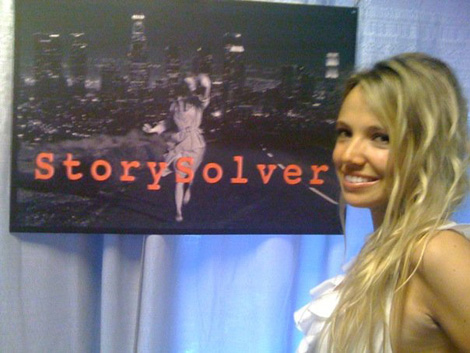
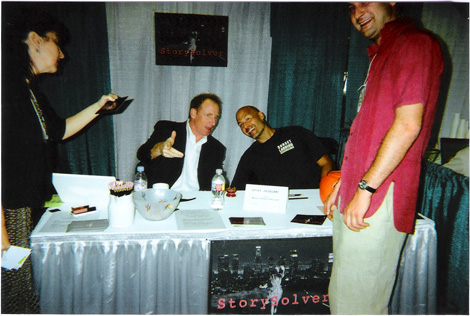
“Written By,” the official magazine of the Writers Guild of America, certainly has the cred to put out a magazine. Others, like Creative Screenwriting, are into the picks and shovels business. Creative Screenwriting Magazine produces the Screenwriting Expo (screenwritingexpo.com), an annual convention/ trade show. Expo 2010 is coming up October 7-10. The Screenwriting Expo is a for-profit event packed with vendors selling their wares, seminars, classes and panels, guest speakers, screenplay contests, and a story pitch fest (the “Golden Pitch Event”). The attendees are folks decidedly outside of “the business.” I attended Expo ‘09 as an exhibitor, hawking my story consulting service (storysolver.com). I was accompanied by my radiant assistant, Roma Perrier, and my enforcer, Joe Basile.
Expo is peripheral to the actual film industry, and one should approach it with a “buyer beware” attitude. There is way too much crap for sale there that writers don’t need to buy, and at times it seems to trade on unrealistic hopes. That said, the guest speakers were pretty cool (William Goldman, John Cleese, Shane Black), and the many classes and panels certainly are informative. And, I saw a guy win a $20,000 dollar grand prize in the Expo screenplay competition (while selection of winners is somewhat arbitrary, that’s still a lot of tacos). Anyway, following is a smattering of the vendor/ exhibitor services offered at the ’09 Expo:

Tons of how-to books: seems there is no limit to what can be said about screenwriting, though the books often feel like mice describing an elephant from an infinite number of points of view. Be wary of books that promise “secrets,” “magic steps,” or how to “write a script in two weeks” (or three, or whatever). Biography, history, science, true crime or even the newspaper might be a better choice for the writer than how-to books.
The more elaborate guru—book—DVD—seminar offerings tend to construct their own “systems,” complete with their own vocabularies and axioms. These would be like Truby, or McKee (though McKee did not have a presence at the Expo, he’s more of a stand-alone brand.) McKee (played by Brian Cox in the movie “Adaptation”) offers pricey seminars, which are rendered unnecessary by his excellent book, “Story.” Truby is all about selling DVDs. In fact, there are lots of DVDS for sale, including interviews with successful writers (they have no idea), and even a do-it-yourself entertainment law DVD.
The purveyors of script formatting software were out in full force. Final Draft, Movie Magic, and a newer one called Screenwriting Pro, a web-based system with more bells and whistles. Beyond that, there is software for story development, outlining, plot invention, and so on. Much of this is a pointless distraction from writing, and an unnecessary expense. But if it works for you, hey, it’s a free country.
L.A. based “The Writers Store” sells everything you need, and everything you don’t need. They even have staff screenwriting coaches, like personal trainers, that you can pay to nudge you along. They are the rare brick-and-mortar establishment that sells the little brass washers that go with the little brass brads used for binding scripts in the professional world.
Web-based pitch services and coaches abound, like “Pitch-Slap,” and “Pitch-Q”. These services purport to train you to pitch effectively, and some provide a way to post your pitch online where “industry professionals” will access your pitches, and you can “sell your screenplay,” or “learn from your mistakes before you make them.” (Doesn’t that require time travel?)
And then there are contests. Some are affiliated with film festivals, others are start-ups. Most of these “contests” are for-profit operations – they make money on submission fees, and make some pretty big promises about all the hundreds of companies and producers that will read your script if it is a finalist. Such promises are weak at best, so look for contests associated with reputable or time-honored film fests, with zero, or low, submission fees (or at least with big cash prizes!) KAIROS is a Christian media advocacy group that offers “$50,000 in prizes for spiritually uplifting” family-friendly screenplays. (Praise the Lord and pass the soup!) ACT ONE is another Christian-based service offering networking, mentoring, coverage and so on.
Other competitors for the aspiring screenwriter’s bucks include Script Pimp. The Pimp offers contests, and also a kind of middleman service – where they catalogue scripts on a website, and make them available for review by companies and buyers. A number of companies are pursuing this kind of model, and some are claiming successes. I’ve never used this type of web-based company, but it seems like as the idea matures it could be viable. iScript.com offers a service where “professional actors” read your script, and then an mp3 file is created so that one can listen to it in the car, on ipod, or whatever, like a book-on-tape. They are touting it as a good tool for busy executives and imperious actors.

This brings us to the category of Script Consultants, Script Doctors, Story Analysts, and their ilk, a group that I claim membership to. Next week, we will lay out the consultant thing, and the “story notes” and “coverage” game. My cred as a story/ script consultant is earned: I’ve got produced movies, film school degrees, union membership and twenty-plus years of script writing experience. But I don’t have a gimmick, a system, a “secret,” a DVD set, or a how-to book. If I did a how-to book, it would be only one sentence long: Sit in a room by yourself and work your ass off until your script doesn’t suck.
– david warfield