Photo by Logan Young
For a series still in its infancy, the 130% Surround Sound concerts at Normals Books and Records have produced some surprisingly sophisticated results.
Tucked away in a cramped, un-air conditioned cranny of the venerable East 31st Street emporium dubbed The Red Room, the curious sit front-to-back in creaky folding chairs ensconced in a blanket of warm, analogue 4.0 surround sound.
Quadraphony fell out of favor decades ago but given Normals status as ground zero for the world-renown High Zero Festival, it’s a lovably archaic, suitably arcane notion to explore.
Only three gigs in and already these happenings have enveloped not just the physical performance space, but also the entire avant community of Baltimore at large – thus reaffirming Charm City’s hard-fought reputation as thee hub of East Coast experimental music. Just a cursory glance at the fifty or so in attendance last Thursday included True Vine co-owner/Ehse Records head Dr. Stewart Mostofsky, Lexi and Samantha from Lexi Mountain Boys and Hexagon synthsmith Logan Mitchell, Sr.
Perhaps it had more than a little to do with the talent. Thursday’s third installment featured a triple bill of bona fide Baltimore demigods: Leprechaun Caterer Tom Boram, Matmos’ M.C. Schmidt and Tarantula Hill’s resident beanpole Twig Harper.
Photo and story by Logan Young.

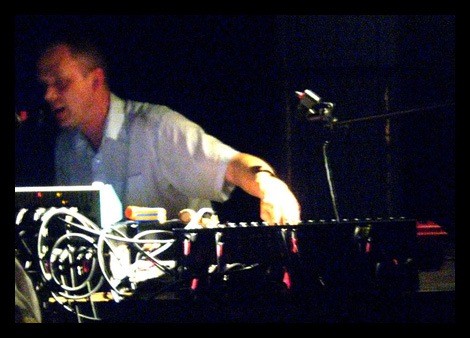
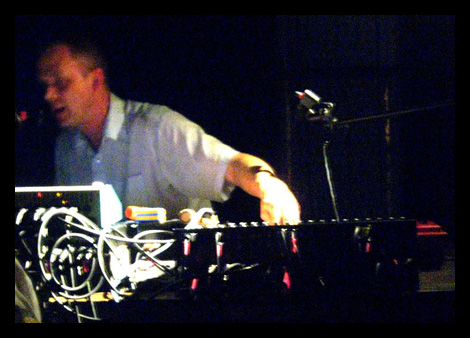
Photo by Logan Young Twig Harper
For the opening set, Boram and Schmidt played tag team. The former’s gutter-wrenched electronics providing the perfect foil to the latter’s acoustic implements. Along with Drew Daniel, Schmidt’s partner in love and in theft, Matmos made their name concrète sampling everything from a nose job to their own cigarette-burnt skin to the amplified synapses of a crayfish’s nerve tissue. And while Schmidt’s arsenal was decidedly less obtuse here, he nonetheless managed to coax both the beautiful and the damned from a duck call, baking spoons and his own personal bottle of import beer. With Boram’s homemade noise salvos coming from all sides, Schmidt continued to tout texture and subtlety over sheer spatial confusion. Just because you have four speakers instead of two, it doesn’t mean you’re obliged to use them all all of the time. Discretion, like brevity, is often the soul of wit. And to wit, Martin Schmidt emerged the better man.
After a brief recess for the smokers, Twig Harper took the stand. Disheveled yet imposing, his set began in earnest when he flung an equally tattered crash cymbal to the floor, startling a few latecomers who, backs turned, had been resigned to there. Still reeling, himself, from a gloriously rabble-rousing performance at this year’s Whartscape, Harper wasted little time dialing up the din he’s become so revered for. With no less than four noisemakers of various intention and intensities plugged directly into his mixer, there was seemingly no shortage of source scuzz from which to cull. Nor was there any sign of Harper relenting. For nigh on twenty inscrutable minutes, he saturated the place with a clamor atypical within its confines. So often, those involved in the live noise trade appear as if they’re having a downright wretched time. One look in Harper’s direction however, and anyone could tell that devilish smirk of his was nothing but pure bliss.
Compared to pitch, rhythm and timbre, for most sound artists, space remains an all too infrequently explored frontier. For the good people “sitting in a room” at Normals though, the wide expanse where sound ultimately exists is ever-shortening. And while their math and their jargon may be a bit off, maybe that’s the true manifest destiny of Baltimore’s 130% Surround Sound.
Photo and story by Logan Young.