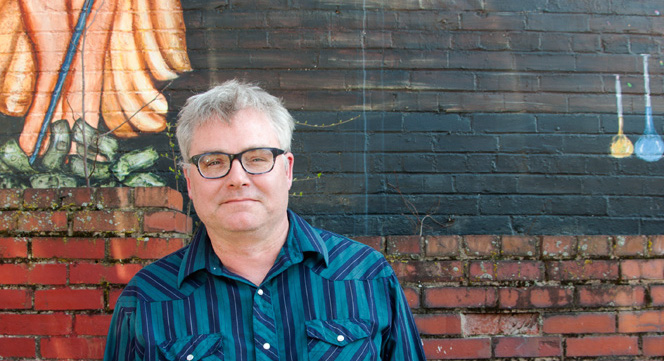
Photo by Bob Howl
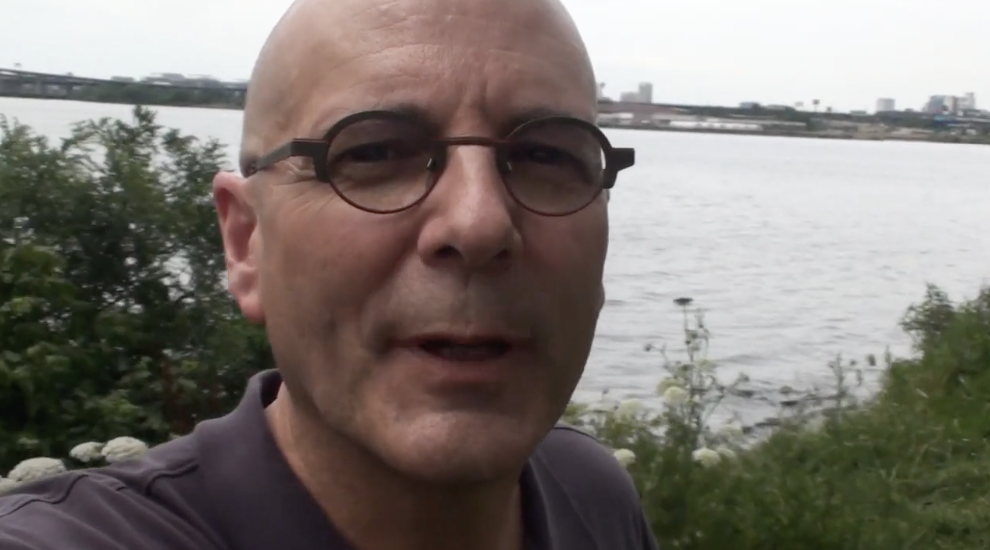
Before their hiatus, punk rockers Fugazi preached kinetic music and creative independence at a time when the label-based music industry was at its height. Did ‘80s audiences as far away as Japan understand their precepts of active awareness and a do-it-yourself mentality? Brendan Canty (Fugazi, Deathfix, Rites of Spring), now a prolific filmmaker and father of four in Washington, DC says: “Of course!”
“Mostly we would tour because someone would write Ian [McKaye, Fugazi lead singer] a letter,” he explains. In the absence of drumsticks he gestures to lead us back in time. “The kid who first brought us over to Australia was only 17; a fan named Steve Pavlovich. Pav. We never had a booking agent, just a network of people.”
That mentality inspires all of Brendan’s projects. Most recently he handled the sound for two new short films that capture the rich contemporary Ethiopian scene in DC through Feedel Band’s buffet of horns, keys, percussion and the krar:
“Ethiopian Ocean”:
“Girl from Ethiopia”:
From DC to Addis Ababa to the Berlin Wall, Brendan seems to know everyone in the music world and in the neighborhood where we met for coffee. “I’ve been here my whole life,” he says. “Well, I was born in New Jersey. Not my fault. I’ve been in DC since ’67; I think that counts for something.” Here’s how Brendan Canty ennobles the Fugazi way.
DC’s Ethiopian music scene
For the well-traveled musician, the robust Ethiopian music scene at home is unlike anything else he’s seen touring. “The scales they’re pulling from are totally different [from the Western seven-note scale] and they have this whole language within the music that just blows me away. The musicianship is off the charts,” Brendan says.
A history buff, he explains: “There’s a real continuum between [Ethiopia and DC]. Any decent employment [in Ethiopia] in the ‘60s was done through Haile Selassie’s military. Amha was a guy in the bodyguard band and Ethiopiques, a Paris label, started to re-release his music. Amha started having hits and created a whole scene in Addis Ababa. He left [Ethiopia] in ‘74 when The Derg happened, when the communists came. He moved to DC and started the Ibex club here and that became one of the primary homes of go-go back in the late ‘80s.
“Once Amha came here, they all came here. I found out all the Ethiopian music legends I was passionately in love with are all living here.” Brendan curates an international performance series in Washington DC, “Dounouya: Global Sounds on the Hill,” which has its next performance on June 28.
Films that need to be made
When Brendan and coconspirator Christoph Green started Trixie Films, their series Burn to Shine took a Viking funeral approach to condemned buildings in DC, Chicago, Portland, Seattle, Atlanta and Louisville Kentucky. “We’d find a historic house or building that was about to be demolished in controlled burnings. We’d film eight or ten bands there in one day. Then we’d film it actually burning down.
“It started because the DC I grew up in had entire swaths of dilapidated historic houses that nobody would go into. They would just decay ‘til they had to be torn down.” Brendan was inspired by a friend, singer Lois Maffeo in Seattle, who told him: “The only way we can really preserve these places is by documenting them.” The series also led Trixie Films to steady gigs with the likes of Wilco and The Decemberists.
In a new full-length film, The Liberation, the team follows a set of students entirely through DC Central Kitchen’s transitional recovery program. “The whole morning is spent on life skills and figuring out bad habits,” says Brendan. “We were filming in all those group sessions. Then they bring in chefs who teach them how to do the actual work. They get them jobs and they go out and do these cool cooking events and competitions with each other. Mostly it’s a story about the side of DC that doesn’t get as much representation.” The film is in final stages of production.
Yes on Prop. 71
Fugazi’s was also an anti-drug movement, but marijuana’s status as a drug is unclear. Still, legalization in DC is a dilemma for Brendan. “I have a space in Takoma Park where Priests and Mary Timony practice, and we’re all getting kicked out cuz it’s getting turned into a grow center. Thirty thousand square feet of weed is going in,” he laughs. “I feel conflicted. My 11-year-old son constantly reminds me that I voted for this.”
Emotion into sound
“When I do scoring for films, a lot of it is about understanding where the peaks and valleys in the script are,” Brendan reflects. “Most sequences in a show are around a minute-and-a-half long so you can kind of feel the arc of the message of what someone writes and put the tension at the right moment. If you make all your emotional points in the first minute there’s nowhere else to go.”
Brendan’s first soundtrack gigs came from fellow DC native Kurt Sayenga, who became a producer at Discovery Channel and went on to produce in L.A. But in the Fugazi days, Sayenga ran Greed magazine. “It was a glossy, funny-cartoony kind of fanzine but, you know, higher quality than most.” Brendan has since scored “probably a hundred hours of TV,” notably for National Geographic’s Hard Time prison reality series and for ESPN’s 30 for 30 videos. For the latter he teams up with Jeff Tremaine of Jackass and his production group Dickhouse.
“The Dickhouse guys focus on people like Matt Hoffman who invented the big skate ramp. The one we have coming up is called Angry Sky and that’s about a guy in the ‘60s who went up into the stratosphere and jumped out of an airplane. He basically bullshitted his way into the whole thing; scammed a space suit off of somebody; didn’t do any tests. Just trying to kill himself. It’s an incredible story,” he says. “This was fifty years before [Felix] Baumgartner, the guy who was sponsored by Red Bull.” Angry Sky is part of this year’s Tribeca/ESPN Sports Film Festival.
Fugazi stories
Fugazi was in Germany the week the Berlin Wall came down; then they (and Pav) helped Nirvana book their first Australian tour. These are the kinds of stories that start sayings like Fucked Up, Got Ambushed, Zipped In.
Poland’s Checkpoint Charlie: “Before the E.U., it took forever to get in and out of borders. Once we were going up to the checkpoint to get out of Poland. Our equipment had fallen against the back door and we couldn’t unlock it. They were getting more and more irate. The only thing we could do about it was to convince them we had to drive really fast toward the border and then slam on the brakes [to loosen the equipment]. ‘It’s gonna look like this, but what we’re gonna do is that’ – it took a lot of sign language!”
Australia’s Clara Barton: “Ian got really sick for a month once in Australia with pleurisy. It’s like pneumonia but it’s on the outside of your lungs. We had to cancel the rest of the tour and I stayed with him. I was trying to keep everyone updated with the shitty time change, and this was before cell phones. They ended up having to cut him open, I mean, he could have died!”
Did Brendan ever have any tour-threatening issues?: “Once I was developing tendinitis in my arm from touring and I was freaking out. I couldn’t even hold the drumstick. I was going to see my massage therapist three times a week at The Teal Center in Arlington. She would sit there and ask me about my processes of drumming. ‘Well sometimes I have to adjust my high hat.’ ‘Well, that probably throws off your equilibrium, doesn’t it?’ That was exactly it so I bought a new high hat stand and it fixed it.”
Renaissance musician
Long form projects and live improvisation have been complementary in shaping Brendan’s musicianship. “Live performance makes sense to everybody involved including the audience,” he says. “You see it happen and it’s much more of a utopian approach to performance; you can screw up, it’s tangible, you can really feel it. They’re all so different.” His next performance is with the live documentary The Measure of All Things directed by Sam Green in Toronto on June 12.
Photos © Bob Howl. Article © M.D.O. Productions, www.mothersdaystories.com.
Watch the drummer-turned-filmmaker’s new Feedel Band videos