
Fred Lazarus IV, photo courtesy of the Maryland Institute College of Art
After steering the Maryland Institute College of Art (MICA) for more than three decades, on a long-term course of expansion that has made it one of the leading art schools in the United States, Fred Lazarus IV retired a year ago as MICA’s president.
He continues to spend plenty of time and energy advancing the cause of art education, through his involvement with the new Baltimore Design School and many other projects.
He was kind enough to give his time to What Weekly and share with us some of his thoughts on the present and future of arts education.
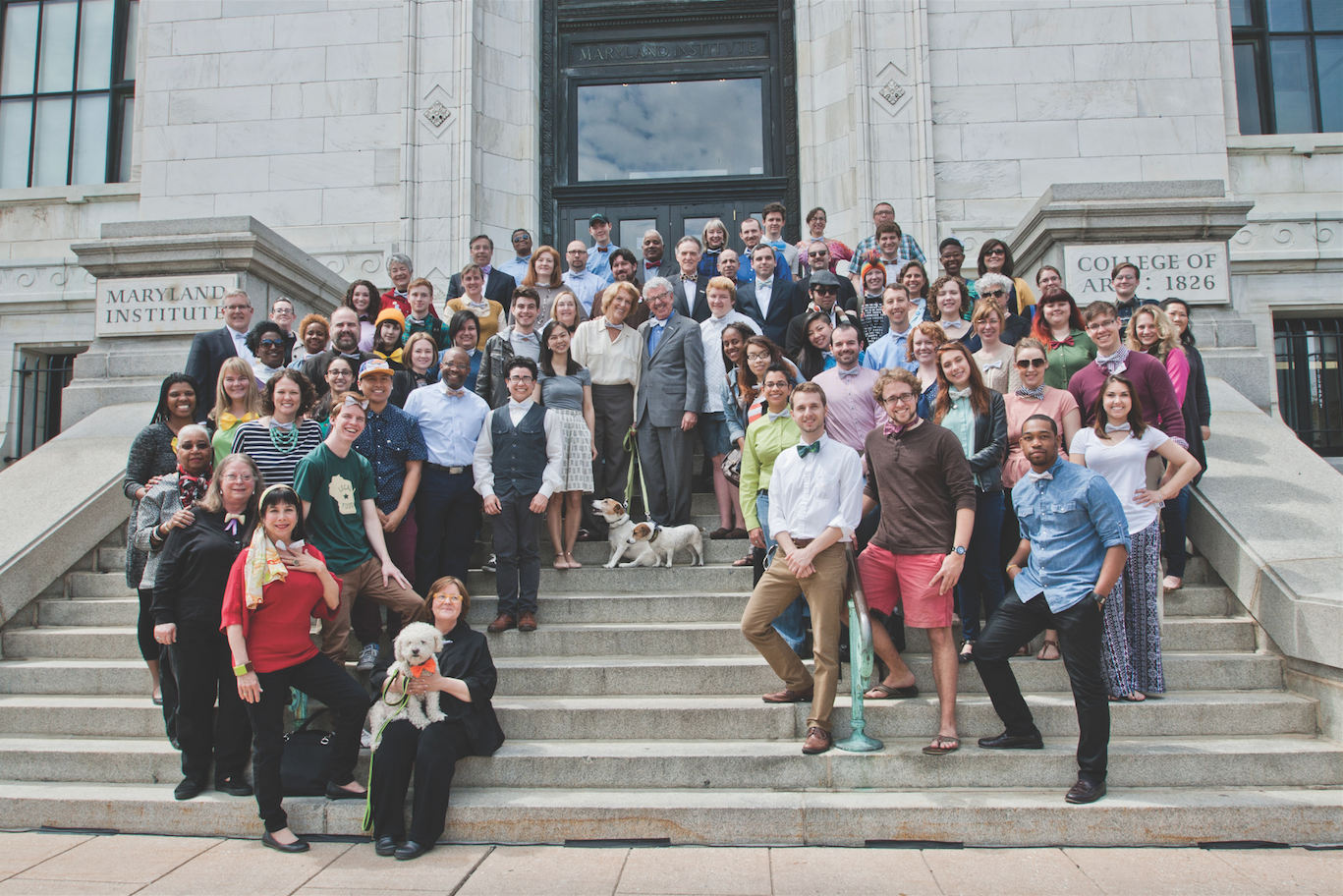
Fred and Jonna Lazarus (center), with alumni, students, faculty and staff during Lazarus Legacy Week, April 2014, photo by Phylicia Ghee ’10
While creativity is a required talent in many fields, according to Lazarus there are related qualities that set artists apart from other creative entrepreneurs.
“We talk about a creative economy,” says Lazarus, “the fact of the matter is, everything is based on innovation. Artists have a way of seeing the world differently, it is perceptually based. Artists translate that vision to help the rest of us see things in a different way, to see different kinds of solutions to problems. That quality is not the same as an engineer or a business person who’s creative.”
This perceptual capability is translated through learned skills and expressed through various art forms. In the process, artists perform a service through creative expression that can also yield shared experiences and community impact way beyond its original scope and intentions.
“That quality of perception, it’s like a filter that they put it through,” he continues, “and the skills to translate it into something meaningful, an expression that is effective. Some artists are more and more interested in the impact that their art will have. This younger generation influences the world that we live in.”
Since MICA launched its innovative Community Arts Programs in 2005, many students have found new directions and involvement using their creativity in engaging with the public and developing projects around sustainable objectives for community service.
By contrast, in the many forms of art including theatre and film, Lazarus acknowledges that “entertainment has always been a dirty word for artists.”
However, he believes that in order to engage and perhaps influence an audience, the best performance art, theatre and conceptual art is a blend of many layers, including the spiritual and psychological facets of the work and the ways that audiences experience it.
“If a new composition in music is so complicated that no one can relate to it, does it fail?” he asks. “Maybe on one level, but on another level maybe it transforms the way people think about music.”
In discussing art as psychotherapy, he shifts the focus from the viewer’s perspective to the creator’s perspective, emphasizing that artists are the ones who express themselves freely through their work.
Lazarus considers himself a logical thinker but not an artist, and says that many people in society may not have those expressive abilities or opportunities, and thus they hold psychological problems in because they have no way of releasing them.
“It is something that most other people in society don’t have, and they hold this stuff within because they have no way of getting it out. Certainly art is a therapeutic resource of self-expression, and a help to those who do have those talents and can learn the skills to develop them.”
He relates the story of a UNESCO-sponsored exhibit of children’s art works, in which one young child’s finger-painting was a messy red blob that didn’t appear to mean much at first glance.
The curator informed him that the student had first painted a picture of his house, with stick figures of his family around it, and then covered it with red, because his house was blown up and the explosion killed his family. The red was really the blood of the family; the painting was the end result, but the process was buried underneath.
“This was a child who had not spoken for almost a year,” he recounts, “until he did this painting and then started talking. In this case the process of creating art was unbelievably therapeutic.”
“For lots of artists it’s a means of expressing things you’re trying to find a way to articulate,” says Lazarus, “through language, images, music or other art forms. And to the extent that people can talk about their work, it sometimes helps to move them to get to that next level, when they realize that they can go deeper and push it farther.”
Lazarus attests that new graduates entering the job market face more economic pressure than ever in the current environment, which makes it even more important for them to find a way to do something economically viable.
He believes that the community arts focus has provided a unified path for these young artists to develop their careers as well as serving a broader purpose.
“MICA attracts kids who care about the world and want to be able to change things. They look for ways to bring their passion and artistic life together. These kids come in with a combination of amazing perseverance and amazing outrage at the state of the world around them, and they are committed to doing the things that need to be done, it creates a wonderful tension between their own motivations.”
Lazarus says that another great part of the strength of MICA is “unbelievable diversity among faculty.”
“The teachers need to be passionate about helping and educating young people, teaching and mentoring. They need to be both great artists and great teachers. To have all those things coming together, being open to innovative ideas, growing and changing, to be able to evolve.”
Their mission is “to inspire these young people without dictating where they should go, like a great coach. Being able to say something that will ignite the idea, so the student can move forward on their own, to facilitate them doing it.”

Fred Lazarus IV (right) and Vice President for Operations Michael Molla review architecture plans at the construction site for the Graduate Studio Center, renamed the Fred Lazarus IV Center in April 2014, photo by Christopher Myers ’94
The historical trend of community arts involvement is being advanced by the art world but also by the broader culture, in contrast with the world of self-indulgence.
“There are people who couldn’t care less about these issues, there’s a lot of that out there. Shared community values are not everywhere. But there are entities and people who do share these values and the MICA culture attracts those people.”
MICA is an incubator, with students making connections by looking outwards and seeing and applying their skills to so many community challenges to be tackled.
“As we moved forward with community arts, some faculty would look at these kids and say, ‘Well, they’re not making art anymore.’ But they do still make art, they’re blending this commitment in a way that European artists have done for years, they have crossed over these boundary lines, instead of getting in a silo, they are taking their creativity and their training and making entrepreneurial possibilities come to life in so many communities in Baltimore, applying creativity in lots of different ways, creative skills and vision expanding to a larger scale of impact.”
Lazarus was instrumental in launching ArtScape in 1982, and praises the most recent version of the festival for its “synergistic effect of everybody doing this together, being intergenerational, and is a very democratic, engaged event; it brings together diverse parts of the community in a safe environment where everybody is having fun and enjoying it.”
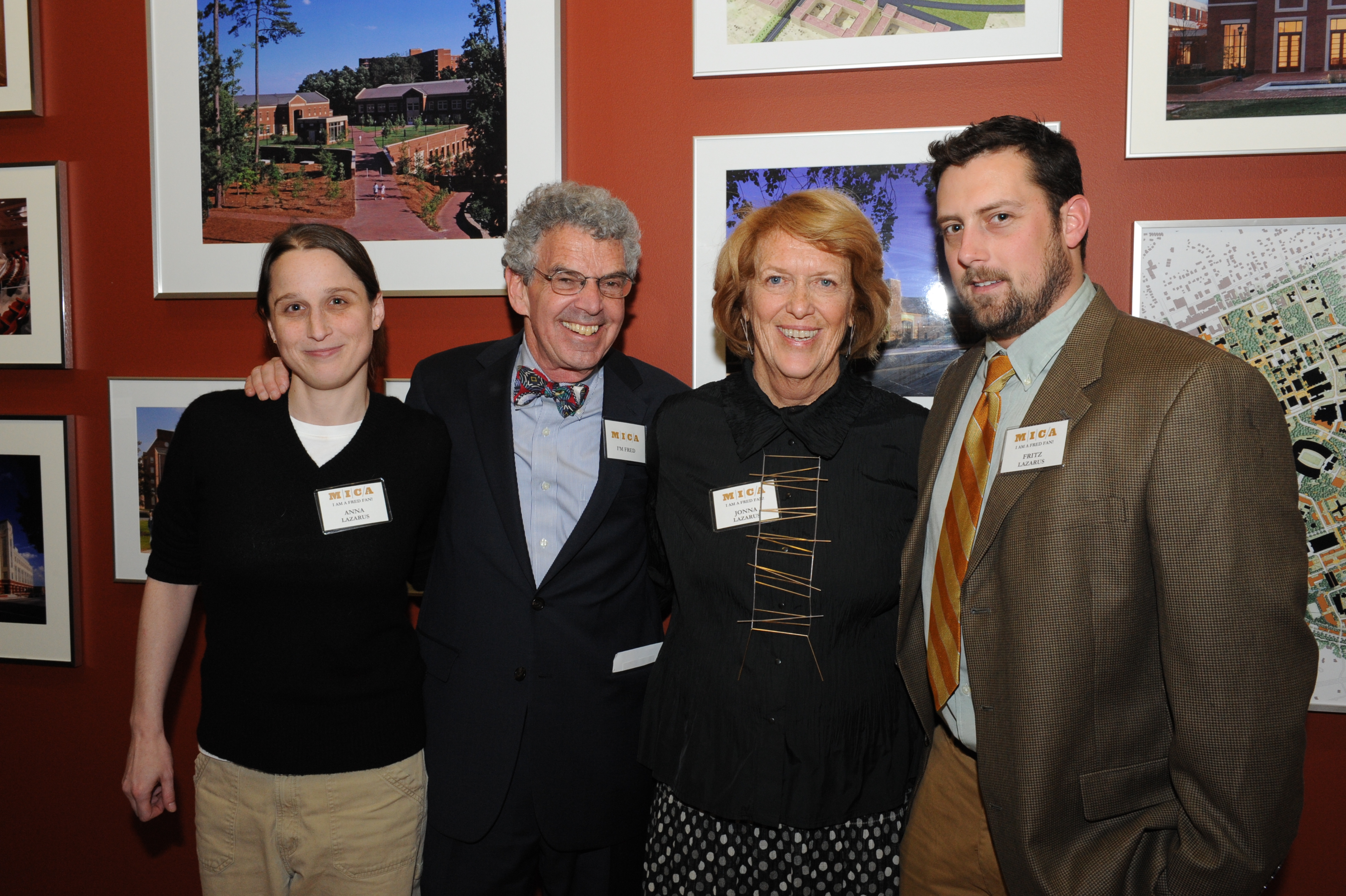
Daughter Anna, Fred IV, Jonna and son Fred “Fritz” V. Lazarus, celebrating President Lazarus’s 30th anniversary, 2009 (photo by Jim Burger ’82)
He recalls an early ArtScape experience, walking with his wife and “overhearing two teenaged kids walking behind us having a heated argument about a video they had seen in the Mount Royal Station building that struck a chord with them. This was probably the first ‘art video’ they’d ever seen. And I thought, isn’t this terrific? That this could cause a debate and discussion like that, they obviously thought about it and took off from there. That’s part of the purpose and power of art, as a catalyst for engagement.”
Concluding the spring semester, MICA hosts a variety of exhibitions open to the public, including the annual campus-wide ArtWalk on Thursday, May 14 from 5:00 to 9:00 pm.
Registration for this event is at Cohen Plaza, 1303 West Mount Royal Avenue, and tickets are $20 for the general public (free for children age 10 and under).
You can find more information on the extensive schedule of commencement and thesis exhibitions coming up in mid-May at fyi.mica.edu.
Lazarus emphasizes that the annual ArtWalk event is a “great opportunity to wander around and ask artists about their work, meet the artists and understand where they’re coming from and how they did it.”
MICA is committed to helping make Baltimore more hospitable and create more opportunities for graduates to stay in the city, to make a living and express themselves, to be engaged in the city and develop a passion for building success here.
“We have a lot of opportunity ahead of us,” says Lazarus. “We have a wonderful dynamic with committed young leaders in the city who have this kind of passion to make it happen, they are great folks, really smart and really good.”