Words and art by Lee Boot
I don’t know about ya’ll but I think we’re in the middle of a big change. It’s as if for the last 1000 years we’ve been looking for the smallest possible answer to solve everything. Post-modernism didn’t change a thing. We’re still looking for the main point; the true meaning; the vaccine.
But the roundworm says no. The roundworm has been the subject of neuroscientists’ long search to unlock the mysteries of neural circuitry so that one-day, we might explain the human brain. Humans have maybe 100 billion neurons in their brains; roundworms have only 302, exactly. It’s understandable why we might think that given enough time, diligence and creativity, we can figure out the neural basis of the decision tree that determines these organisms’ behavior. Nope. Thirty-seven years on the project and things just keep getting more complex. We’re not even close to fully understanding how the neurons ultimately determine the final decisions that worm makes.
It’s funny how the tiniest cloud on the horizon can turn into the most turbulent storm. Einstein published his General Theory of Relativity in 1916 and if Newton had been around, he’d be all, Doh! Every time we think we’ve found the answer, we see a wider view of a vast landscape that just won’t behave. Antibiotics yield to drug-resistant strains. Fillings give you mercury poisoning. Hydroelectric dams turn into ecological disasters. It’s as if we climb and climb and climb to reach the top of the pyramid, only to have it expand around us and leave us entombed in ignorance until we can climb out again into the light.

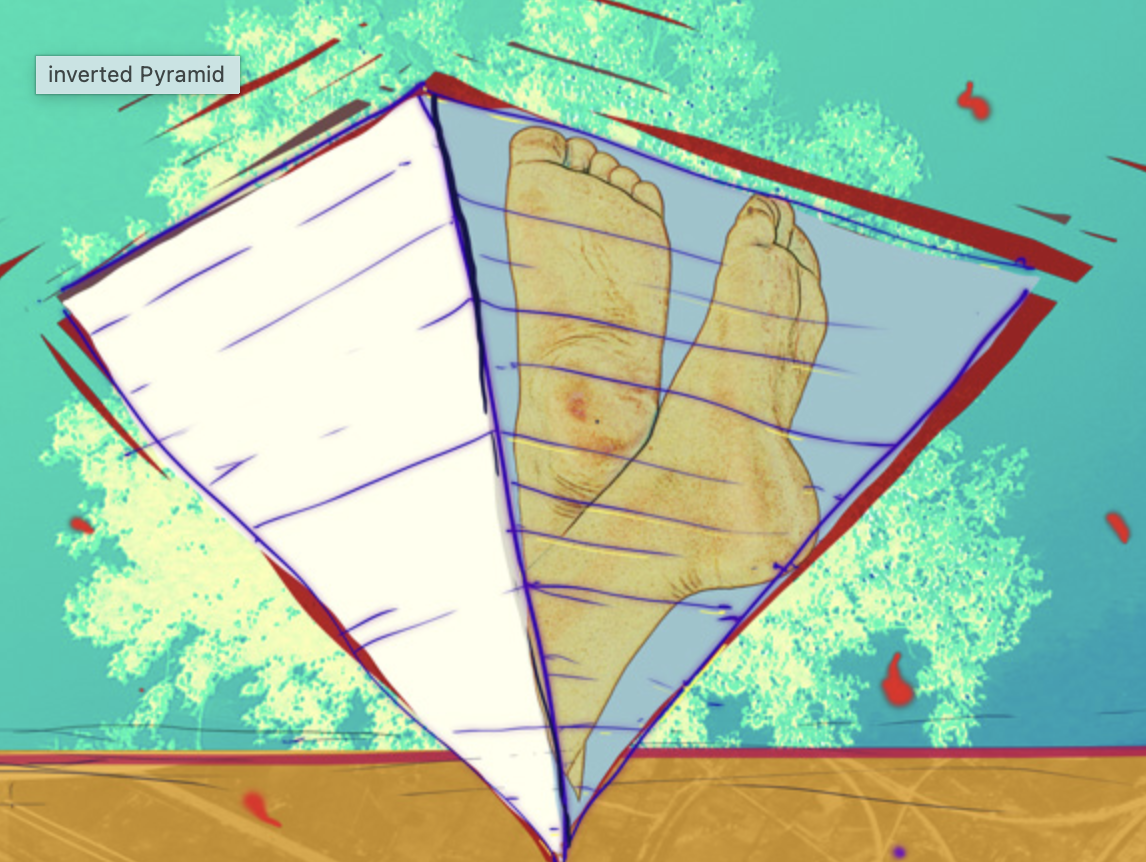
Maybe next time we get to the top, in the brief moment just before things go dark again, we should consider leaping up to a new pyramid—one that’s hovering upside down, above. Though it has a structure too, the inverted pyramid doesn’t play by our old rules. It floats above the earth with no visible means of support. As we climb up, it gets bigger, not smaller. The more we explore it, the more there is to explore. Our drive was to reduce complexity, but it’s complexity that makes things work: beauty, ecosystems, good stories and roundworms. We have tried to understand ourselves as good or evil, rational, driven by Freudian dreams, possessed, a machine like process of chemicals and electricity—only to find we’re all of that and a great deal more. We have no idea how much more. Turn Maslow and Bloom upside down, we’re still climbing.
Words and art by Lee Boot