Walking into Red Emma’s on the corner of Maryland and North Avenue, you can’t help but take stock of the sheer size of the place. It’s a far cry from its old location on the corner of St. Paul and Madison, in Mount Vernon. There, the few tables they had were nearly stacked on top of each other, books and computers were crammed into every available space and a mere dozen patrons gave you the feeling of constriction normally reserved for the galley of a ship or a 5:30pm bus commute. At the new Red Emma’s location, everything looks and feels big and new, or at least the kind of newish, rustic-chic look a bookstore-coffee shop is apt to emulate these days. There is even an in-house coffee roaster, which isn’t something you see very often in today’s world of mass production.
At a glance, the unwitting patron might think of the place as nothing more than a hip, bustling urban coffee shop and book store, when in reality, what they are witnessing is a social experiment over 10 years in the making. To really understand the motivation behind Red Emma’s as a business, it’s important to point out a couple practices they’ve instituted that lie in stark contrast to traditional business wisdom.
The first and most significant of these differences being that, although Red Emma’s requires revenue from the sale of books, coffee and food, it is in no way solely focused on capital gain. In fact, the store as a whole operates on essentially anti-capitalist principles. The second difference is that, unlike 99.9% (I am approximating, here) of businesses in the world, there are no bosses, meaning there is no one person whose priorities and demands outweigh another’s. 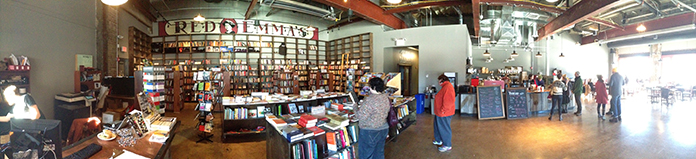
Ask any business owner or advisor and chances are they will tell you that such notions are almost a guarantee for failure in the modern business climate. And the truth of the matter is, for the most part, they aren’t entirely wrong. The fact that Red Emma’s has been operating as long as it has defies traditional business logic.
So what is it that makes this business and social experiment work the way it does? Why, in light of a down economy and set to the stage of a city often said to be struggling, are there only signs of growth for Baltimore’s biggest radical bookstore and coffee shop? One way to get a good idea as to what made it work is by looking closer at how it all came together.
First Disclosure: Although I have never been formally involved with the Red Emma’s collective, I have been a close observer since its inception and during its growth over the years. Many of the people I interviewed for this article are either acquaintances or friends.
Second Disclosure: Being that Red Emma’s is a collectively run business, there isn’t one voice or message to represent it. That being said, all of the quotes and commentary from the collective members are that of the individuals and do not necessarily represent the views or opinions of the entire collective.
Back before Red Emma’s opened, there weren’t a whole lot of places you could physically go to for literature if you had a penchant for politically radical fare. More often, you would have to resort to online or even (you might want to sit down for this) mail order catalogues. There was however a dilapidated bookstore in Fells Point called Black Planet Books.
“It was owned by this guy named Andrew Smith,” explains Red Emma’s co-owner Cullen Nawalkowsky. “It had traits of an anarchist bookstore… But it was kind of falling apart, kind of smelly, didn’t really keep up with inventory and tended to sell the same books to a small group of people.”
Before moving to Baltimore from Philadelphia in 1999, Nawalkowsky was already a community activist and avid book reader. At the time, a lot of his political focus was centered on the Black Panther Party and proclaimed political prisoners like Mumia Abu-Jamal, but moving to Baltimore meant he would have to re-sow his political roots in a new landscape. It was at a meeting at Black Planet Books held by supporters of Eddie Conway that Nawalkowsky found his in, and by proxy his connection to the store.
Nawalkowsky’s reasons for showing up to Black Planet when he did are unique to him, but it makes for a good example of how a person would typically get involved in community activism. You either had to already be involved in an issue or at least already know that something was going on, for the most part. Around the same time, Smith had gotten, more or less in over his head, as far as owning the bookstore by him self was concerned and he decided that the next logical step would be to collectivize. It was shortly after the beginning of this process that the collective members came to the conclusion that the Fells Point location could no longer adequately serve the long-term goals of the patrons and volunteers turned owners.
“After banging our heads against the wall and then having water leak on us from the ceiling we realized that what we needed to do was open up a new shop and put Black Planet to rest,” says Nawalkowsky. And so, in 2003, naming their new location after the early 20th century anarchist, writer and political activist Emma Goldman, Red Emma’s was born.
“We were ready to do something a little bit different, a little bit bigger, and a little bit more public. Something that was going to have an appeal for people outside of the self identified radical community,” explains co-owner Kate Katib. Katib is another founding member of the Red Emma’s collective and had coincidentally come from Philadelphia just like Nawalkowsky, though they first met in Baltimore. 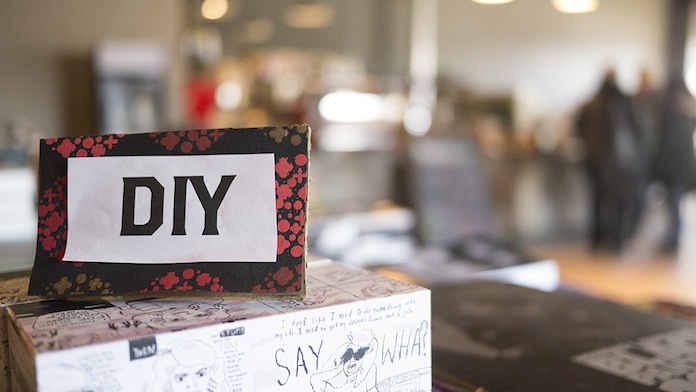
One of the first big changes the collective wanted to make was to give the original shop a far more inviting atmosphere and to offer its customers more than just books, especially considering the reality that Black Planet sold, on average, a book a day. After weighing the pros and cons of varying business strategies, it was decided that fair trade coffee and vegetarian food would be the commodity they would use to subsidize the sale of books.
The collective also tried to look at the broader political and cultural scene they would be stepping into. They wanted to make a place that people would see as welcoming to all types of communities and to have it serve as a hub or meeting place that isn’t sectarian and that doesn’t draw social lines before you enter the door. “No one is trying to convert anybody here,” one Emma’s co-owner told me. “That’s not the mentality. We’re not trying to get you to read this specific book. We’re just trying to get you to read some books… and have a discussion.”
It’s important to note that this idea was especially important considering what was going on in the world at the time. America had entered its second war and after September 11th, vocal dissent had become grounds for questioning your patriotism. Phrases like “You are either with us or against us,” found its way into the rhetoric of the powers that be and legislations like the Patriot Act had started to chip away at our personal freedoms. With so many reasons to organize and educate, Red Emma’s quickly became a central hub for the local community both socially and politically.
One of the most interesting things about this time was, how many different ways the space was utilized. A typical day at the old Red Emma’s started with its doors opening at 10am. From opening ‘til about mid-afternoon, Red Emma’s was a study hall for students, employment resource center for the unemployed, and general place of physical and emotional warmth for any one hard up and looking to get out of the cold. At around 4pm the number of patrons would start to swell. You might find teachers grading papers at a back table, or people from the neighborhood chewing the fat with the barista on staff. By 6pm, the place would be packed with all sorts of individuals and coteries. You might overhear two strangers debating the merits of punk rock at the bar while a cluster of union members tries to find the right date for their next demonstration.
All of this would have to be wrapped up by 7:30pm though, because an author is coming in to do a reading, or a political folk collective is showing up to perform. The more the Red Emma’s engaged the community, the more it became apparent that Red Emma’s needed to expand. The collective had started to gain new members, and with them, the opportunity for new growth. In 2007, the collective realized that they needed more than just a tiny basement coffee shop and bookstore.
When the opportunity to partner with the St. Johns United Methodist Church on St. Paul and 27th street arose, they pounced. Through this partnership the collective started to host and rent out the space for events as utilitarian as a D.I.Y. (Do It Yourself) festival and as entertaining as the Baltimore Rock Opera Society’s first showing of Gründlehämmer. In 2009 the Red Emma’s goal of being a community resource matured further to the point of starting the Baltimore Free School. Through this project, anyone can apply to teach a course on almost any subject matter and anyone interested in learning can sign up for free or almost free. You can now attend the Baltimore Free School at Red Emma’s new location at 30 W. North Avenue.
This latest move, albeit impressive, should in no way be a surprising one. Yes, there were bumps in the road leading up to this accomplishment, but I can’t rightly recall a time when the Red Emma’s wasn’t operating with forward momentum. There is a certain insatiable tenacity in its collective members; the kind where setting a goal and achieving it means you should have set the goal higher. A lot has changed for the collective members over the years too. What were once seven or eight volunteers working for free is now a group of about 18 co-owners, all making a living wage.
Now that Red Emma’s has space to grow, there are even more opportunities and projects springing up, the latest being Thread Coffee. Thread is a co-op coffee roaster that operates out of Red Emma’s and accounts for the big red coffee roaster by the front counter. It’s run by three of the Emma’s co-owners but operates as a separate entity from the collective. The co-op is “committed to a transparent model of trade that promotes dignity, sustainability, and solidarity.” So you know, they are just trying to redefine the way the world looks at the second largest traded commodity in the world, only surpassed by oil. NBD, right?