Photo by Leo Ryan
Photo by Macon Street Books
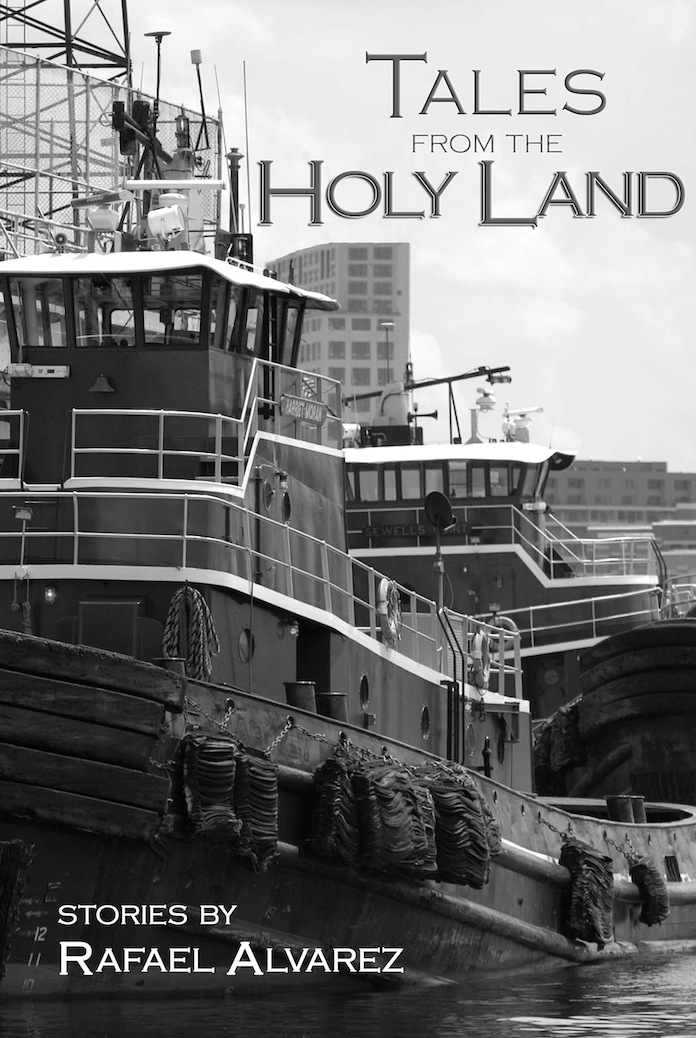
Rafael Alvarez’ third collection of fiction, Tales From the Holy Land, opens Baltimore’s last century up like a cadaver, then offers readers a look at some of the working parts: tough lives punctuated with moments of heart, hilarity, and human sadness. These interconnected stories, when compiled together, read like a sweeping portrait of the City from a man who loves it and has been nourished by it for a lifetime. Individually, they show a keen understanding, a love for the lives of ordinary people. The book is full of beautiful black and white photographs, all taken by local photographers.
To mark the book’s release, Alvarez will be doing some readings locally worth checking out. He’ll be at the Creative Alliance for a reading/Q&A session at 5 pm on Saturday, January 11th, as well as a featured reader at this month’s 510 Reading Series on January 25th at Minas in Hampden.
Alvarez was kind enough to answer a few questions about the book, his long writing career, and Crabtown for What Weekly’s readers. Honestly, I could listen to this guy talk about Baltimore all day; I am very much looking forward to the Q&A after his reading and so should you.
WW: One of the first things I found evident in this collection – as well as your feature writing for the Baltimore Sun – is an obvious infatuation with hometown history. The book is loaded with fascinating local historical references – politicians, artists, events, etc. – that are woven into the personal stories of the characters as much as they are a part of the neighborhoods they live in. What are your thoughts on the relationship between City history and personal history in the stories? What about in real-life?
RA: I cannot separate the history of Baltimore from my personal history – not only have I lived it since 1958 (born at St. Agnes Hospital, across from Babe Ruth’s reform school) but it has been passed down to me by generations going back to the Polish immigration of the late 19th century. Plus for 23 years at The Sun, I got paid to be a student of the City of Baltimore, the only subject of my work, except for a few years of writing network TV in LA (2005 through 2008.)
WW: Your studies come through in the lives of the characters; there are all these wonderful little civic details that have helped shaped their circumstances. It makes each story feel connected, whether they feature a recurring character or not. Tell me about the title, Tales from the Holy Land, and a little bit about how you chose the stories that went in.
RA: Back in the late 1980s – beginning about 1987, I guess – I began hanging out at a bar just east of Fells Point called “Bonnie’s” at the corner of Fleet Street and an alley called Port Street. It’s right behind the Ukranian Catholic Church with the onion domes near Patterson Park, and has since been renovated into a private home monstrosity. But back then, it was a shrine to Elvis – with a huge mural of the King’s face on the outside wall facing Port Street – and I befriended Miss Bonnie Lavonda Hunt.
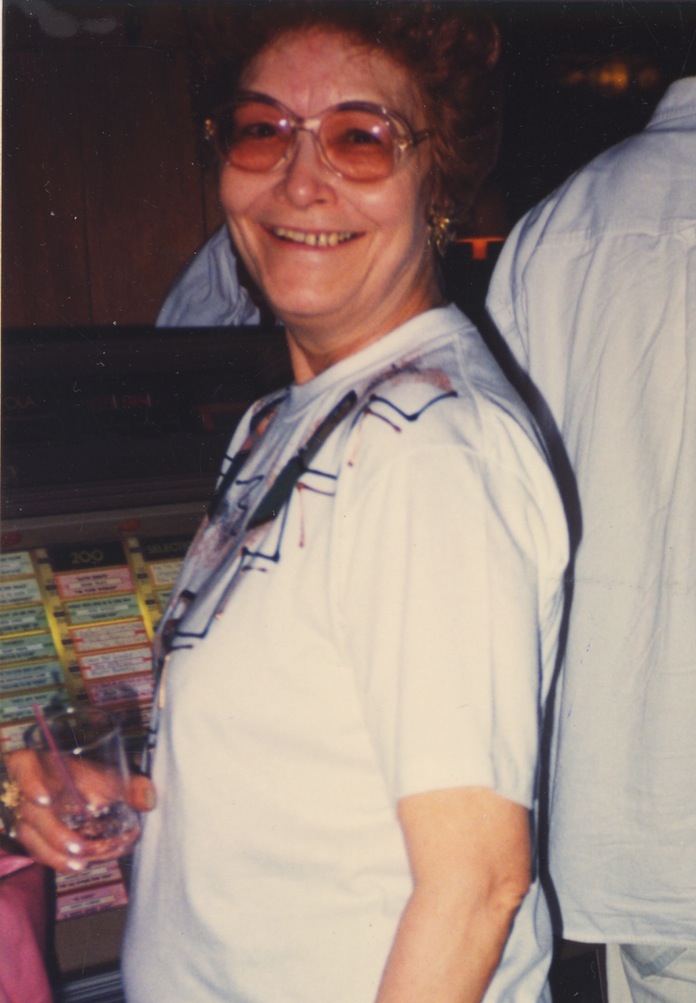
Photo by Macon Street Books
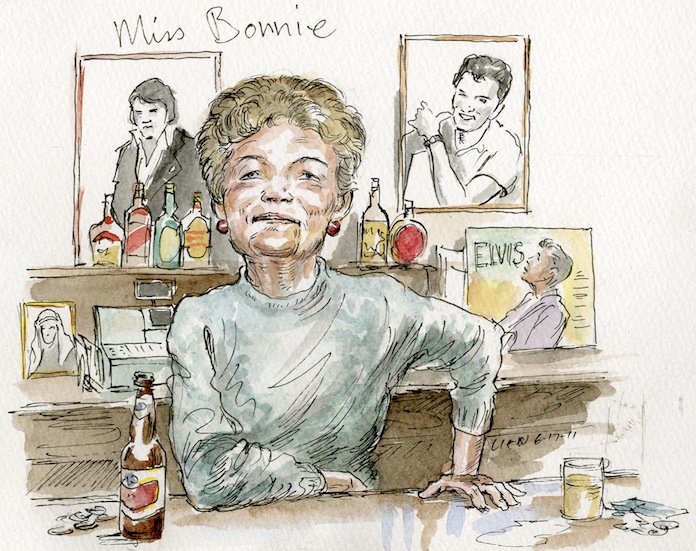
Photo by Art Lien
Like many of the everyday ‘characters” I chronicled in The Sun during my days getting paid to wander the city, I became friends with Miss Bonnie and she gave me free reign at her tavern. My children went with me when they were young and enjoyed the electronic bowling game and toaster oven pizzas she treated them to.
I turned Bonnie’s into sort of a private playhouse for myself and friends (always referring to it as ‘Miss Bonnie’s Elvis Bar’), including many of my cohorts from the newspaper and writing worlds. For a while I taught fiction workshops there. The Baltimore fiction writer Jen Grow was one of my students. Some of the earliest fiction readings I hosted were at Bonnie’s.
Just for fun, I began calling the area ‘The Holy Land’ with Elvis as the monarch. It sort of stuck and because – beyond fun and games – East Baltimore is sacred to me for its importance to my genealogy and the place where my family made its living (Polish grandfather at National Beer / Spanish grandfather at Sparrows Point shipyard / father at tugboats on Thames Street / my mother walking to Broadway Market as a kid to buy crumbled cookies ’cause they were cheaper than the kind that were not crumbled) – because of all that, I decided to embrace the term “Holy Land” as something emblematic of how I felt about everything east of President Street, south of Baltimore Street, north of the Harbor and west of Dundalk.
I am not ignorant of its many deficiencies, nor are those who live in the traditional Holy Land, in and around Jerusalem, blind to the problems there.
The stories in this anthology were chosen in two ways: the first section are largely stuff that had not been collected in a book since my last short story anthology – Orlo & Leini – published in 2000.
The stories collected at the back – The Basilio Stories – consist of every story I have yet written about Basilio Boullosa, a man very much like myself (all my stories are emotionally autobiographical, that’s a line I stole from the story writer Susan Minot). I put them in chronological order so that if you read in sequence they work like a novel.
WW: I love that the Bonnie in “The King of a Rainy Kingdom” was a real person, and I now like to at least imagine as I read it that Pio was (or is) a real person, too. I liked reading that one right next to other one with Pio and the car/body in Patterson Park. You have a number of characters who reappear in the stories at different times in their lives – you already mentioned The Basilio Stories section – and you also often allow your narrator to foreshadow events in the characters’ lives – I think of Gibby and his tugboat right off the bat – in a way that gives the whole book a novelistic quality. Was that something you thought about as you were writing the stories? That they would all appear together as a collection, complimenting each other like that one day?
RA: I view my work – the fictional history of the margins of Baltimore from 1920 to 2020 – as one very large and detailed book. The story I’m working on now – somewhat long – is called All the Young Dudes: Locust Point, 1971.
WW: When were these stories written?
RA: I wrote fiction every day…always had a few manuscript pages in my pocket as I roamed the town…always wrote some stuff in the margin’s of my reporter’s notebook (things I saw, stuff I overheard baltimoreans say) that I knew would be of use in fiction.
The stories in “Tales” were written over the past 20 years … the oldest would be “Fountain of Highlandtown” (anthologized many times) and the newest is “Nine Innings in Baltimore.”
WW: What made you want to write fiction – both in short stories and for television – after so many years covering Baltimore City as a journalist?
RA: I always wanted to be a fiction writer and became fixed on the idea around age 15, when I read The Sun Also Rises and a literary life seemed to be painted in colorful strokes of restaurants, adventures, women and travel. I believe I was too young to know what Jake Barnes’ injury was, but it was the life I wanted (with a rock and roll soundtrack instead of a Roaring 20’s soundtrack) and I somehow knew I could have it both ways: by writing about it and by living it (it was one of the reasons I asked my father to get me a job on a ship when I graduated Mount St. Joseph High School at age 18 in 1976.)
Anyway, I never had dreams of becoming a reporter, my desire was always to write short stories and novels, which even at a very young age I considered to be a higher shelf behind the bar. I began writing stories in the third grade, and by freshman year of high school, was keeping a journal that has continued to this day (a school composition book devoted to each year, begun on the first of january and pretty much filled up with all manner of notes and remnants and stuff clipped from the paper to this day). The nature of the journals have changed dramatically from the days when all I did was ride around with my buddy Terry Hesse in his parent’s beige 1971 LTD getting high, chasing girls and listening to Robin Trower on the 8-track player. They have steadily become work books and a ship’s log.
So, I scribbled along through my first summer at sea. Sailing from Baltimore to Puerto Rico to New Orleans and back, over and over on a container ship after high school graduation, I wrote to the Playboy Advisor (lots of nudie books on a ship) as a teenager asking how to get an agent. They told me about Scott Meredith and when we hit New Orleans I went to the public library and took out a book written by Meredith called, Writing to Sell. I read it, kept scribbling and wouldn’t get a literary agent for another 20 years.
And then journalism and I fell in together when I was a sophomore at Loyola College in Baltimore. I was an English Major and two things happened at once: The City Paper– originally called, The City Squeeze – began to be published out of the Hopkins News-Letter office. They dropped off bundles at Loyola and I looked at one, read the masthead, called them up and told them I was a writer. That was sort of true. I was a person who wrote and I was willing to do whatever it took to get published.
And a girl in my Political Science class (who introduced me to another Loyola girl whom I would marry and have children with) got me a job in the circulation department of The Baltimore Sun, dispatching trucks to neighborhoods where the kids had not delivered that day’s paper.
My fiction dreams never died – never wavered (for a while, Saroyan was my hero) – but I was now getting paid not just to write but getting paid to learn how to write. In 1978, the reporter Tom Nugent returned a favor I had done (giving him contacts in the world of Harford County cock fighting) and put in a good word for me with the features editor of The Sun. I pitched a story about Studs Terkel, drove to Chicago with a friend to see the Stones at Soldier Field, interviewed Studs and got my first Sun byline on Aug. 8. 1978.
Thus my journalism career was launched. I would not get serious about fiction – truly serious in a disciplined way – for another 12 years.
Tales From The Holy Land is available locally at Atomic Books in Hampden and The Ivy Bookshop at Lake Falls, as well as the publisher, Perpetual Motion Machine Publishing through Amazon.

Photo by Phillip Edward Laubner

Photo by George Hagegeorge
Photo by Zach Greenbaum