The Baltimore House Gallery Phenomenon, By Max Guy
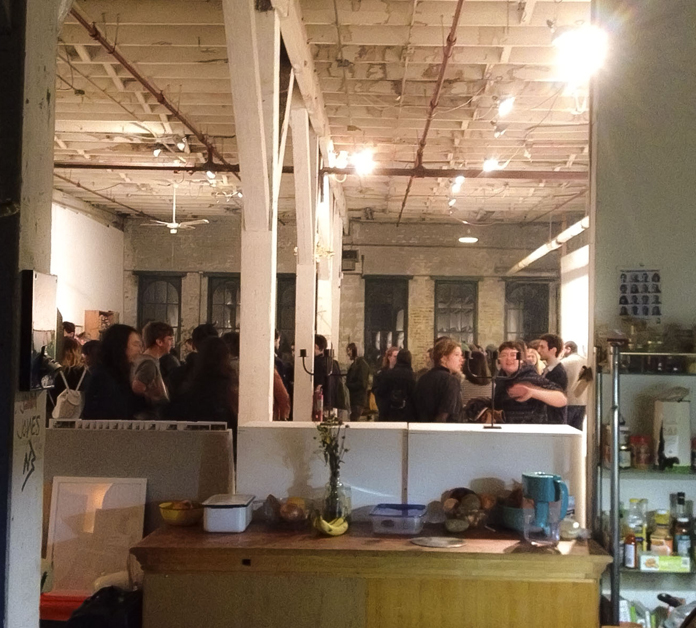
Penthouse Gallery Viewed from the Kitchen
I want to start out by considering networking. The web has provided a creative and discursive outlet through which communities can form. Generally, low overhead costs and collective free time are incentives for production and creative output. NYU Professor Clay Shirky describes this abundance in the book, Cognitive Surplus: How Technology Turns Consumers into Collaborators. The amorphous, customizable nature of blogs, message boards, and social networks seems utopian. The creation and distribution of art is no longer limited to a small privileged group. Shirky outlines the utopian potential in societies driven not by capitalism or socialism, but by an economy of amateurism. Increasingly networked, people form communities to do the things that they love, eventually striving for competence and innovation.
I live in a gallery space in Baltimore with my friends where the overhead is essentially paying rent and fundraising means throwing a New Year’s Eve banger. I have the privilege of walking through an art exhibition on the way to and from work.
I’ve been familiar with a young artist community here in Baltimore for about six years. That community works and exhibits almost entirely out of house galleries. Open Space Gallery (where I live), Nudashank, the Penthouse, Guest Spot, Gallery Four–these are all spaces that small groups of individuals have voluntarily carved out of their homes. The walls are white and dedicated to the presentation of art. Most of the galleries are run part-time (open on the weekends and by appointment), and the people running them have other jobs.

The Living Room Above Open Space Gallery
As a young creative-type, reading articles on the decline of the capital-driven art world and quotes from Patti Smith saying I’m not welcome in New York (where I grew up), Baltimore’s art scene seems positively utopic. Or at least heterotopic.
Philosopher Michel Foucault describes the term heterotopic in his essay Of Other Spaces. As opposed to utopia–a perfect world in its entirety–heterotopia is a constructed space that embodies an ideal. Heterotopias are private constructs, isolated from but reacting to the real world. These are spaces that seem to do the impossible in their multi-functionality, spaces like an online social network or an artist gallery commune within an auto body shop. When building these structures it is necessary to be aware of surrounding social, philosophical, economic, and political constructs.
The establishment of a heterotopic space is often the product of collective interests and collective decision-making. The domestic dynamic of communal living becomes a major factor in the creation of a house gallery. Open Space, for example, is collectively run not only by the tenants of the house, but also by the previous generations of tenants. Influence within the space is not only based on a collective member’s dedication, but to an extent on their seniority as well. This system of governance functions somewhat like a nonprofit’s board of trustees or a curatorial committee. All curators have biases. In house galleries, camaraderie is the main interest that informs curating. An all-of-my-friends approach to curating can make bland exhibitions.
So can the minimal aesthetic of so-called white cube galleries. The construction of a multi-use “neutral” gallery-style space not only confuses the function of the home, but everything else that happens there. For example, in house galleries, gallery openings become house parties. It is easy to confuse and conflate commercial art openings and house parties at house galleries. While the commercial opening reception is easily adapted into a more subdued house party, it is best not to forget that these events are evidence of different ecosystems with different customs and different purposes.
As a writer, it is difficult for me to determine when a critical voice is appropriate in the house gallery scene. Critical discourse can flounder in this context, and the work can become temporary ornament to the event of the exhibition. I am uncomfortable judging my peers’ work based on commercial and institutional standards not representative of our community. Instead, when asked what I think of an art show, my response is often a description of what is displayed. Perhaps I create a metaphor, a reiteration of the thesis of a group exhibition.
In the spring of 2011, artists Matt Papich and Neal Reinalda co-curated Approximate Infinite Daydream, a concert series held at the Baltimore Museum of Art and at the artists’ homes. The series explored the development of domestic ambient music in Baltimore as a unique cultural phenomenon. Concerned with how lifestyle influences creation, Papich and Reinalda recognized the effect of domestic culture on musical production. Comfortable living brings comfortable, relaxed, great music, and vice-versa. Is the same true for visual art in house galleries?
How much is Baltimore a co-determined music scene and art scene? I see music’s influence on visual aesthetics most exemplified in the eclectic interior design of music venues. At Open Space we change the space’s ambiance to complement or react to performances by altering lighting and temporary display.

Image courtesy of Open Space
Perhaps something needs to change in a small city with little to no art market. As a young and perhaps naïve artist, I am eager to find some utopian alternative to the increasingly closed-off commercial art world and the predominant amateurism of the house gallery. I have come to know and love Baltimore’s art community: the prolific output and dedication of the artists is inspiring. An art scene needs more than the production of work and a local audience. I say: Let’s establish a genuine dialogue on our home turf, then open the discussion to cities with similar art scenes, sharing what works for us and pinpointing systemic flaws.
Max Guy is an artist and curator living in Baltimore. He has exhibited locally at Guest Spot, Penthouse Gallery, Current Space, Open Space Gallery, and Nudashank. Max often collaborates on film screenings and publications with Spiral Cinema and with Peggy Chiang on the curatorial project, Szechuan Best. What Weekly’s Art Criticism Column is made possible by the generous support of the William G. Baker, Jr. Memorial Fund, creator of the Baker Artist Awards, www.BakerArtistAwards.org. Art Criticism in What Weekly is edited by Marcus Civin. For more information about this column, please contact marcus@whatweekly.com.