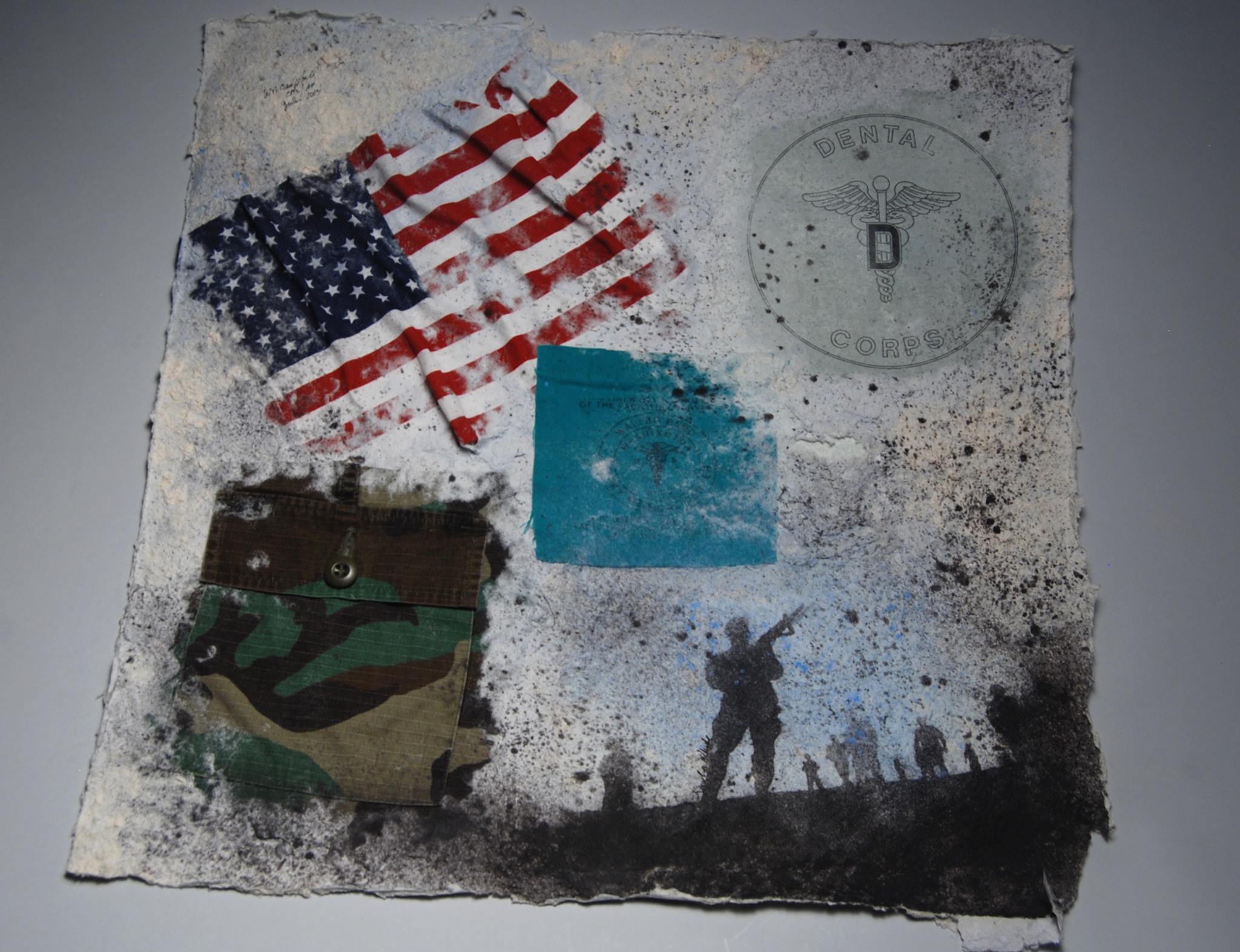
From music therapy and acupuncture to therapy dogs and yoga, there are alternative ways to cope with trauma that are becoming more mainstream. Today, there are so many creative alternative therapies for our military members who suffer from injuries like Post Traumatic Stress Disorder (PTSD), Traumatic Brain Injury (TBI), depression, addiction, abuse, or physical injury. Innovative artists Ehren Tool and Drew Matott are using ceramics and papermaking as engaging, transformative, and empowering tools for healing. These artists talk about their experiences with the military and reveal how art has transformed each of their senses of self.
Ehren Tool, a former Marine active from 1989-1994 and during the 1991 Gulf War, is a contemporary ceramist who uses the potters wheel and his “soldier” cups to start alternative conversations about war and how the country cares for our veterans. Currently living in Berkeley, Calif. with his wife and son, Tool occasionally teaches ceramics classes at the University of California, Berkeley. He has given away over 15,000 ceramic cups to individuals and collections in the hopes that they will encourage veterans and civilians alike to engage in tough conversations about the military.

When did you start making art?
Ehren Tool: When I got out of the Marines I took the GI Bill and went to school. The idea was to find something I believe in doing. I took many classes but was drawn to art. I just make cups. Not everyone would agree I am making art.
How does your art medium help you express your experiences or beliefs about the military?
ET: I think clay is a good analogy for war. In war, things are immediate and the results last a long time. In the same way, you can make marks easily in the clay but once they go through the kiln the marks will last 500,000 to one million years. The cups also seem to me to be the appropriate scale to talk about war. Hand to hand. A cup cannot express what war is like but it may be the opportunity for a vet and someone who cares about that vet to have a conversation about unspeakable things.
How do you use your art medium to start dialogue between art, artist, and audience?
ET: I just make cups. Any power they have comes from the people who take the time to interact with them and share their stories and experiences.
How do you go about creating one of your cups?
ET: I take images from toys, propaganda, the media and from individuals who want cups made for family or friends who have some connection to the military.
I know you make the cylinder first. But once that is done, do you know exactly what you are going to put on it or do you improvise with different images and symbols that are around you or you’re thinking about?
ET: I have made hundreds of stamp spring molds from toys and insignia and stamps using a laser engraver. Sometimes the cups are really composed and sometimes they are just random images from my lexicon.
What is the significance of the cup?
ET: The cup is just a cup. I am more than a little hesitant to make any other claims about what I or the cups are doing. I had great hopes for what I was going to do in the Marine Corps. The gap between the stated goal and the outcome has been difficult for me to come to terms with. Think how lovely the world would be if we actually did what the politicians said we were doing.
Why did you choose to use that as your canvas as opposed to a blank slab or some other ceramic surface?
ET: In many stories humans are referred to as vessels. “We are flawed unclean vessels that only God’s love can clean”…The cups are my little Jarheads running through time and space. I don’t have the heart to make something pretty to sit in a shelf.
As a curator, I am always thinking about exhibition display and aesthetics. When creating your cups in bulk, are you thinking about how they might be exhibited together in a show or is that an afterthought?
ET: Over the years I have tried to come up with interesting ways to display the work. I have also gotten into (friendly) arguments with curators because I was too relaxed about how the work is displayed. Most shows only last a few months at most. The cups could last one million years. It is funny to me to get too upset about how they are shown. If my work is not strong enough to attract attention, it is the works fault, not the lighting. Again I have one million years to find a receptive audience for the work. The poor little cups are going to have to fend for themselves in the big bad world. I wont be there to make sure the lighting is right or even to interpret what the cups mean. Maybe my interpretation is wrong.

Drew Mattot is the director of the Peace Paper Project, an organization that “bring(s) hand paper-making to different communities affected by trauma.” After starting the Combat Paper Project with Iraq War veteran Drew Cameron in 2007, Matott realized that other communities, outside of those in the military, could benefit from the hands-on process of paper-making. Individuals are able to express their difficult emotions in a creative and communal way. Here, he explains how the process itself is a healing endeavor, and a way for individuals to express things visually that they cannot do so verbally.
What is your relationship to the military?
Drew Mattot: Up until I started working with veterans out of the Green Door Studio in 2007, I had no relationship with the military that I was aware of. It was something that was on the TV. After I started pulping uniforms with members of Iraq Veterans Against the War, I became aware of the veteran community and then started to realize that there were more veterans in my life than I knew about — my grandfather worked on the H-bomb after WWII, my uncle served in Vietnam, my father evaded the draft by hitchhiking to Mexico and was later pardoned by Jimmy Carter; Tom Lascell, an old dear friend and collaborator, was drafted and served during the Vietnam war.
When did you start making art?
DM: I grew up without a TV and since I was a child, my brothers and I read books, played and made things — it was not until I went to college that I become aware that I was really good at challenging myself to think outside the box and in the process making art. In 1998, I was first exposed to hand papermaking and I immediately fell in love with the processes. I was drawn to each step, as the rag material transformed and did not stop transforming until I had printed, drawn or painted onto the surface.
How does your art medium help you express your experiences or beliefs about the military?
DM: In the beginning of my activist art-making, I used my art to take an anti-war stance. But since developing Combat Paper and working with veterans of war, I have realized that war is not so black and white. So, since 2009, my work has shifted to help veterans and other survivors to activate their voice, project their stories, and help communities heal from violence, neglect, and abuse. I believe that by using hand papermaking to help service men and women begin the healing process, I am doing my part to help enrich and protect America.
Do you think creative expression is a good tool for all individuals in the military to utilize? Why?
DM: I believe that creative expression is a universal human experience, so of course I believe that it is a good tool for individuals in the military to use. Anything that encourages the development of an individualized voice is empowering and potentially healing. It helps people who have been through trauma make sense of their experiences. I believe that trauma is passed down from generation to generation and if an individual does not deal with their trauma, its effects will be felt for generations to come.
How do you use your art medium to start dialogue between art, artist, and audience?
DM: Papermaking is a very inviting process, the steps to making paper are easy to do, they build on each other and develop into personal expression in a matter of minutes. We start each workshop with participants introducing themselves through the rag material that they have brought in to transform. In this way we are all on the same page; we start by sharing our stories through the rag material. Then everyone spends thirty minutes or so cutting up the rag. During this time, each individual converses with the people around them embarking on the same journey. In this way the friendships begin to form and community is built. One by one we take each participant, with their cut up rag, to the hollander beater where they add their material to the beater and watch it as it transforms into pulp. Following the pulping of material, we teach each individual how to make paper from their slurry.

Why did you decide to create another organization called Peace Paper Project?
DM: One of the challenges as an artist, entrepreneur and self starter is to create a project that works, becomes sustainable and let it go so that it can continue to grow free of the creators control. So in this way, after developing and directing Combat Paper Project from 2007 to 2011, it had become a household name in the book arts and activist communities; it was bringing in over a hundred thousand dollars a year in revenue and had all the clear markings of a long term successful project. For me it was time to move on and try something new, develop a new project and embark on new challenges.
In 2011, Margaret Mahan, Gretchen Miller and I envisioned Peace Paper Project. It developed out of a need to grow as an artist by doing something different. Collaborating with art therapists took my understanding of the responsibility of the community engaged artist to a new level; while Combat Paper Project was used as a form or anti-war activism and self expression for ex-combatants, Peace Paper brings together international communities effected by violence, war & terrorism to embark on a professionally guided path to healing through papermaking.
Curator: I think there is a huge significance that the paper is made from used military uniforms. Can you explain the importance of this material within the artwork?
DM: We purchase clothing for a specific reason; it fits our style, our budget, our perception of self. Clothing is more than just something that we toss on to keep us warm, it is our self selected skin, it is a part of our living organism. It is apart of our human experience. To take our clothing and transform it into paper is to take all the experiences we have had in those clothes and transform them into something new.
Curator: What is the importance of creating the paper within a group, or is there none?
DM: It is very important to go through these processes as a group. It is important to build community and a support network while undergoing the processes. In addition, I believe it is important to have trained professionals present to help guide those who are struggling with the process of catharsis.
Healing Journeys: How Art Serves our Military is a local exhibition celebrating both ceramics and papermaking. During the fall of 2014, papermaking and ceramics workshops were implemented at the Walter Reed National Military Medical Center (WRNMMC) to boost self-confidence, foster a sense of achievement, and build space for sharing experiences and stories with others. These acts of physical engagement and collaborative interaction help individuals in the military express themselves in ways they cannot do with words. The exhibition showcases artwork from these workshops as well as 50 of Ehren Tool’s cups from The Arts & The Military Collection, Culpeper, VA. Healing Journeys: How Art Serves our Military is on view at Baltimore Clayworks (Community Arts Gallery) 5707 Smith Avenue, Baltimore 21209 from March 14-May 9, 2015. The opening reception will take place on March 13, 6:00-8:00 pm and is free and open to the public.
For more information about the exhibition email Emily Kohlenstein at erussell@mica.edu or visit healingjourneysart.weebly.com.