Sometimes, on nice afternoons in the Inner Harbor, just above the din of shoppers,
tourists, strollers, families, and flocks of cackling teenagers, you can hear a spectral
note linger in the air, sweet, as if it had drifted landward from the Domino Sugar plant in
the distance and decided to just hang around.
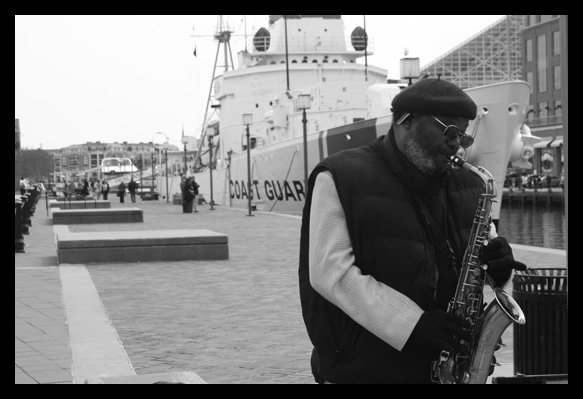
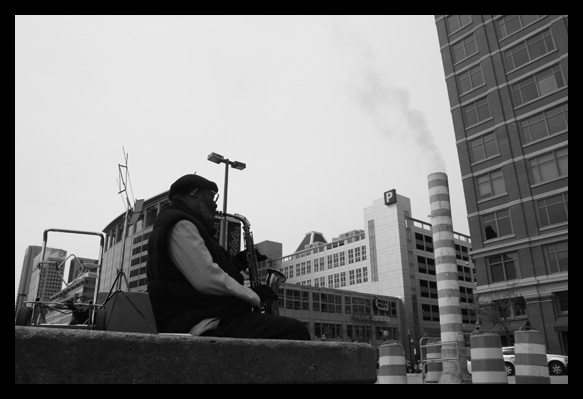
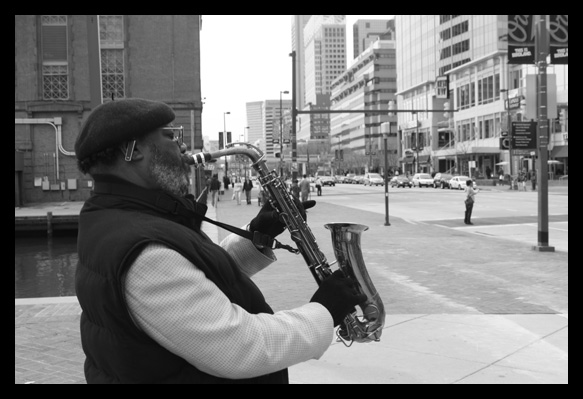
As I followed this sound on a recent afternoon, I found Aaron Thomas playing on a
saxaphone in front of the Coast Guard ship, for the people passing buy. “I alter the
sound for the person,” he said. “I sit here and watch as I play. The whole world is music.
Life is music. The first thing they listen for is the beat. If you ever quit playing, quit that
beat, then you’re done. But it is a gift, a miracle for the people walking by.”
Often Aaron plays with his friend Wendell Shepherd, but today he was just sitting
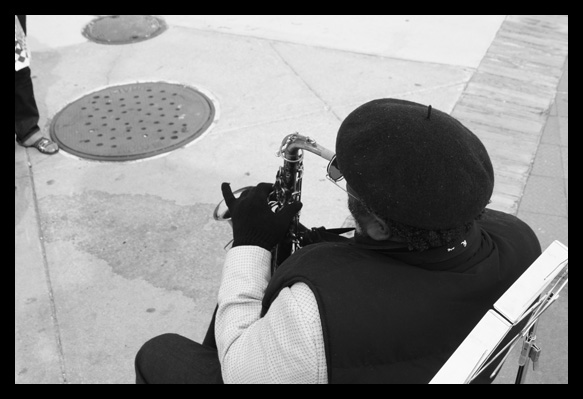
there, scanning the city through his clip on glasses. At gigs, and at home, Thomas
plays the trombone, but it doesn’t translate as well to the solo context of the street and
so he’s been playing the sax for the last few years. He began as a piano and organ
player. His parents had a piano, but when the first portable organ came out he begged
them. “Mom, Dad, if you get me that organ I will play it for the REST OF MY LIFE!” But
the organ wasn’t in the family’s budget. Aaron stuck to the piano… and when the family
got a television and it interfered with his practice, he would take a tube out of it and tell
everyone the set was broken.
When he got to junior high school, he wanted to join the marching band, so he thought
he would pick up the sax. “I was used to pressing notes. I figured that the saxophone
was just a piano you blew through. I didn’t know.” But when he went to the bandleader,
there were no more sax spots in the band. “But we have a trombone,” Thomas recalls
the bandleader saying. When he saw the trombone Thomas remembered being
puzzled, as a kid, about how the tube got longer and shorter. It seemed like magic. “I
didn’t know that one pipe went into another one.”
Since there was nothing to press, he didn’t know how to make notes, either. The
bandleader explained it was all about sliding. So Aaron took it home and started
playing.
“I’d slide that thing up and down– trying to get precise,” Thomas said. “Now that’s my
main ax. The trombone is me. It saved my life. When I was in an accident, I needed
very strong lungs to survive and I developed them through the trombone. Music is life,
love is the song. It’s why I’m alive.”

A group of people approached. Thomas quit talking and started playing. He stood up,
he swaying and arching his back, titling the horn up as he played in smooth Coleman
Hawkins lines. A big guy, Thomas was wearing a sleeveless coat, gloves, and a beret.
When the crowd passed, he removed the reed from his mouth and asked, “You know
why I wear that beret don’t you?”
“No,” I said.
“When I was about thirteen, it was 1965 or so, and National Beer had a Jazz Mobile
in Baltimore. It was this trailer and they’d set it up and one day in a parking lot around
Caroline and Biddle streets, as I recall, and I walked over and there was this one
guy sitting back behind the drum kit, setting up. Now, my dad was into music, and I
recognized the cat. I didn’t say nothing at first, I just started talking to him, asking where
everybody was. ‘Aw, they went to get sandwiches,’ he said. I told him, I said, ‘Aren’t you
Dizzy Gillespie?'”
I could see Aaron Thomas’ eyes grinning behind his dark clip on glasses– and in his
eyes, I caught a glimpse of the 13 year old kid. “He said, ‘Yeah.’ See I didn’t really know
what that meant, or how special he was at the time. I just knew he was the cool looking
cat with the beret and the big puffy cheeks, and that bent horn that my dad had showed
me. So I said, ‘You know, I play some too.’
‘Oh, you do?’ Diz said. So he said, ‘Why don’t you run and get your axe.'”
So, Aaron Thomas ran home. He came back later with the trombone. Gillespie wanted
to check the kid out before letting him perform. So he called Aaron back stage. Nervous,
the kid picked up his bone and he and Dizzy Gillespie jammed a few minutes.
“He hit a b flat. I hit a b flat. I mean I was tuning up with Diz. I mean, in those days, all
musicians were like family, you know. I could play the notes– if they could write it, I
could play it. Everybody was like that so I just played with anybody. We all did.
“So later on, Dizzy is up there on the stage with his beret on and he says ‘We have this
local cat, young kid, and he’s gonna come up and play… And I did it, I played with them.
It only started to hit me what had happened the next day when my teacher said ‘You
played with Dizzy Gillespie?’
“I still drink National beer to this day,” he said. “Healthiest beer around.”
A young black man and his girlfriend stopped. “Blow something, man,” the guy
demanded through a wide grin. Thomas brought the reed to his lips and closed his
eyes. The man smiled at his girl; passing children stopped; Aaron Thomas was lost in
time. When he finished the blues, the man slipped a ten into his case. Aaron Thomas
took it out and put it in his pocket. “I’m blowing notes, but the wind keeps blowing notes
too. Blowing my notes right out of the box.”
After he got out of school, Aaron went on to play in several bands (including the
original Black Eyed Peas, from Baltimore, another Motown sounding group called The Circulations and the 229th Army National Guard Band) but he eventually started working in the hospitality industry for
Hilton. “It was 1974 or ‘75 and was no colleges in the east that did hospitality, and so
they trained me in everything at Hilton. I did everything. But it was all like playing music.
It was just a different beat. And because of promoting gigs, I was pretty good at booking
conventions.
“Mayor Schaefer wrote me several letters thanking me for all I was trying to do with this
area. I mean, man, there was almost nothing down at Harbor Place then– but I loved
it. I was only twenty five and for me to take my sax and play and watch this piece of
property develop, it’s like taking a lullaby and watching it become a symphony. I’m glad
I’m able to see this. People say I’m just playing sax—they don’t see that I know every
foot of space in this area. They don’t see what I see, but I try to make them hear it.”
Traffic rushed forward. Gulls flew overhead. A family approached with a camera and
once again, Aaron Thomas joined his breath with the wind and jammed along with the
song of the world where earth, wind, and water meet.