There’s an entirely singular feeling you get when you’re sitting in a darkened room the size of a big garage with 3 friends and 40 strangers, on a folding metal chair with rust spots you’re trying not to touch, waiting for something, whatever it is, to happen. It’s a little too warm to stop sweating, you keep bumping your friends’ elbows, and if you have a paper program, you’re either sitting on it or it’s tossed somewhere you can’t see under your chair. The lights come on, dim purples and reds, or maybe bright white, and something comes to life in front of you for the next hour or two, something made for you at this moment by human bodies and voices and sounds and gestures and skin and outfits. It’s something made for you out of someone else’s viewpoint on a struggle, or someone else’s journey finding the line between the opposite sides of beauty, or someone else’s gut-wrenching loss. You’re in someone else’s mind, seeing a story play out with whatever tools they could get their hands on—props bought at a thrift store or found for free on the curb, sewn from bedsheets that someone no longer needed, made out of wood from a house with its own stories that got torn down 20 years ago.
Live performance art tells a story that the artist needs to share, and in many cases needs to be heard. Sometimes that’s theater, sometimes that doesn’t look like theater at all. Some of it is happening at established places in Baltimore like Centerstage or the Single Carrot or Everyman Theatre, and even more of it is happening in warehouses and former storefronts and rowhouse basements around the city. Some groups have gotten a footing in some small, ill-suited real estate and are able to call themselves a company and have a season, but most of these groups of artists get together and manage to afford to rent a venue for a night or two and are gone the next week. Their theater isn’t any less amazing, it’s just that most artists can’t seem to get a footing in a place where people will come to see them.
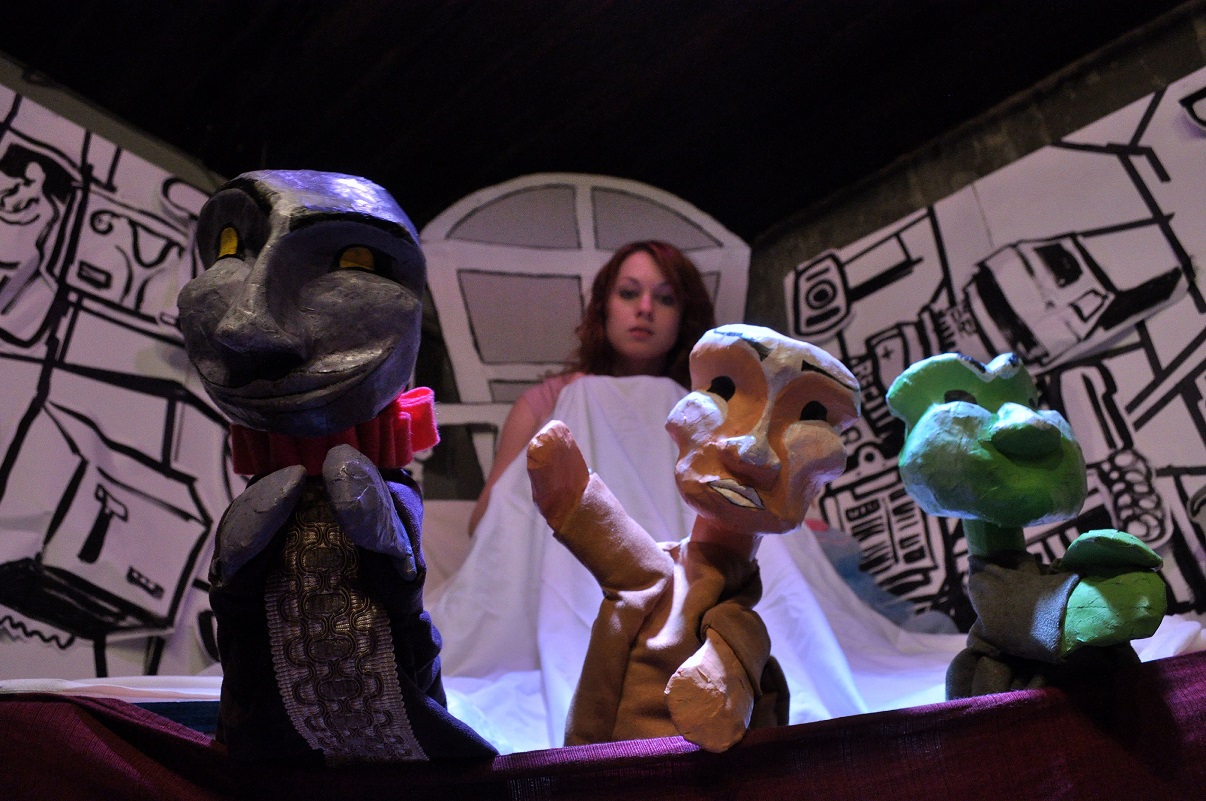
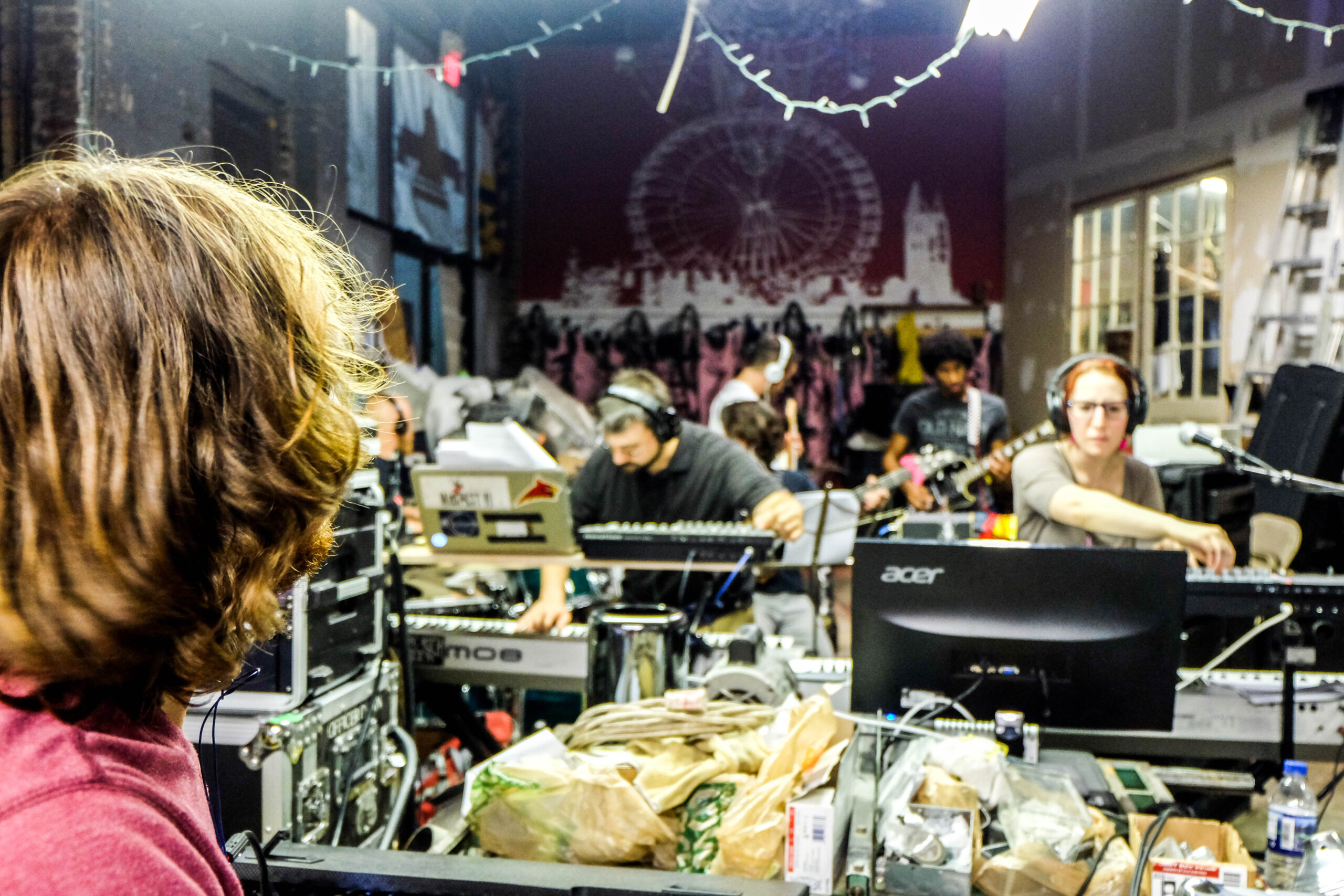
Photo courtesy of EMP Collective
A venture called Le Mondo was started for this reason. Carly Bales of EMP Collective, Ric Royer of Psychic Readings and Evan Moritz of Annex Theater are the managers of the project, which is already off the ground and moving: they’ve got a group of adjacent buildings on the 400 block of Howard Street, in what’s now called the Bromo Arts District. They’re working with the Baltimore Development Corporation to turn a large amount of unused space there into an artist-owned incubator for performances, performance groups and individual artists. That neighborhood is actually already home to a few performance and artist spaces: the Current Gallery, H&H, 14 Karat Cabaret, Maryland Art Place and others. And it’s right around the corner from the Hippodrome, another performing arts spot you may have heard of. So what used to be a lofty idea to give art some space to breathe and grow is about to become realized in the perfect neighborhood.
“The main thrust for Le Mondo,” says Bales, “is to create a staging ground for new works, experimentation, a no-rules playground for performance development without the worry of ‘am I going to be here in three months? And I have to find a new space, because the space I have has been taken over.’” Which is not only a worry but an actuality that has, unfortunately, killed off many would-be-outstanding performance groups. Royer stresses that the space will be always artist-owned. Which means that besides keeping the doors open, the impetus for any and all decisions made in the management of Le Mondo will be in the interest of artists. Le Mondo will be its own non-profit organization that will deal with the back-end operations of the space, giving the managers the freedom to focus on their resident companies: Annex Theater, EMP Collective and Psychic Readings who will also hold shows at Le Mondo, will in fact call the space home.
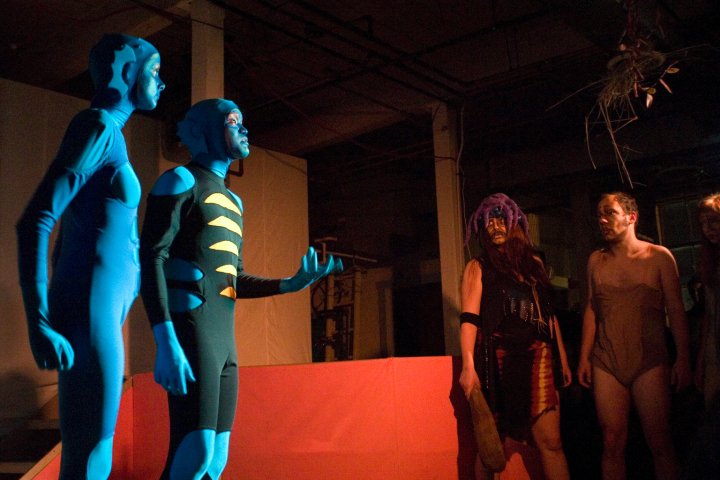
Photo by Annex Theater
These buildings will be divided into three main performance spaces in order to host artists across the spectrum of “do-it-yourself,” or, as Moritz puts it, across the spectrum of risk from the “risk maximal” space of a warehouse venue with no infrastructure or guarantee of longevity (and often fuzzy legality), to the rental spaces that usually come with a lighting grid, booth and sound system but cost too much money for groups to sustain their visions beyond one or two shows. Le Mondo, by having three different venues, will span those scopes without the risk at one end of the spectrum and without the impenetrable rental costs at the other. Moritz believes that it is not the “DIY-ness” of DIY theater that makes it great, that the philosophy has had a lot of holes in it, being too reliant on landlords and forces that don’t care enough about it to make room for it. Le Mondo wants to patch some of those holes. The philosophy here is that good art benefits from incubation by people who believe in its existence and want to give it what it needs to grow.
Le Mondo even has its first community partner ready to set up offices and classroom space on Howard Street: Baltimore Youth Arts. Their mission, as they state, is “to assist young people in gaining the creative, personal, and educational skills that will enable them to become leaders in their communities. BYA provides artistic and entrepreneurial opportunities to youth so that they can hone their talents and use them to shape the world. BYA creates a rare opportunity: providing access to art within adult and juvenile justice institutions and using art as a tool for employment once they reenter the workforce. ” You can check them out here.
How did this get started? As Moritz says, “Ryan Haase [of Stillpointe Initiative] came up to me and said, ‘you know what would be great, is if people moved back into the theater district and there were just all sorts of theaters, lines of theaters,’ and I was thinking about Howard Street… because of how many abandoned buildings there are and how many awesome venues could be there.” Meetings happened with other theater groups, and in 2014 they’d heard about a request for proposals by the city for the use of three buildings on Howard Street. They put in for the request and found a developer who believes in them and who was willing to match funds with them to begin development. They also found an architect, found contractors, and then the proposal was accepted. In “lightning speed,” as Moritz puts it. And now the ball is rolling. Also at lightning speed.
The developer in question has agreed to match their funds if they can raise $25,000 by June 30th, a city-established deadline, which would create the $50,000 total amount they need for this round. That day is coming up fast. As of today, they need about $12,000 more to reach that $25,000 mark. Interested? You can help fund Le Mondo like this: go to their CrowdRise website and donate. That site is right here.
Also, Le Mondo, like all modern projects, has taken the reins of technology and has a promo video.
But what’s better than a video? Theater. Live art. Having people get up and create a moment for you that comes from a bottle of realness they’ve got put away deep in their souls, and they’re only going to open it for you if you trek across town and sit in a dark room with a bunch of strangers and open your eyes. I want to see what they’ve got in there, and that’s why I believe in this project. I recommend to anyone who cares about art to put some of their faith in Le Mondo and help it see the light. I honestly cannot wait for this to happen.
Click here to donate to Le Mondo.