Hot on the heels of his exhibition of street artist Toven’s haunting wheatpaste pieces, Bank Gallery owner Gabriel Kirk featured the frenetic energy and color of two more street artists, Nether and Stefan Ways. First having met Nether painting a wall, Kirk said of the artist, “Nether sees the streets of our city through the eyes of those that live in the community he paints. His images tell the untold story of the inner parts of our city that most choose to ignore, not the ‘Small-timore’ most chose to stay in, he travels beyond the borders we psychologically set for self preservation or fear.” As for Ways, “We’ve communicated for years through the graffiti culture and I’ve always been amazed at his tenacity and dedication to the art. The street installations WAYS has done are unprecedented, and clearly his own vision uniquely placed for us to see,” Kirk said.
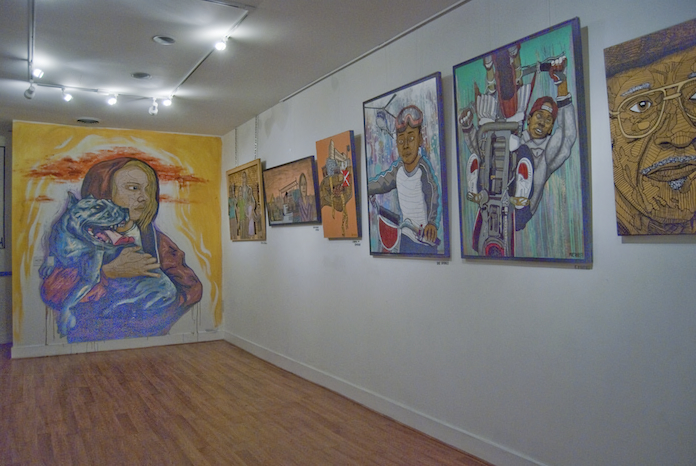
Photo by Kelly Wise
Upon walking into the gallery, visitors were greeted by a large collaborative installation taking up the back wall. A brave-faced girl in Nether’s signature woodcut wheatpaste style stared outward, holding a sly-looking pit bull in Ways’ dynamic graphic look in her arms. While some of the pieces in the gallery are scaled-down versions of installations that have appeared on the street, as Nether explained, others are, in Ways’ words, “preparation for the street. A lot of the work you see today is eventually something that’s going to be part of a mural at some point. A lot of my gallery work and canvas work is sort of my conceptualization of what I’m going to put on the street at some point, if I can find an appropriate location for the theme of the piece.” The collaborative piece will, in the future, be one of them.
The gallery was split, one wall occupied by Nether’s work and one by Ways’. Each piece had its title and information written under it in the artist’s signature hand, and both artists had put their tags directly on their respective walls before the artwork began.
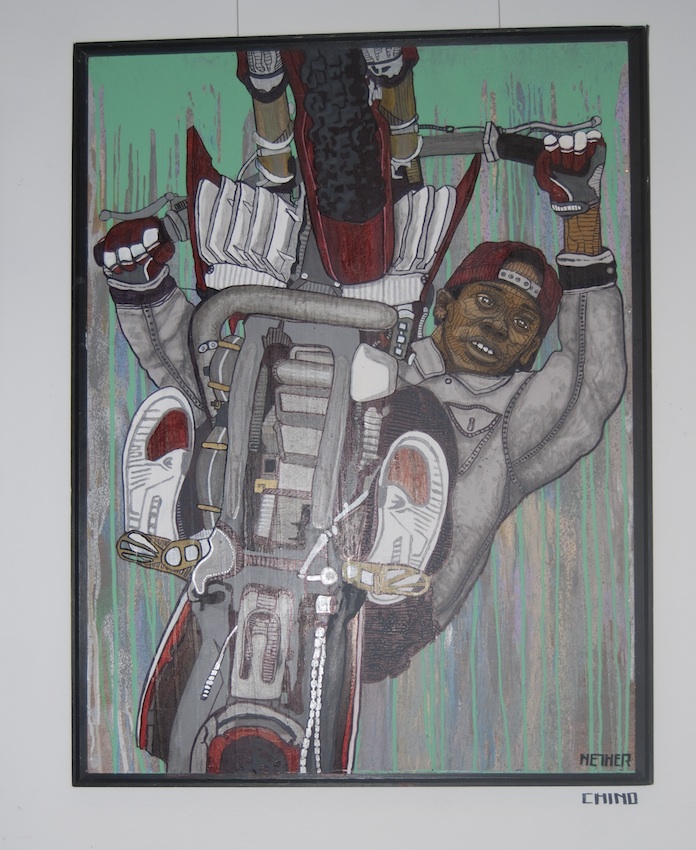
Photo by Kelly Wise
The lost seem to be a theme for Nether, with his pieces “Lost Kid” and “Lost in Baltimore” showing, respectively, a young boy with his head on his arm resting over a row of vacants, and a family moving through the streets with varying expressions of hope and despair on their faces. As Nether put it, his art often centers on “ignored subjects in Baltimore… I try to take a lot of kids, but mainly people that are stuck in situations that are being ignored by the city and try to get the city to pay attention to them. I see it kind of as civil disobedience as generally the work is on the grayer side of the law, sometimes dark gray. But I see it as civil disobedience, since some things in Baltimore have gotten so out of hand and we need to do something extraordinary to call attention to them.”
Nether says that his drive comes from “essentially being really overly passionately obsessed with Baltimore, growing up here.” After ventures into more traditional forms of artwork, he experienced frustration at “feeling like I failed to get to the audiences that I was trying to get at.” Befriending several street artists taught him the technique and gave him the connections to take his art public. “After meeting them I kind of realized that it made sense to put my art out in public,” Nether said. “I kind of decided to transition to the streets, and decided that it was the best way I could artistically help the city.”
Nether’s pieces adhere to what he calls a “classic Baltimore wheatpaste style.” Mostly black and white wheatpastes on colored canvas backgrounds, the art is then colored in the earth tones Nether favors, or sometimes more explosive splashes of color, like the boy and his bright red dirt bike in “The Dance.” The artist was trying to keep it simple when evolving his style: “I was kind of screwing around with line schemes and trying to get something that could translate really well in terms of tonality in simply two colors. I usually try to keep earth tones and colors pretty simplistic. I’ve been branching out a little bit recently. I like to have things that will translate into different mediums, whether it’s a mural or a t-shirt.”
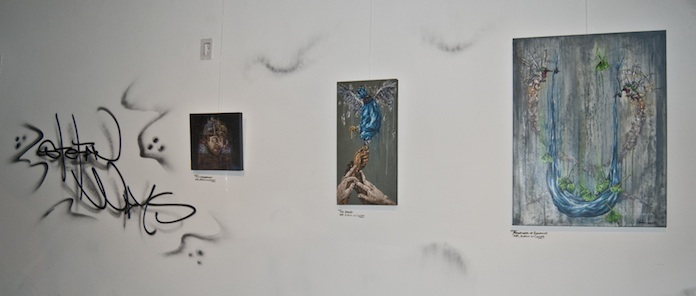
Photo by Kelly Wise
For Ways, his art has evolved over time into being less graffiti- and more environmentally based. Growing up in Baltimore County, Ways would often take the light rail into the city: “some of the graffiti along the light rail tracks inspired me to paint, and then slowly through painting over the past four years I’ve been trying to evolve my style out of a graffiti based style to a sort of fine art based street art.” Ways’ pieces in the gallery often demonstrate both his commitment to a fine arts sensibility, as in his “Losing Touch,” a variation on Michelangelo’s Creation of Adam. In Ways’ version we only see the two hands nearly touching, but while they are recognizable in their positioning, they are also cyborgs, metal and gears with the flesh dripping away.
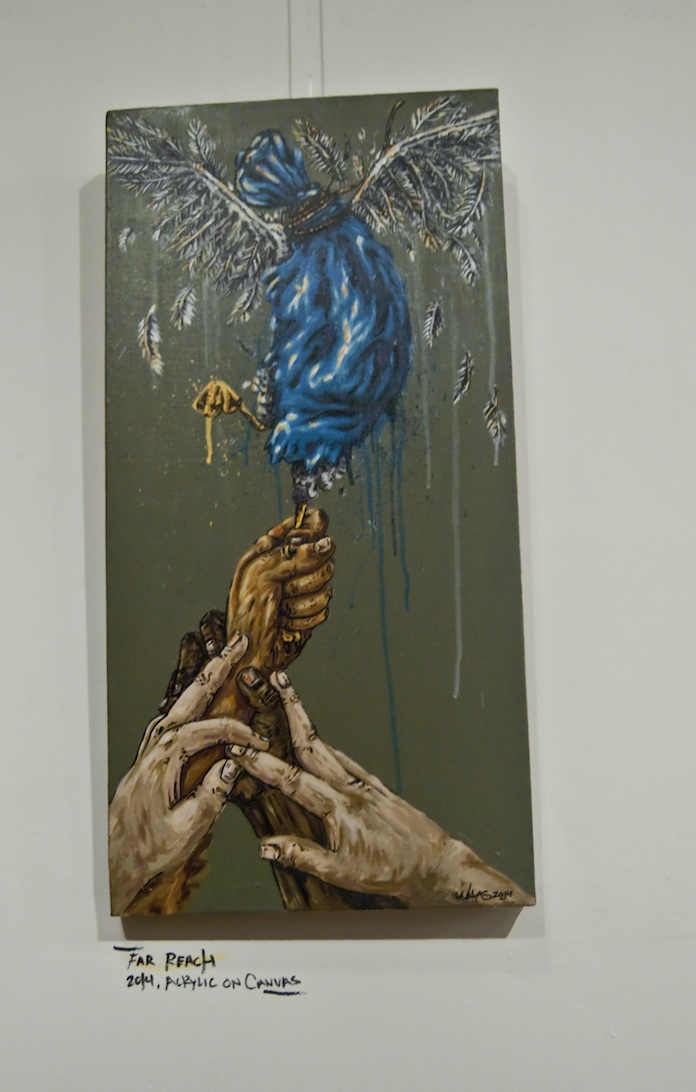
Photo by Kelly Wise
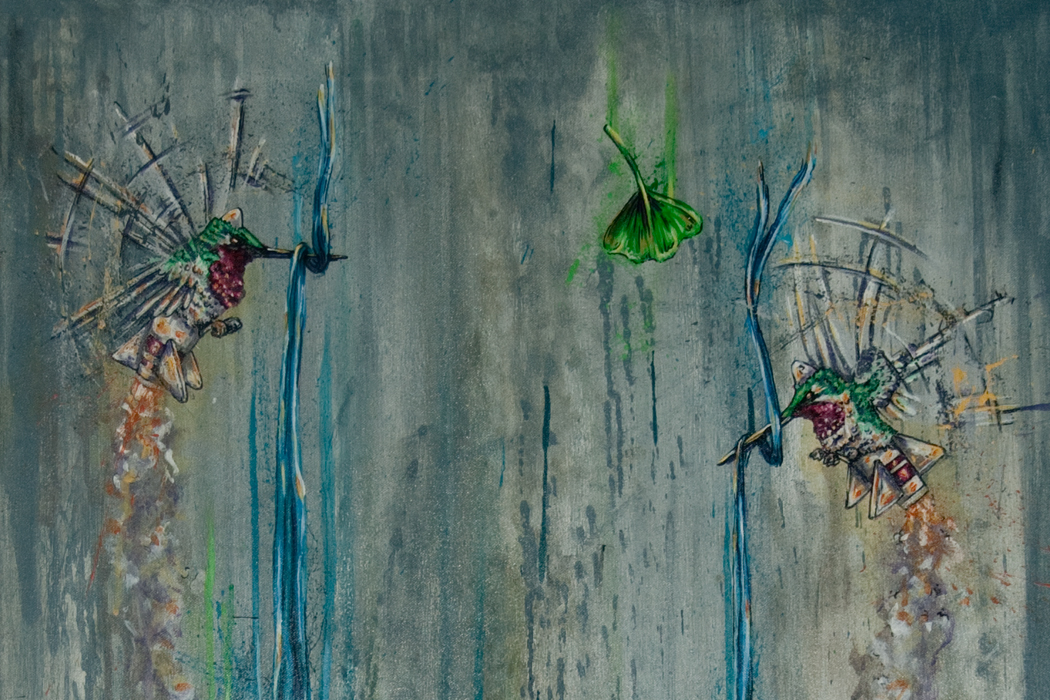
His further commitment to the environment is also apparent in pieces like “Messengers of Endurance,” where two hummingbirds with rockets in place of their rear ends struggle to hold up a sling carrying clovers and dirt. Ways sees his environmentally themed work as “sort of the struggle of nature to hang on despite man’s intervention with it.” His methods of choosing location are often dictated by environment as well: “What neighborhood it is can relate to my subject matter. When I’m figuring out a place to paint in the street a lot of buildings just kind of capture me, sometimes if it even comes down to just the color of the building.”
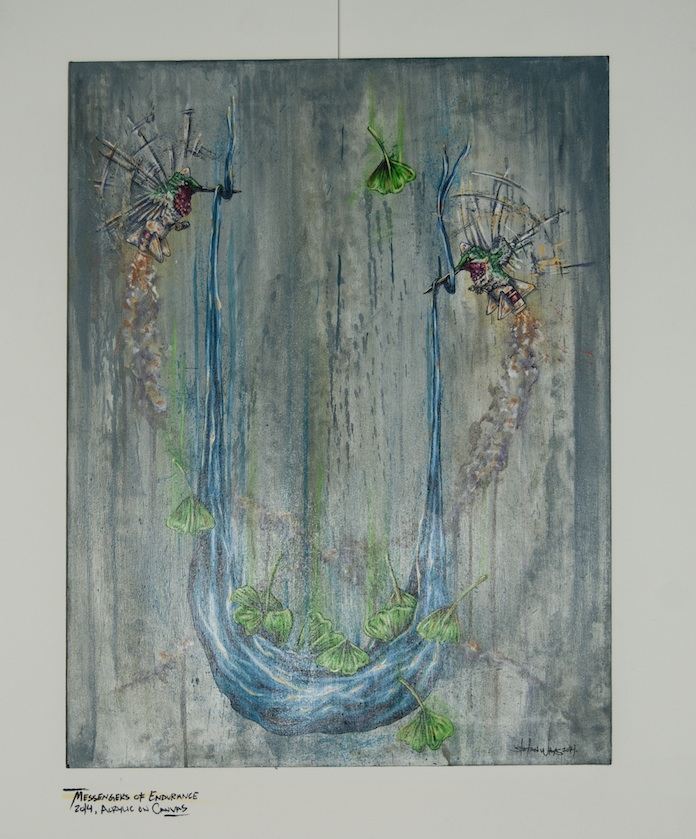
Photo by Kelly Wise
Nether and Ways are friends outside of their artistic commitments and have worked together before, most notably on the Slumlord Project, an initiative by housing activist Carol Ott to bring attention to Baltimore’s vacant housing crisis. Nether, Ways, and various other artists painted artwork on the sides of selected vacants and put up QR codes that corresponded to information about the vacants and the general problem of housing. Some of the vacants were later torn down. While the two artists do not have plans at the moment for further collaboration beyond a street version of the girl and dog mural on the gallery’s wall, Ways speaks to Baltimore’s challenges as a city without much money for the arts, and its ability to evolve two such creative, passionate artists anyway: “I guess one of the advantages in Baltimore is that it’s a thriving artists’ city somehow. There’s a lot of artists here, and the creative energy from having all those artists around.”