Cynthia Chin and C.S. Lewis analyze the exhibit Knowing, curated by Manian E. Chettle, at Area 405, on view from August 25-September 27, 405 East Oliver Street, Baltimore.
I’ve heard rumors of Poe ghosts floating around Charm City, but imagine my delight at having the opportunity to meet up with C.S. Lewis (1898-1963) at a recent art exhibit in Baltimore. One of my all-time literary heroes, Lewis is recognized for his teaching career at Oxford University and popular radio broadcasts during World War II. The author of The Chronicles of Narnia and The Screwtape Letters, he is most known for opening a powerful dialogue of faith, culture, and reason in the twentieth century. Just for you, here’s what it was like talking with CS Lewis at Area 405…
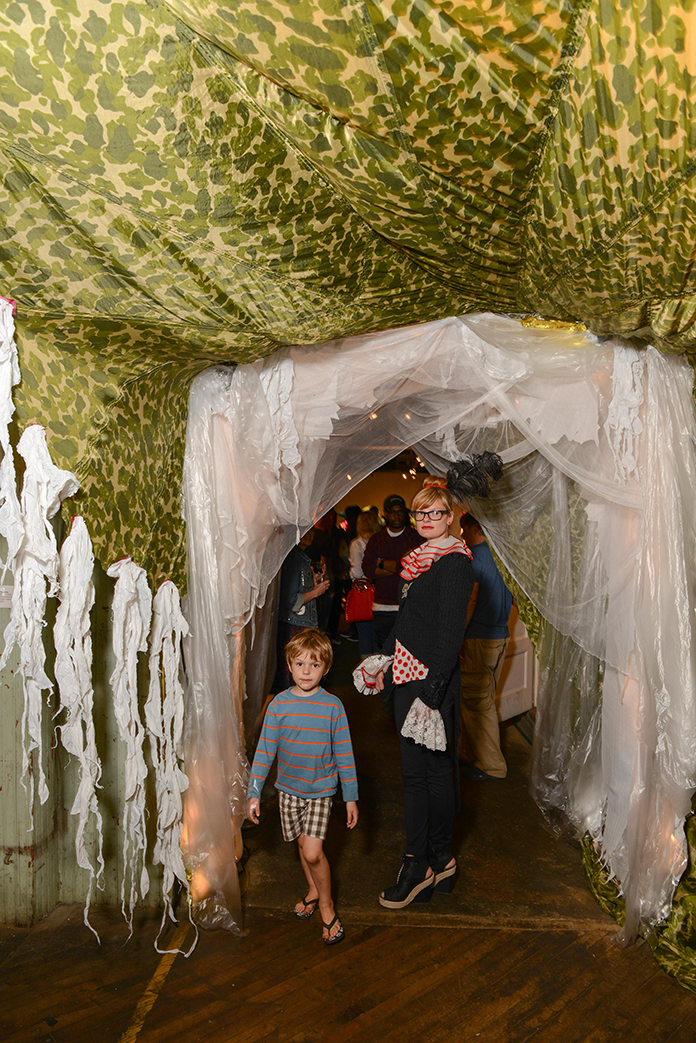
Alzaruba, Eden’s Gate, photograph by Theresa Keil
My eyes widen at the sight of him. An older gentleman with authoritative eyebrows and a tweed suit the exact umber tone of Marmite hesitantly enters the room. As he removes his fedora, his eyes seem to smile a bit as they find mine.
“Mr. Lewis, it’s so good of you to meet me here,” I say, walking toward him in a sort of surreal delight. “I can’t believe you actually came.”
My voice echoes against the brick walls of Area 405, an artist-owned warehouse and exhibition space in Baltimore.
“Well, I’ve been known to manipulate a world or two,” Mr. Lewis chuckles. He looks around. “When I heard about this exhibition’s focus on the story of Creation and the book of Genesis, I was quite keen on viewing it for myself.”
“Yes, Mr. Lewis, I asked you to come because I really respect your thoughts on creative expression. And you also had much to say about The Fall, Creation, and Paradise and that sort of thing—like in your books Mere Christianity and The Great Divorce.”
“I’ve conjured a thought or two about the subjects.”
I nod. “I personally think there’s something missing from how these pieces approach the themes but I can’t put my finger on what it is. That’s why I wanted your perspective on them—a counter-perspective, perhaps. I know that what you have to say might go against the grain a bit, but that’s the beauty of dialogue. If it’s okay with you, I’d like to walk around and talk about these works a bit.”
“Yes, yes. This is indeed well worth being interrupted from my duties as one of the Lord’s scribes. Heaven is a busy place you know. There’s quite a bit to get ready.”
Reaching into the pocket of his jacket, his eyes brighten. “Well, I’ll be.”
Extracting a cigar, he holds it between his fingers, regarding it longingly: an object from another world, an earlier time.
“You know, there aren’t any cigars in heaven, my dear,” he says, slipping it back into his pocket. Turning around, he regards the space around him as if recalibrating his body to the limitations of earth.
His eyes fix upon an entryway festooned with a large green translucent piece of silk. A light glows behind the fabric as if to simulate sunlight pouring through branches. Beneath the entryway hangs sheer white fabric. He walks toward it, and I follow.
“Ah, I believe this piece represents the famed entrance to the Garden,” he says.
“Yes, it’s called Eden’s Gate, by the artist Alzaruba.”
He slides a pair of thick, black-framed glasses over his nose, peering up at the backlit, billowing silk stretching over our heads. The entryway makes me feel small, closed in, yet somehow safe. I can almost feel the shadow of leaves patterning on my face.
“Quite delightful!” says Lewis, “I’m rather keen on entrances to other worlds.”
“And how might you approach this one?” I ask.
“It encourages a sense of wonder,” he notes, nearly touching the diaphanous silk with an admiring hand. He closes his eyes.
“One does feel quite human here. Yes, I remember certain feelings from life here on earth. Frailty. Fear. This is the entrance to an enchanted place, naturally.”
“The puffs of sheer white fabric here on this wall are redolent of bridal veils and other machinations of ideas about woman’s—and man’s—supposed purity. But as we know, the story in Genesis does take a turn when Eve eats the fruit. If this is the Garden of Eden we are entering when we approach Alzaruba’s artwork, then we know too that as we walk through this entrance, things inevitably shall change.”
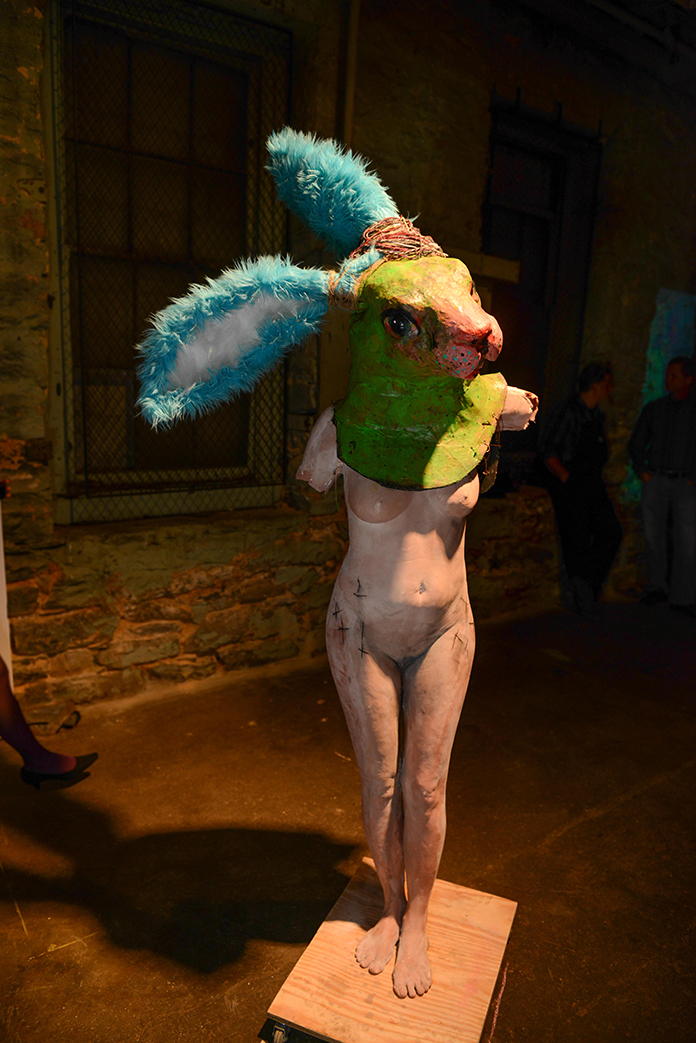
Lania D’Agostino, Chapel of Transfiguration, photograph by Theresa Keil
Lewis passes through the entrance to an open space and stands before seven nearly-life-size anthropomorphic figures with animal heads—monkeys, squirrels with feather rabbit ears, and fantastic horses—part carnival, part natural history museum diorama, part evolutionary oddity.
“What’s this particular piece called?” Lewis asks.
“Chapel of Transfiguration, by Lania D’Agostino,” I say.
He nods, eyes scanning a corpulent figure with the breasts of a woman, the genitals of a man, and the head of a monkey. Its monkey head stares—at once a part of the figure, but also suggesting a covering veil set over the figure’s head like an Egyptian funerary mask.
“Fascinating,” he murmurs.
He bends closer. “I’ve always reacted against men being reduced to trousered apes, but this does stretch the mind to consider the marvelous variety of Edenic faunae that could have roamed, and the estimation that fallen man might have interrupted this imagined race of garish beasts.”
“Or that as a result of the Fall, man was reduced to another kind of animal,” I offer.
I watch him, his mind chewing on a thought: a secret one. He does not share it. Extracting a piece of paper from my pocket, I look at the list of works I’d reviewed beforehand.

D’Agostino, Chapel of Transfiguration, photograph by Theresa Keil
“Mr. Lewis, I’d particularly like for you to see this next piece—Pennance by Jenna Boyles,” I say.
Suspended from the ceiling by a trinity of strings is a sheet-like, amorphous form. Also from the ceiling, red streamers flow downwards through a large hole in the center of the hanging and onto a sphere on the floor. Nails encircle the hanging’s center opening as well as its front and back edges. At once ghost and horror show, the work perhaps suggests menstruation. The fringe of nails conjures the unsettling intimacy of hair. The use of nails also possibly nods to Christ who was crucified with nails in his hands and feet.
As a woman I feel oddly embarrassed and exposed. I think I know what he’s about to say, but rather than pontificating about the indecency of such a graphic subject, he asks me a question.
“Do you ever worry that art is often reduced to intellectual statements?”
I’m not sure if I’m supposed to answer.
He asks another question: “What did you feel when you first looked at this piece?”
I color at the thought of discussing periods with the man who created my childhood world of fauns and sprites.
“Discomfort,” I say. It’s a kinder word than what I actually felt.
“So you viscerally reacted first.”
I nod. Mr. Lewis watches me walk away as I uneasily consult my list. I wait for him to follow me to the next piece: David Fair’s Checkerboard.
A pair of chairs sits on either side of a table, on top of which looks to be a game of checkers about to be played by imaginary participants.
Studying the familiar pattern of the checkerboard on the table, Mr. Lewis chuckles. Some squares contain a picture of an apple, while other squares are emblazoned with a serpent. What appear to be eyes cover the playing pieces.
“It’s a game of checkers, naturally, but as you see, every move is such that the player would be bound to navigate the route of the apple or the serpent,” Lewis says. “And the eyes on the playing pieces, perhaps watch menacingly to see which the players will choose.”
“It might even suggest that Adam and Eve didn’t have a choice,” I add.
Mr. Lewis nods. “Or it proposes that The Fall was perhaps God’s predestined trap.”
Lewis pauses thoughtfully. He looks tired, as if his body again grows weary of the earth. I continue to follow him as his hawkish eyes sweep over sculptures: metal totems, trees of wisdom, and a pair of legs emitting disco lights from its gartered stockings and Mary Janes.
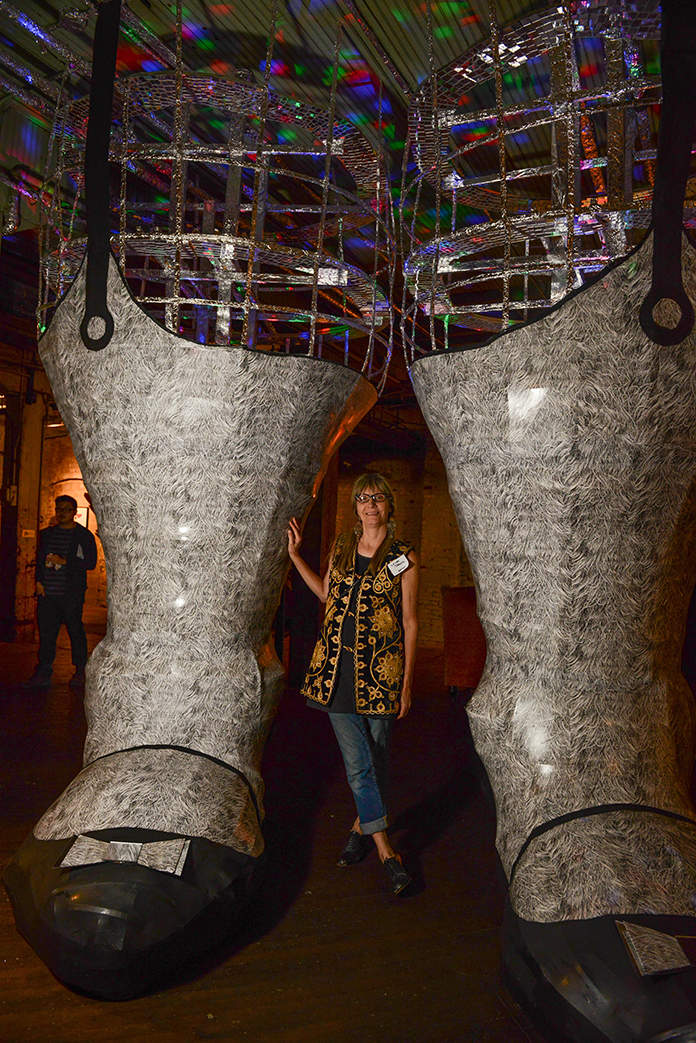
Laure Drogoul with her sculpture, Father Sky, photograph by Theresa Keil
“I wonder how much these artists relied on textual analyses of Genesis rather than the ideas culture has generated over time,” he says.
“Take the notion that the fruit Eve ate was an apple, like we saw in David Fair’s Checkerboard. Genesis never reports an apple, but somehow the apple became accepted iconography as a visual marker for the fruit of temptation in the Middle Ages. Now this is just amusing, but what would it take for a new iconography to develop in relationship to temptation? What would a new fruit be, for example?
“How do you mean?”
“These Old Testament Judeo-Christian themes are age-old and to some, antediluvian. We’ve spent several thousand years making art around them, reacting to them, and yet no artist who bothers about originality will ever be original. If you simply tell try to tell the truth—without caring twopence how often a story has been told before, mind you, you will become original without ever having noticed it.”
I pause for a moment, processing.
“You see, there’s one thing that stands out to me,” he continues, “more than the repulsion one feels from the suggestion of menstruation so rawly played out, or the notion that the Fall was some sort of divinely-appointed diversion, orchestrated at man’s expense. These artists shied away from the rest of the story.”
“In the second half of the story in Genesis, Adam and Eve were expelled from the Garden. They were separated from God. Created estranged from creator, and in a sense, art disconnected from artist. But that wasn’t the end of the story. As soon as Adam and Eve sinned, God said something to them. Do you remember what it was?”
“When they were hiding from shame, God asked them where they were, right?”
“Precisely. Even after their sin and disobedience, God pursued them. He went after them, quite sympathetically. He fashioned clothes for them to wear, knowing their humiliation. Yet he covered them and the relationship was to some degree, restored. Even the very name God gives Eve is significant. The very core of Eve’s name in Hebrew is derived from Yahweh, God’s own name. He named her after himself, as she was created in his image. So you see, my dear, there’s a treasure trove of interpretation and complexity that begs deep probing beyond the confines of cliché modern interpretation, iconographic tradition, and the fleeting visceral reactions of shock and repulsion.”
“And what’s that?” I realize that this is what he had been silently contemplating earlier.
Mr. Lewis smiles.
“To not be afraid of examining a story’s end.”
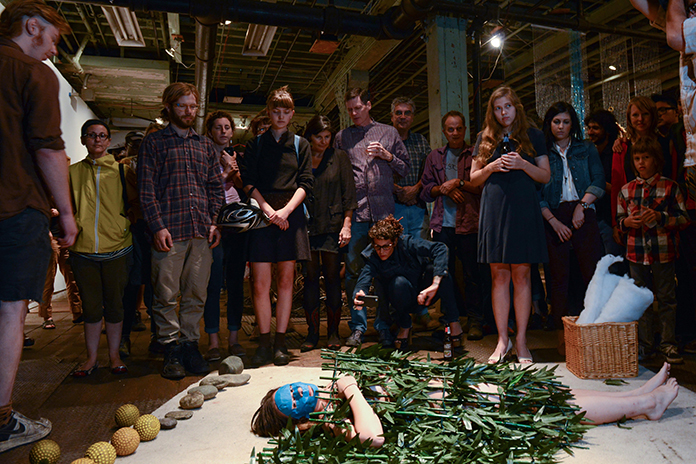
Performance by Isa Gonzalez at Knowing, September 14. The performance was titled: J Walking In The Garden (Jazzy, Josh & Julia). Photo by Theresa Keil
______
Cynthia Chin is a writer, poet, and fabric artist. Her writing has appeared in The Saranac Review, Ellipsis, The Baltimore Review, and The Slush Pile Magazine, among others. She wrote on the artist Cat Sachse for What Weekly back in July. She holds a B.A. in art history and English from Colgate University, an M.A. in writing from Johns Hopkins University, and has taught art history and material culture at a local independent school. Art Criticism in What Weekly (whatweekly.com/artcrit) is made possible with the generous support of the William G. Baker, Jr. Memorial Fund, creator of the Baker Artist Awards, www.BakerArtistAwards.org. Marcus Civin has so far edited twenty-three of these art criticism articles for What Weekly. Ben Andrew co-edited this one. Contact marcus@whatweekly.com.