Max Guy gives serious thought to an exhibition at the new Springsteen Gallery. The show is over now, but the gallery continues an ambitious program at 1511 Guilford Avenue, Unit B303, Baltimore.

Springsteen Gallery opened up a few months ago in the Copycat Building. Artists and curators Amelia Szpiech and Hunter Bradley have constructed a white-walled gallery within a considerable portion of their loft-style apartment. Springsteen resembles Baltimore’s Nudashank Gallery, located in the H&H Building on Franklin Street, with it’s semi gloss grey floors and high ceilings. A key difference is the lighting; fluorescent tube lights hang above the entire gallery at Springsteen and the window tinting at Springsteen makes it difficult to tell what time of day it is outside.
Only up from June 21 – July 6, Springsteen’s sophomore show, Metaspace, was a group exhibition featuring work by Hermonie Only, John Bohl, Justin Kelly, Michael Bussell, and Michael Koliner. Consisting of prints, paintings, and sculpture, Metaspace was described by Springsteen as “the space objects and images inhabit (currently) as well as the space in which it was produced. It also serves as a precursor to where it may go, as it only marks as an intermediary place for viewership.”

- The Panorama at Springsteen, by Max Guy
According to co-curator Hunter Bradley, the show was inspired in part by Berlin-based artist, Timur Si-Qin’s essay “Metamaterialism.” The short essay was originally published in the online publication Pool. Loosely, metamaterial refers to any artificially constructed material with physical properties not found in nature. Si-Qin’s essay is a heady read on how media informs our understanding of a work of art. Viewing a painting in a textbook, for example, prompts an entirely different conversation from viewing it in person or on a computer screen. This is an important concept for anyone thinking critically about art. No one way of seeing is more or less valid than another but brings entirely new properties to an artwork. Si-Qin attempts to explain a shift in what we define as material.
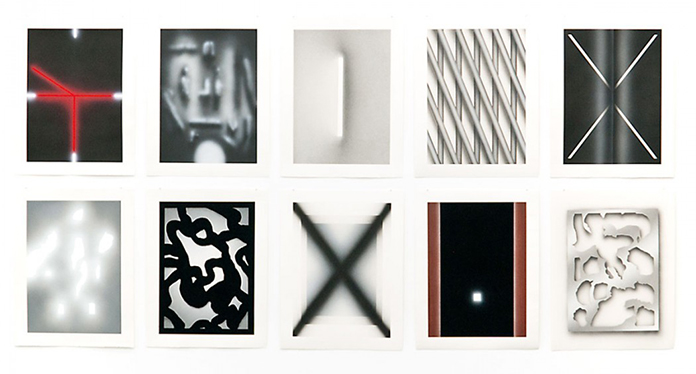
- John Bohl, Untitled, Image courtesy of Springsteen Gallery
I think of the concept of Metaspace as a meta-space, a space about space; something overarching, all-encompassing, amorphous, fluid, omnipresent, a gallery in its essence but larger, a gallery that expands out from itself in all directions. Artwork will move. It is occupying a gallery, it occupied a studio, and it might move to another gallery or home; this gallery is only an intermediate home. In Springsteen, though, I found myself struggling to find a complex metaspace, especially in such a controlled environment.
To me—with few exceptions—Metaspace at Springsteen is a survey of works that employ various trompel’oeil techniques. In the show, the dynamic between the actual object (a painting or sculpture or print) and the image (a picture, an optical illusion), is closest to the concepts in the Si-Qin essay. Michael Bussell’s prints, Still Life with Real Forms and Everything both present objects in a fashion as to propose that unusual objects in bizarre settings could be real commonplace facts. In Still Life, what looks like two pieces of coral are stacked up on top of each other with an incredibly sharp object floating closely behind them, like a ghost. This is the first still life that I can think of where the scale of the room and the scale of the objects occupying it are difficult to discern.
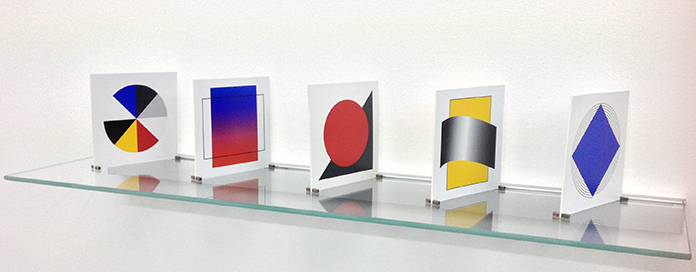
- Hermonie Only, Come Again, Photograph by Max Guy
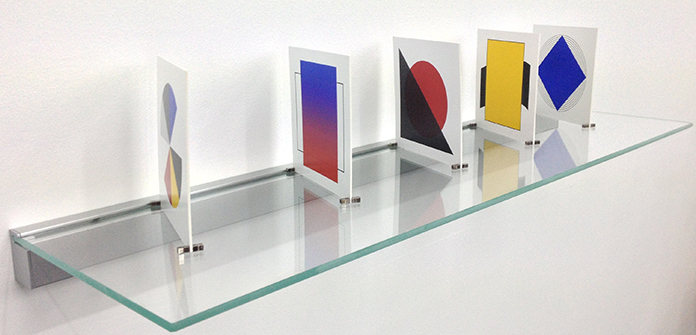
- Hermonie Only, Come Again, Photograph by Max Guy
Hermonie Only’s sculptural drawing, Come Again displays five cards, approximately four square inches each, on a glass shelf. The bottom corners of the cards are propped-up by small silver magnets so that they are freestanding. Images reminiscent of logos and statistical diagrams are printed on either side of each card in opaque primary colors or in grayscale. Often two shapes overlap so that a blue diamond, for example, is printed over concentric circles. On the back of that card then, the concentric circles would be printed over the blue diamond, the reverse of the image on the front. Or, a vertically oriented rectangle with a blue-and-red gradient lays over a line drawing of a horizontal rectangle on the front. And, on the back, the same horizontal rectangle floats over the blue-and-red gradient. If these images were presented in some other fashion, side-by-side perhaps, they would still be two halves of the same whole, two sides of the same object. The alternating patterning here creates a two-sided material reality; drawing on paper evokes a dimensional form.
Thinking about Come Again opens my mind to a broader understanding of images in general. Within the context of Metaspace, I at first misread Only’s work as failed trompe l’oeil. It was the warping of the cards, breaking the trompe l’oeil that first made me recognize the work instead as ideogrammatic—the images not actually being “front” or “behind” but being signifiers of “front” and “behind”. This signification speaks to the semantic shift described in Metamaterialism, how objects and images morph and change depending on their context.
Part of the discussion of metamaterial, metaspace, metaphysicality ought to be in metacognition, an awareness of awareness. I know the artists in this show. So, when I see the work of John Bohl, I have a background knowledge of his work and it’s diaspora. I understand Bohl’s paintings have an extensive post-studio life, especially when he posts them on his tumblr and they are shared and shared and shared.
In Metaspace, John Bohl presented Untitled, a series of 10 primarily dichromatic paintings on paper arranged in two rows of five. Each painting is 16 by 20 inches with a one-and-a-half inch border. Bohl is able to create amazing illusions of depth and light by combining the flatness of gouache with the atomized quality of airbrushed acrylic paint. The images resemble creased sheets of paper, metal patinas, light at the end of a pitch-black tunnel or blurry vision. The renderings are so precisely executed that one might confuse them with a print of some sort. To me Bohl’s paintings are about the relation between an illusion, its material components, and its composition.
A major strength in Bohl’s work is its craft, but more so, strength is in his recognition that no one has to rely on mechanical reproduction to distribute artwork any longer. The reason that the medium remains ambiguous in the physical form of the work (is this a print or what?) is because it doesn’t really matter. Once online, the images are presented to us again and again, we can make them personal, we have all the time in the world to identify with them. As a JPEG, GIF, etc., we all know we can modify any image to conform with our own ideals.
Some works in Metaspace read as the exact opposite of a metamaterial or metaspace. In his piece Ignore the Cans, for example, Michael Koliner has framed a brick of compressed beer and soda cans with steel bar. The sculpture is propped up by a piece of rectangular styrofoam, a quasi-pedestal giving the sculpture an almost 35-degree lean. I spoke to Koliner about his work. The brick of cans Koliner found at a local scrapyard. Koliner said: “[it] had an intense material presence, and I just wanted to deal with one unit of it… to bind it, make it an almost-perfect fact.” In this sense, Koliner’s sculpture is more about the quantification of material in a physical manner.
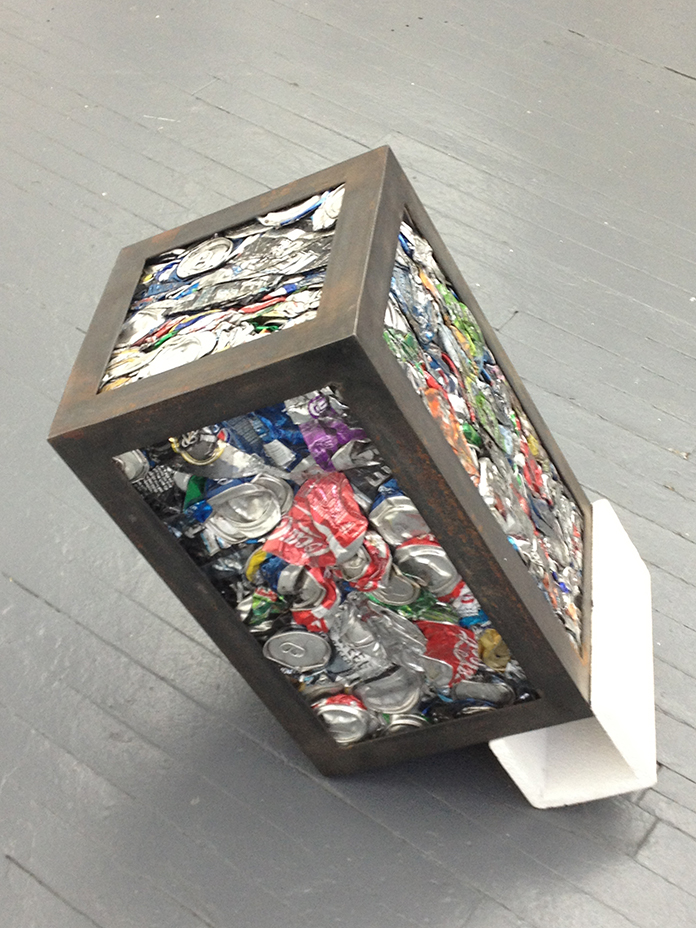
- Michael Koliner, Ignore the Cans, Photograph by Max Guy
Justin Kelly created a preliminary digital drawing for Bust #1, fleshtones, lime green, blues, and bronzes composed to look like an abstracted, headless sculpture bust. When looking at Bust #1, I have no doubt that the form created on paper could exist as a physical three-dimensional object. The display however draws more attention to the printed paper as an object, hung along metal cable by two clips. The cable is suspended by two mounts on the wall, with the clips hung loosely, leaving the print to buckle and create a convex three-dimensional form.
Ultimately, Metaspace fails to delve deeply into the concept of metamaterialism. The objects displayed—as beautiful as they are—do not introduce new physical properties or dynamics but replicate pre-existing ones. Using the prefix meta-, which refers to something beyond, seems strange in a show that is so rooted in material. The show is seemingly more about illusionism, image play, the material facts of certain media, or approaches to art making than it is about a metaphysical concept of space.
Metaspace was an exhibition about artwork exceeding its life within an exhibition, within the confines of its materiality. I understand that, but I don’t think the presentation contextualized the work as such. Few gallery exhibitions reveal artists in full depth, but rather they are part of a situation in which artists’ work is placed. My critique of Metaspace is how it failed to deliver on its framing statement. The curators seemed to assume that the audience understood the work of the artists, and how it does or does not already exist inside and outside the gallery. In particular it was assumed that we are all aware of these artists’ particular presence today, or how their work transcends material presence.
_______
First Image: Justin Kelly, Bust #1, Image courtesy of Springsteen gallery
Max Guy is an artist and curator living in Baltimore, Maryland. He has exhibited locally as well as in New York and Chicago. He is co-founder of Spiral Cinema, which organizes public programming including film screenings, lectures, and panels, and he is a collective member of Open Space Gallery, previously located in the Remington neighborhood in Baltimore. In February, Guy wrote The Baltimore House Gallery Phenomenon for What Weekly.
Art Criticism in What Weekly (whatweekly.com/artcrit) is made possible with the generous support of the William G. Baker, Jr. Memorial Fund, creator of the Baker Artist Awards, www.BakerArtistAwards.org. Marcus Civin edits these art criticism articles. For more information, please contact marcus@whatweekly.com.