by Zvezdana Stojmirovic
Colette Fu, We are Tiger Dragon People, Curated by Susan Isaacs
Towson University, Center for the Arts
Asian Arts Gallery, Asian Arts & Culture Center
February 7 – March 16, 2013
I recently stopped by Towson University’s Asian Arts Gallery to check out We are Tiger Dragon People, an exhibition by Philadelphia-based artist Colette Fu. Fu explores her Chinese heritage in a series of photographic pop-up books, a display of artifacts, and a few photographic wall panels. The work centers on the Yunnan Province, a southwestern region of China bordering Vietnam, Laos, Burma, and Tibet, home to over twenty-five ethnic minorities rich with diverse traditions. Fu’s great-grandfather was the provincial governor of the area during World War II. Supported by a Fulbright fellowship and driven by the call of her ancestral roots, Fu spent 2008 photographing in Yunnan Province.
The result is sixteen books that probe deep into immigrant notions of identity. Each extraordinary pop-up depicts a colorful custom—a wedding, a harvest feast or other traditional gathering. Enlarged photo-details, such as a girl’s face or ornaments on a dress, jut out above a background that sets the scene. This layering creates active spatial relationships: vivid close-ups leap off the page; it’s us against them, culture against culture, the past versus the future. Suspended above their setting, these close-ups break through the gloss of digital media with questions such as: Who speaks here? What power relations drive this cultural encounter?
Walking an identity tightrope, Fu plays both the parts, the viewer and the viewed. Engaging her own Yunnan heritage, Fu aligns herself with her subjects, but at the same time she acts as the “Westerner” recording the “other”.

Yao Bride, Colette Fu, Courtesy of the artist and Towson Asian Arts & Culture Center
Fu’s work invokes the photomontages of John Heartfield, the early Twentieth-Century German artist who used art as a political tool, combining disparate elements to communicate powerful messages. Although not nearly as overt, Fu boldly constructs visual statements by combining parts of photographs. At the same time, the American anthropologist Margaret Mead could have had a hand in an exhibition like this one. We are Tiger Dragon People uses “museological” exhibition labels that create an educational context around Fu’s books by describing each custom in an objective voice. Neither blatantly political nor scientifically disinterested, these pop-ups are a hybrid: part fine art, part photo-journalism, and part anthropology. Through their dimensionality, they simultaneously question and reassert the very idea of a book as authoritative source of knowledge.
In 1908, the Viennese architect Adolf Loos, decried ornamentation as the purvey of the unenlightened exploited person of the past. (See Loos’ infamous Ornament and Crime.) Modern man, Loos believed, despised ornament as superfluous, wasted labor. He preferred his things to be purely functional. Even Loos however, made an exception for ornament made in innocence, ornament that “constitutes the joy of [his] fellow man”. Fu’s exhibition celebrates the Yunnan ornament through photography as well as through the artifacts on display. Stitch by careful stitch, the artifacts question mass production and globalization and all of the related entangled power relations. If measured using a Western system of value, the carefully embroidered everyday artifacts could be considered expensive luxury items, and their makers would then likely not be able to afford them. But these objects exist outside of the Western value system, defying global mass production, even as it circles back to China.
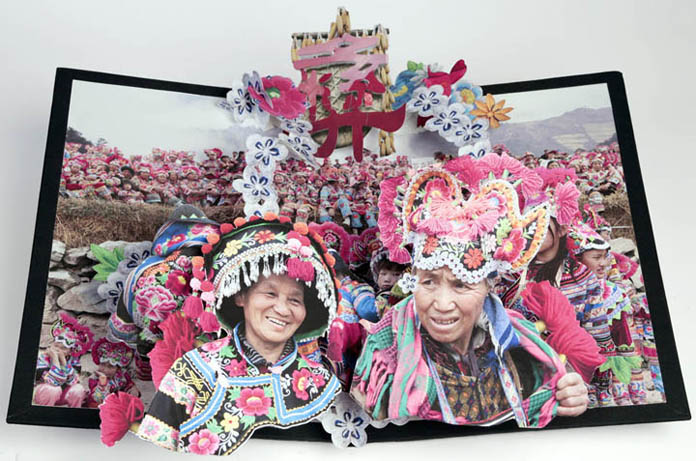
Yi Costume Festival, Colette Fu, Courtesy of the artist and Towson Asian Arts & Culture Center
I’m most impressed by the formal decision making behind the pop-ups. They are small enough to seem intimate, but large enough to be panoramic. There is a thoughtful play of scale and color. Flurries of bright accents—magentas, cyans, and reds— are dispersed around neutral backgrounds creating a seductive cacophony of color. Drawn in by the color, I find myself taken slightly aback by details that challenge my assumptions of beauty: creased skin, missing teeth and heads wrapped in sacks. This dynamic push and pull embedded in the dimensionality of the pop-ups is missing from the flat photo-panels, which seem a bit redundant.
Fu’s work is deeply personal. I wonder, what will Fu embark on next? If immersed in a culture wholly different from her own, would she apply the same fervor and passion? An inquiry into identity led Fu to Yunnan. This work is a journey to understand her own self, the migratory flights that have landed her in America, and the constructions of race and ethnicity that continue to define us, despite the passage of time.
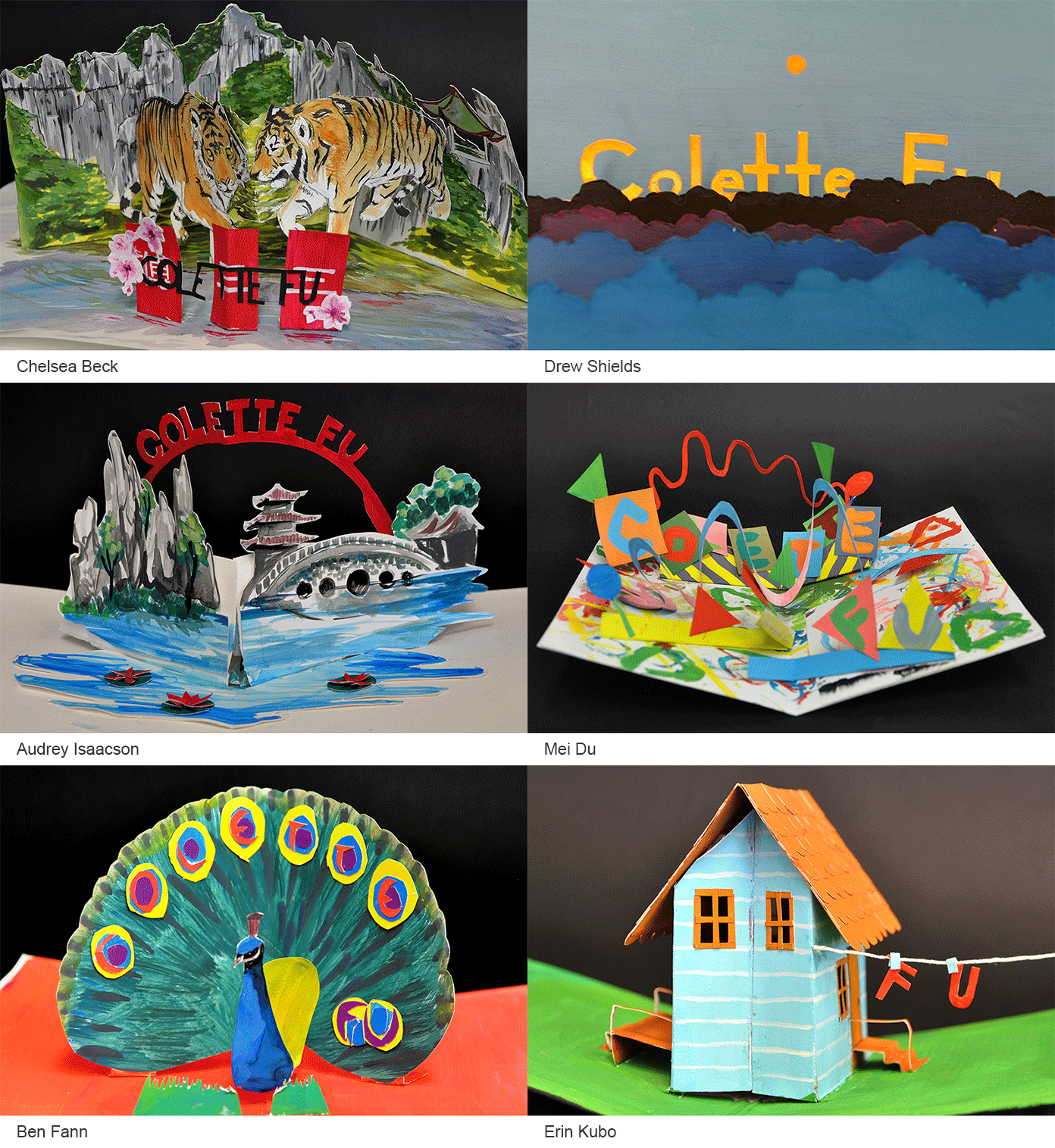
A Professor of Graphic Design at Maryland Institute College of Art (MICA), Zvezdana Stojmirovic teaches a Foundation course called Elements of Visual Thinking. Right now, the students are studying color. Stojmirovic and her students looked at how Colette Fu sprinkles bright saturated colors over neutral backgrounds. They also talked about representations of culture. This class group includes many students with Asian heritage. Strojmirovic asked all of the students to create pop-ups using Fu’s name. Here are some results, compiled into an animated GIF. Artists: Erin Kubo, Ben Fann, Mei Du, Audrey Isaacson, Drew Shields, and Chelsea Beck. Stojmirovic’s first book, Participate (2011), studies the role of participatory culture in her field. Her second book, a work-in-progress, is about interdisciplinary graphic design. She thinks that design and art are inseparable and exhibits her work internationally.