Mobtown Playwright’s Group
Brick and Mortar
Interview by Peter Davis
Photographs by Jack Sossman
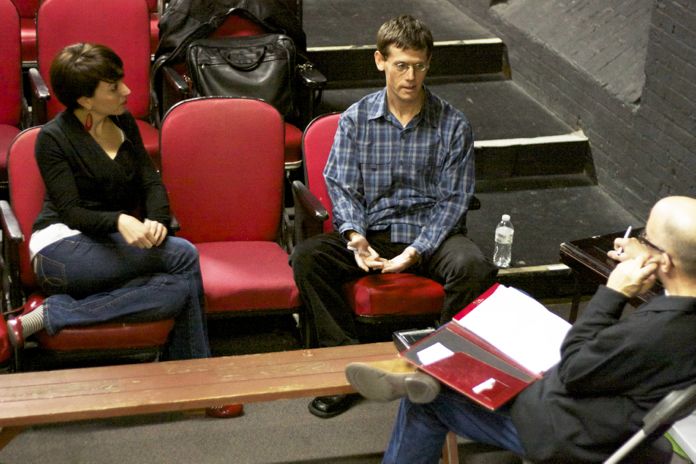
Mobtown Playwright’s Group (MPG) is led by Brent Englar. MPG is part of The Mobtown Players, a local theater led by Artistic Director, Melissa O’Brien. A few years ago Melissa invited Brent to revive the Playwright’s Group. He’s work shopped 3 new plays a year since. And The Mobtown Players have produced 1 of those 3 plays each year. Brent and Melissa are working together, as we speak, on the 3rd main stage season play written by Brent called The Apple Don’t Fall. Brent is directing his play, too. Brent is my hero.
Interviewed:
Brent Englar, Producer
– Mobtown Playwright’s Group (MPG)
Melissa O’Brien, President
– The Mobtown Players
Peter
Why start a new play development program?
Brent
We didn’t start a new effort we refocused it.
Melissa
When I first took a leadership role at Mobtown one of the things that struck me was how MPG was treated. I thought about how maybe we should treat it. Then, it was focused on full productions of new plays… some which I thought weren’t necessarily ready for that. I wanted to offer something for a playwright who was ready to put it in front of people but maybe not ready for the whole she-bang, could have an opportunity to have an audience, a safe environment, and get some feed back. Find out what’s working for the audience and what might not be. By chance I met Brent when we were working (a day job) together and started talking to him about it. I found out he was a playwright. And soon I pestered him to take it over.

Brent
I basically approached you. Said I’m happy to throw my hat in the ring.
Melissa
I was thrilled. And he’s turned the playwrights program into more than I dreamed it could be.
Peter
What makes it such a good fit for Mobtown?
Melissa
I wanted to bring the community aspect into it. I wanted Mobtown to be part of the community. The people who come to see plays but don’t think they could be involved in the process…I want them to be a part of the arts process. Plays we’ve premiered have been produced elsewhere. Our patrons can be a part of that process.
Peter
How does your program work? Or, what makes your program different?
Brent
The amount of time the playwright has to develop the script. We rehearsed your play (Girdle Bound), Peter, once a week for 7 or 8 weeks! It was a great experience.
Peter
It was awesome and fruitful.
Brent
So, you get considerable rehearsal as well as 4 performances over 2 weekends to get feedback and get a chance to revise. Then hear the revisions in front of an audience. And continue to revise if desired.
Playwrights rarely get to see their work on its feet. When you’re writing in your room it sounds very different than when it’s alive on a stage. You see and you hear what actors bring to it. How an audience deals with it. Whether it’s in a reading or a production, how do you give playwrights opportunities to hear their work come alive? To you’re your work performed by people who have rehearsed, and who are committed. I ask an actor for 4 performances they know if they say yes, it’s a commitment. 4 performances you expect to rehearse. An actor going to a reading, maybe you get the script before and show up the day off a little before you read.
It’s nice to provide that longer process to playwrights. And as an additional bonus, one of these shows gets a full production. The two we’ve mounted so far have been wonderful productions.

Peter
What do you look for in a script as you decide whether to give it your process?
Brent
I like theatricality. The play you submitted is set in a very limited world, an apartment, but in that world, you have characters dancing, music comes in, a character she’s in a bathtub, she steps out, maybe she’s naked, maybe she isn’t, that’s all very theatrical. In Fool’s Call It Fate by Jessica McHugh a character named No One is masked. One of the plays we read earlier this season, something relatively straight forward, realism. Towards the end of it there’s a flashback where a character is painting his house—and how do you do this onstage—having a conversation with another character, and as he’s painting the floor, the other character is taking apart the set and the floor has become the inner harbor as he’s painting the floor blue. I love that! That’s theater in its purest form.
Does the play have characters I connect with? Does it have a plot that interests me? And, understand I’m not the only person making decisions.
Peter
You work shop 3 plays in a year. It’s a season, actually. How do you decide which one to produce?
Melissa
We talk as a board about it. We talk about the progress a script has made, the response it got from the audience.
Brent
We talk about how doable it is.
Peter
Where is Mobtown Playwright’s Group in 5 years?
Brent
What I struggle with and would like to get traction on, and everyone struggles with this, is how do you get more people to see it? How do you get people to want to come see a reading? And more than that, the ideal situation is that people see it multiple times. That’s why, if you buy a $10 ticket to a reading, you can attend all 4 performances, or one each weekend, and see how the play has evolved. In theory, that’s a valuable thing, to see a play evolve over time. In reality, how many people are going to take us up on that?
How can we make them more interested would be wonderful. I’d love for audiences to also consist of people who have no connection to the show. People who are, “Oh good, workshops of new plays, I want to see these.”
Peter
What the story behind The Apple Don’t Fall (currently in rehearsal)?
Brent
I felt it was the right time for me to direct a play of my own. I’ve directed a lot of these readings and directed some of my shorter plays (for the DC Fringe). I’ve felt ready to direct a more ambitious piece. Mobtown was the natural venue for me. I submitted it and tried to write my best proposal, and we talked about it. It was part of their board decision-making process.
Peter
Why direct your own piece? And what’s it like directing your own piece?
Brent
It depends on how good the process is. I’ve been thrilled with this process. (We were joking earlier that) if you cast Chris Kysztofiak and Melissa O’Brien then you’re 80% there. The larger truth is if you cast good people it’s so much easier to direct when you’re not trying to figure out how I get them to give a coherent and interesting performance. You can focus on details, and in those let the actor play a bit and when possible turn it into something that’s real and believable and funny.
Melissa
Chris and I were talking Monday about how that interaction between our characters has become so natural and so conversational. That’s a testament to the writing, too.
Peter
It starts there.
Melissa
We have this luxury that we’re working with a group of people that works really well together. Some of us have worked together many times before. Some are new to our process. I love it when it clicks.
Peter
Brent, when directing your own play, how do you decide whether to go with your original vision or surrender to the actor’s intuition about a character or a moment?
Brent
It’s easy because I trust all these actors. I’m writing it in my room. It’s easy, for instance, to write some physical altercation on the page, but if the actors aren’t comfortable doing it, my vision doesn’t matter. Let’s find a solution that works and makes everybody comfortable. Honestly, I usually don’t think in grand visions, anyway. I tend to think, both as a writer and director, what is happening in this moment? That’s a good way to think…at least for me.
Peter
Melissa, what makes Mobtown unique in Baltimore?
Melissa
We’re still working on answering that question for ourselves. I’ve been working with the Mobtown board for 4 years now. We’re still in this transitional period. We started (together) with this focus on classics and new works, or presenting classics in new ways.
When I came in they were doing more recent and safe-bet things. I’d like to get back to classics and new work, what we’re doing this season. I think there’s value in that, in finding new approaches and figuring out why classics are classic.

Peter
Speak to that a bit more.
Melissa
Why are we still reading Shakespeare’s Hamlet? Why do we still care about that? Why do we care about why Medea kills her children? We have this opportunity to explore the human experience. No matter what’s happening around us or what technology is coming, it’s the same. We’re all having the same experiences over and over again. That’s why I don’t care for adding too much concept to a production of a classic—like Hamlet in outer space!—if it over shadows why something is a classic.
Brent
I don’t want to sound like I’m trivializing what makes us unique, but, we have a space like this! Space is a huge problem for theaters in Baltimore.
Peter
It is the problem.
Brent
In any city. We’ve been talking a lot because of what happened to Load of Fun (it closed displacing Glass Mind and Single Carrot theaters and many other artists). Where do these people go? Some are still not sure if they can fulfill the rest of their season. If they have to spend all of their energy finding a space, securing it, converting it to their vision…all that energy isn’t going into their show. It’s an incredible luxury to know I can come here every day and I have a really big stage, a lot of seats, a guy doing the lights, a rehearsal room, a place to store lights, costumes and props…it’s an incredible luxury. I’ve seen more consistently good stuff at Mobtown than most any other place. I think the main reason for that is because almost all the creative energy can go into the show.
Peter
You’ve created an ideal situation to exercise your passions.
Brent
I think I’m good at this. I really enjoy reading a script, and taking about what makes it work and what doesn’t work…and thinking about those things. If I’d been born 50 years ago my job would have been to be a theater or film critic for a newspaper. I would get paid to do that. You can’t earn a living doing that now. But, I love it and if I see a movie or I see a play I want to talk about it. What I liked about it. And what I didn’t like about it. It’s hard to do that with people, I think, because people have a tendency to attach personal judgments to criticism. And take criticism personally. I’ve had to train myself productive ways to have these conversations, so that people want to have them with me. Why makes it good? What makes it bad? Those questions fascinate me. Mobtown Playwrights Group gives me a chance to exercise that with a playwright, a cast, and an audience who want to have that conversation.

* * *
I’m a MPG alumni. Working with Brent was cool. He’s well read, writes plays, and knows theater. He asks big artistic questions and offers strong opinions. While in the moment I might not have agreed with one or two, in the end, I followed every suggestion. I ended up with a much better play for it. I co-produced that play Breadwinners last spring with Mara Neimanis at In Flight Theater studio.
Brent’s process works. Both past-produced MPG playwrights have had their plays produced elsewhere. Do you have a play that’s ready to move? Is it theatrical? Send it to Brent at — info@mobtownplayers.com