Chrysalis runs through September 10 at Subbasement Artist Studios, 118 N Howard Street.

It takes two separate elevator rides to reach Subbasement Artist Studios. It’s a cavernous space below an apartment complex on Howard Street. In the current exhibition, Chrysalis, featuring 10 emerging artists, only two of the works come close to dominating this space: on the floor, a 54×21″ installation of soil by Jackie Cadiente, and on the gallery wall, an 168″ wide scroll with a sumi ink landscape by Yumi Hogan. Despite their size, these and the other works featured in Chrysalis encourage and reward the viewer for closer study. 
 Hogan’s ‘Untitled 50’ is the most dramatic example of this. From the gallery’s entrance, it reads as an abstract work in sumi ink, full of expressive motion and rhythm. Each step closer to the scroll brings revelations as the abstract splashes transform into hillsides and valleys, pools of light and dark ink reveal fences and buildings. Hogan, who teaches sumi painting at MICA and drawing at Anne Arundel Community College, uses traditional Korean media to create Maryland-inspired landscapes. Born in Korea and having lived in the US for the last 30 years, she sees many connections and similarities between these places, which she interprets in her work. “Korea is similar to Maryland,” said Hogan, “same size, same seasons, same connection to the water.”
  Cadiente’s work also reflects nature and the seasons and often incorporates natural materials, such as earth, wood and leaves. Both her Nest and Untitled works include moths entranced by a light source, a plaster orb in the former and wooden box in the latter. Cadiente’s moths are crafted out of dried leaves, resulting in a representation that deftly conveys the fragility of the actual insects and their brief lives.
Because the works are exhibited without labels, Cadiente’s installation of a block of soil was a mystery that seemed to take on particular humor because it was displayed, after all, in a sub-basement where, without the intervention of man, the entire space had every right to be dirt. Following this line of thinking, the block of soil was far less ridiculous than a gathering of people drinking wine underground. I point this out not to make light of Cadiente’s work, which I enjoyed, but to draw attention to the role an art gallery and its trappings play in how we approach things. Elsewhere, a block of dirt, no matter how intentional looking, might just be passed by or even scooped up for other purposes, like so many pounds of sand recently deposited in the city to make sandbags to shore up against Hurricane Irene. Similarly, without the context provided by an object label, a viewer approaches each work both unencumbered and unassisted, a blessing and a curse. The title of this work, by the way: Here Lies Puer Aeternus (Peter Pan). 

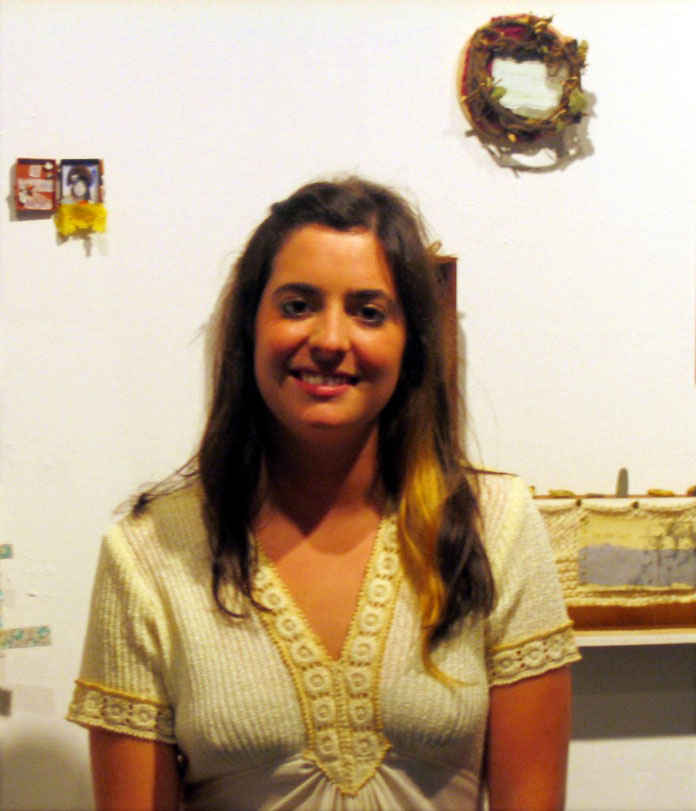 Artists like Marcella Volini and Christi Harris also combined traditional art media with unique materials, though instead of natural objects, their works incorporated more personal or domestic materials. Harris uses oil paints, fabric and trim to create amazing likenesses of cakes and icing that are a step beyond trompe l’oeil in that they trick the mouth as well as the eye. The fabric and trim not only improve the 3D effect of her works, but, as a material they strengthen the connection her work makes to feminine, domestic activities. Volini’s installation and art journal both make clear that she’s an artist who embraces mixed media to its fullest, using everything from ephemera to knitting to trash-picked easels to make her work. A senior at MICA, Volini said she was “overwhelmed with inspiration” while spending her junior year in Florence and the multi-piece installation came mostly out of “stream of consciousness, a impulse to not hold anything back.” The resulting work is extremely tactile and personal, but not in a way that excludes viewers or leads you to feel voyeuristic. Instead, in her exploration, her joy and her heartbreak, Volini shares something of herself that many can relate to.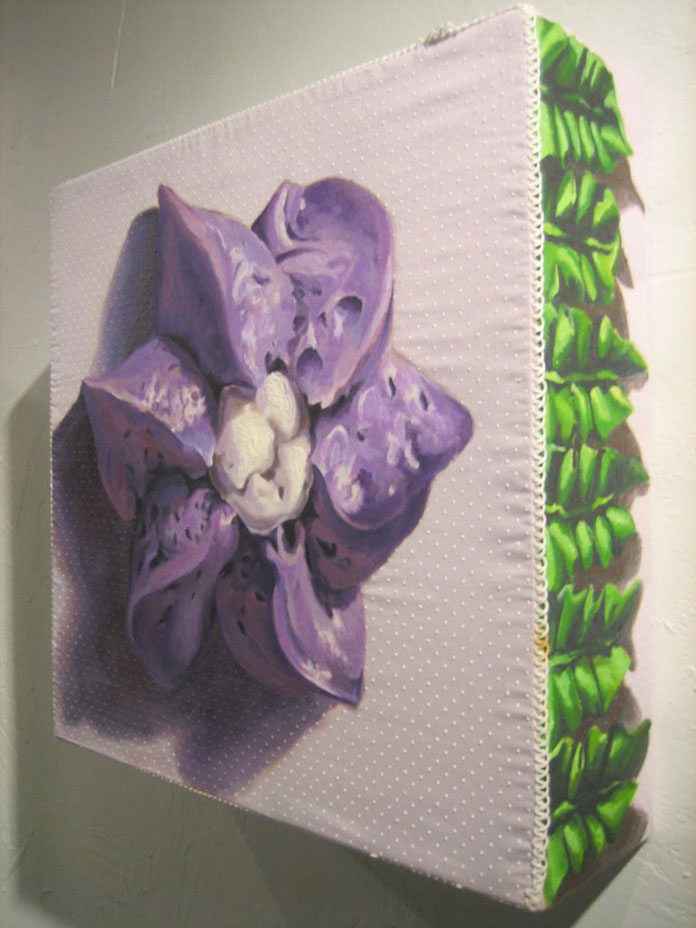

 Other works in the exhibition are less about sharing and more about studying. Both Minku Kim and Theo Willis have series on display; Kim’s oil paintings contemplate the same church steeple from the same angle in a variety of color schemes and conditions, while Willis explores the canvas itself, both as a surface through repeat applications of a paint and as a medium in itself, cutting the canvas and layering it or rolling it into bundles. In both instances, these are insightful explorations and invite viewers to go through these exercises as well, learning alongside the artist about their subjects and materials.