
Meditations on the Landscape of Desire by Sofia Silva and Practice by Lu Zhang, the two shows that opened simultaneously this week at C. Grimaldis Gallery on Charles street, share a certain almost modernist austerity, and yet their purposes and outcomes are completely different from, if not entirely opposed to, each other.
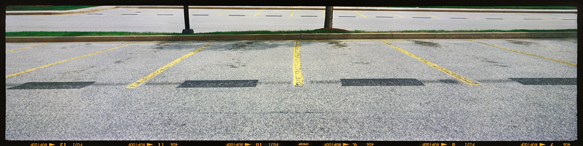
Silva’s large, formal photographs fill the first room. Stretching along the wall beside the door are a series of long, narrow, wide angled images that highlight the sometimes bizarre geometry of our every day environments. The first one of these is perhaps the most powerful. It is a long-view of the chain-linked windows of a parking garage. Through these windows you can see another parking garage, and through it’s windows, trees on the close-up end of the picture. On the other end it recedes in a seemingly infinite line of shrinking concrete pillars. The perspective is strange and hard to figure out. Above all it is lonesome. In all these respects, Silva’s wide angled photographs resemble the classically uncanny plazas Giorgio DeChirico painted at the turn of the twentieth century.


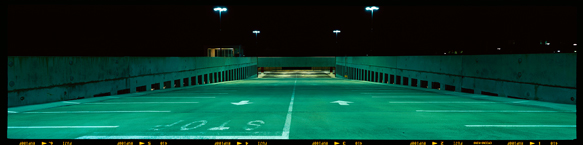
These are the works Silva is known for, and there are several wrapping around the Grimaldis’ walls: one of vinyl siding; a suburban view shot through a lattice-work fence; a nocturnal parking garage whose green lighting and rigid parking grid causes it to look like a submarine football field; the rain-shimmered top floor of yet another garage.
Each of these meticulous images seeks, it seems, to show us the surfaces and the perspectives that compose so much of our lives. IN other words, it seems as if Silva wants to reveal the interior of the spaces we live in by reducing them to surfaces.
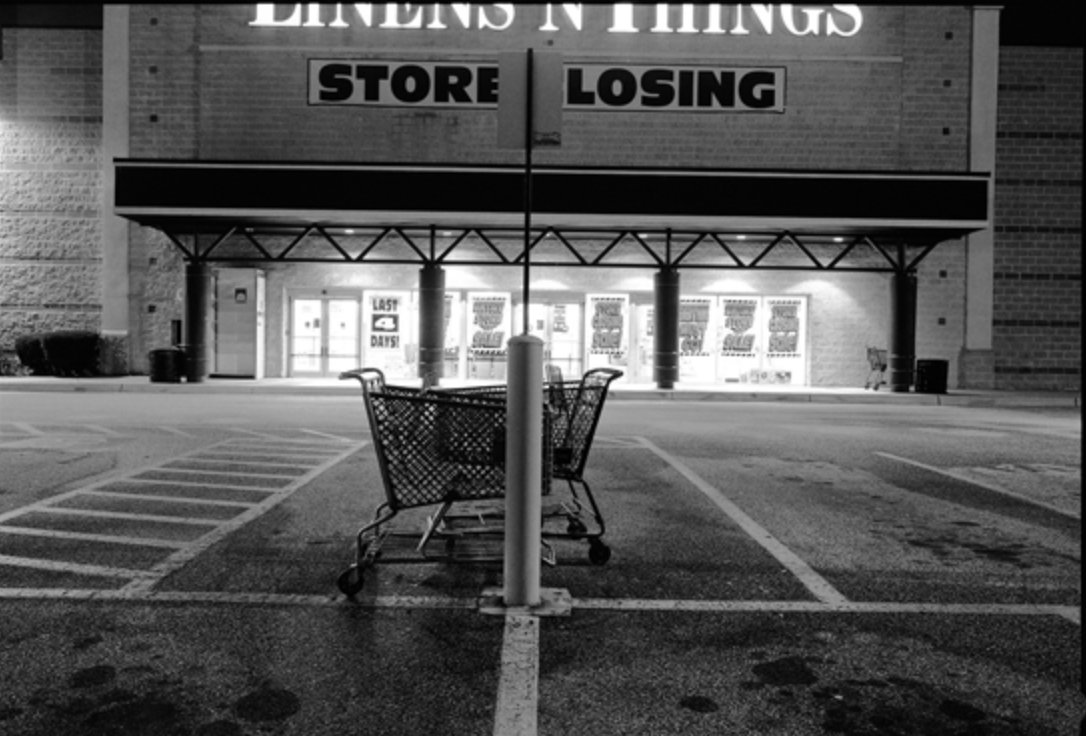
There is also another type of photograph Silva is displaying at Grimaldis. One wall is covered with several larger (that is taller, not necessarily wider) nocturnal black and white photographs of suburban spaces. Here it is not the perspective that makes them spooky, but the night itself. One depicts a Linens N Things store shot from the parking lot. IN the foreground two derelict shopping cars rest, crossing one another and blocking out the letter ‘C’ on the “Store Closing” sign so that it reads “Store Losing.” There’s the drive thru window of a closed bank, a townhouse courtyard, and another empty parking lot. Each of the images is still marked with a time stamp and the Kodak logo from the edges of the negative.
Eventually, it struck me that these could be like the great crime photographer Weegee’s nocturnal portraits of dead bodies; only the crime scene is our current recession. These are the kind of cookie cutter homes and banks that killed the economy.

In the back gallery, Lu Zhang’s works in wood, paper, mirror, and metal, at first seem like they are also interested in pushing us to see reality by focusing on the surface. Instead, she entirely subverts our expectations. These strange and beautiful pieces are in fact playful reflections on the notion of surface and depth, foreground and background, signal and noise. She is interested in the mark on the surface, in the hidden underside of things. The most successful pieces—“For Lu Zhang” and “For Zhang-Lu” which are almost identical, are sorts of A-frame lean-tos up against two walls of the gallery. The wood is simple and nice, but the works don’t seem very interesting until you notice the tiny, meticulous and calligraphic squiggles on the back beam and the mirrors on the bottom and the underside. The top, where it leans against the wall, is cut in a diamond notch. All of this has the effect that, if you happen to look down in just the right way, you are caught in a vortex of the mirrors reflecting each other, the intricate squiggles and the notched top, completing it as a diamond. “A friend of mine said it’s like looking up a skirt,” the artist told me. Her friend was right. There was something of that same thrill of seeing something secret, something meant to be concealed.
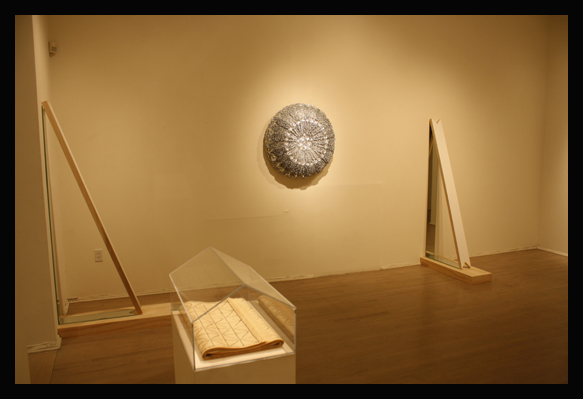
Photo and Story by Baynard Woods
Some of the other works were not quite as interesting. “Funeral Wreath,” a large metal wreath left me cold. It was all surface with no sense of thrill or discovery.
Overall, however, the show has a cumulative effect and the “Funeral Wreath” added something to it. The cumulative effect– the smooth, shimmering wood, the black calligraphy, the smooth pure lines– had something of the sense of a Buddhist zendo. And yet, as in a zendo, you may find yourself pondering questions that belie any purity of form.
In fact, both of these shows might have best been titled after the Heart Sutra, for both tell us loudly “form is emptiness and emptiness is form.”