Child Ballads

Photo by Philip Laubner
Originally conceived as only an exhibition of paintings, the idea for The Child Ballads Show organically grew to include musicians that played traditional folk music and different versions of the songs that inspired the art. The G Spot has a cavernous dance hall in the back that’s perfectly suited for a music event.
Curator Teddy Johnson was introduced to traditional American folk music by his painting professor Art Rosenbaum. While working on his masters in drawing and painting at the University of Georgia he sang with Art and other students in a group called the ‘Around The Globe Sea Chantey Singers.’ It was here where he was initially inspired by Art’s passion and dedication to music.
The Child Ballads will be on view by appointment through Oct. 11. Feel free to
contact teddyschool@hotmail.com or heatherrounds@gmail.com to set up a viewing.
Photo and story by Philip Laubner.

Photo by Philip Laubner
Seeing narrative as an essential part of his own painting, Teddy was drawn to the colorful tales of traditional folk music; the intrigue, romance, betrayal and the violence or what Pete Seeger called “the blood on the castle walls.” For Johnson, the most compelling of these stories were the ballads compiled in the nineteenth century by the scholar Francis James Child.
“I started to notice a little number next to the title on the Child songs.” Teddy said. Intrigued, he investigated further and discovered that there was 305 ballads in the collection, and that the ballads covered an exhaustive range of human experience. “The songs are about every day people, the sort of darker side of what’s going on with everyday people and it’s really alluring subject matter,” remarked Teddy.
Photo and story by Philip Laubner.

Photo by Philip Laubner
Art of Field Recording: Volume 1: “50 year’s of Traditional American Music Documented by Art Rosenbaum,” won a Grammy for Best Historical Recording in 2007, and was nominated for one other. He’s played with some of the great traditional folk artists like The Skillet Lickers and was the featured banjo player on Lalo Schiffrin’s score for the movie, Cool Hand Luke.
At one point Art invited The ‘Around The Glode Sea Chantey Singers’ to join him on stage for a boisterous set. We were told that the songs were originally work songs and it was easy to see how they’d have bolstered men while working. Joining Art on Stage were Bart Lynch, Ty Lytton, Jeremy Hughes, Teddy Johnson and Shaun Preston.
Photo and story by Philip Laubner.

Photo by Philip Laubner
Art’s solo set contained a wide range of variation, from pieces accompanied by the banjo and the violin, to humorous a cappella numbers like Child Ballad #274, ‘Seven Night’s Drunk.’ Like most of the Child Ballads it has had hundreds of variations and changes throughout the years. I was first introduced to the piece by musicologist Mike Seeger’s field recording ‘Close to Home,’ but in Mike’s version it’s ‘Three Nights Drunk,’ and in Art’s version it’s four. Art’s father was a street performer in Patterson, NJ and Art plays a Risque fourth verse that his dad used to play.
Photo and story by Philip Laubner.

Photo by Philip Laubner
A monumental collection, the Child Ballads were culled from ancient broadsides or single-sided manuscripts, correspondence with other scholars, and exhaustive travel and time spent combing through archives from all over the world. The original volume was issued between 1892-98 and titled The English and Scottish Popular Ballads, but Child’s comparative research of the collection came from many countries and over thirty different languages.
Photo and story by Philip Laubner.

Photo by Philip Laubner
Heather Rounds.
Inspired by the Child Ballads, Teddy Johnson approached writer, book designer and curator Heather Rounds with the idea of collaborating on a gallery show of paintings, each one an interpretation of a Child Ballad. Rounds was thrilled with the idea, and suggested that they hold the show at the G Spot gallery. The fact that the site was once a mill is of great significance to both Heather and Teddy. In their hey day, the mills drew workers from Southern Appalachia, Kentucky and Johnson’s native Virginia. These workers, some of them musicians and singers, were more than familiar with the ballads.
Photo and story by Philip Laubner.

Photo by Philip Laubner
Jeremy Hughes.
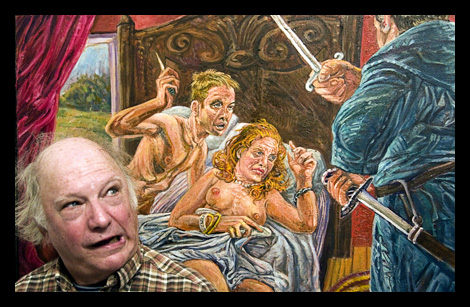
The paintings run the gambit, from literal representations of scenes, like Art Rosenbaum’s ‘Lord Daniel’ to mixed narratives, like Teddy Johnson’s ‘Lady Isabel and the Elfin Knight,’ to the conceptually oblique ‘The Farmer’s Curst Wife,’ by Ty Lytton. There’s even a pop reference triptych by Jeremy Hughes: ‘The Three Ravens’ which uses Alfred Hitchcock’s ‘The Birds,’ as its inspiration.
Photo and story by Philip Laubner.

Photo by Philip Laubner
I first heard Walker and Jay during a recent interview with Aaron Henkin on WYPR’s The Signal. The subject was the upcoming Child Ballads Show and specifically Francis James Child. I was immediately taken by their talent and knowledge of traditional music. At times I was surprised that there was only two musicians as the sound was so lush and complete.
Photo and story by Philip Laubner.
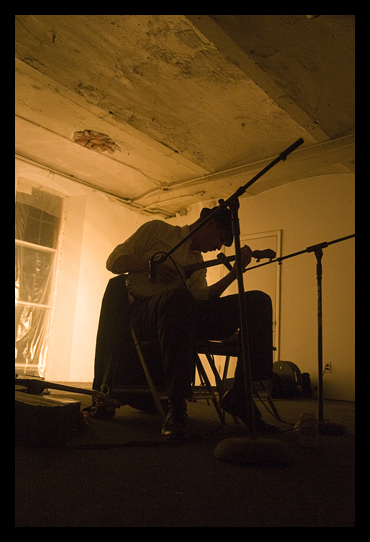
Photo by Philip Laubner
H Honne Wells.
At one point, the single lamp that lit the stage was turned to the back wall so that the next performer a lanky, well dressed soloist became a silhouette. Baltimore’s H Honne Wells’ music and voice is mysterious, deep and menacing. The music sounded at times like an 45 RPM record slowed to 33 RPMs, like Mississippi mud.
Photo and story by Philip Laubner.