Benjamin Andrew remembers a performance on April 19, 2013, at Bromo Seltzer Arts Tower in Baltimore.
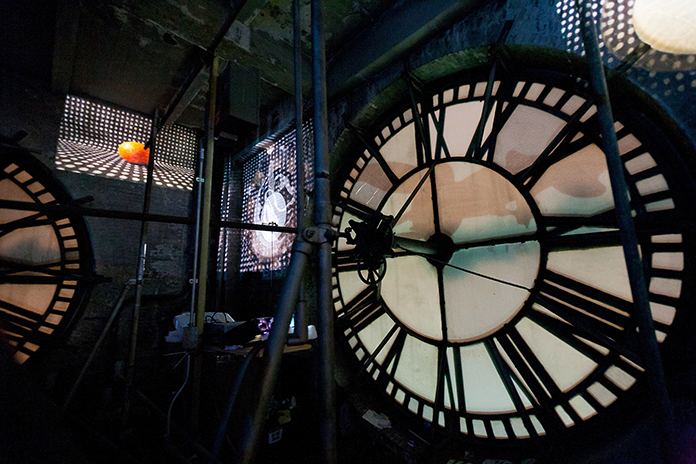
A school of oysters shuffled over my head. Fifteen stories above ground, I was surrounded by an array of gears and metal rods that stood silhouetted against twenty-four foot clock faces. The crackle of a circuit breaker interrupted the sonorous music echoing around the room as I watched the audience members’ eyes rise to the spinning image of an orange projected high up on the wall. At a one-night-only event at the Bromo Seltzer Arts Tower (BSAT), a combination of improvisatory music and video projection created an otherworldly space in the Tower’s clock chamber. The rain outside was coming down hard.
Time is a Milk Bowl resulted from a collaboration between visual artist Zoe Friedman and Baltimore music group Peals. Friedman’s past work has involved intricate cut-paper objects and Mandela-like composites of natural forms. The ethereal romance in her work is also a focus of Baltimore music duo Peals–William Cashion and Bruce Willen–who create atmospheric instrumental music with a variety of instruments. At Milk Bowl, Cashion and Willen controlled an array of effects pedals, alongside instruments like a toy piano and tambourine. Towards the end of a year-long studio residency at the BSAT, Friedman invited Peals to collaborate in the building’s most iconic space, the interior of the hundred-year-old tower’s clock chamber.
All images and video courtesy of Zoe Friedman, 2013
With a brief reign as Baltimore’s tallest building from 1911 to 1923, the Bromo-Seltzer clock tower adorned the manufacturing center for Bromo-Seltzer antacids. Its four clock faces radiated above downtown Baltimore, illuminated by a series of mercury-vapor lamps. The tower was once topped with a fifty-one foot rotating Bromo-Seltzer bottle whose twenty ton glowing blue shape could been seen for twenty miles. According to the BSAT website, it was removed in 1963 due to structural concerns.
The clocktower shone a new light this April, as the fleeting performance of Milk Bowl pointed toward the possibility of more interdisciplinary and site-specific arts programming in Baltimore. Occurring towards the end of Friedman’s year long residency at the BSAT, Milk Bowl felt like a love letter to a place.
All attendees at the performances on April 19 (one early evening, one late night) signed a waiver at the ground floor entrance assuming responsibility for any injuries sustained in the lofty clock chamber. A cramped antique elevator and a flight of near vertical stairs heightened the drama of the nighttime climb up to the tower. Fifteen stories up, the slow moving clockwork didn’t seem particularly dangerous, but then again, given the weather, a dramatic lightening strike didn’t seem entirely out of the question.
The performance lasted about half an hour with Peals keeping the audience adrift in a sea of sustained guitar textures and ambient synthesizers. The clock chamber was inky black, and people crowded together along the narrow walkway beside one of the stone walls. Above the heads of the audience, nestled between the tower’s four clock faces, a medley of videos created by Friedman played from seven projectors mounted throughout the room on narrow beams and metal staircases.
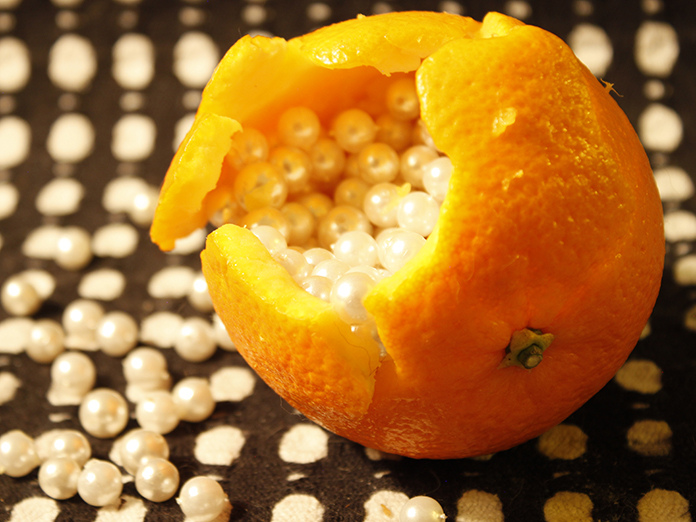 Each of the videos in Time is a Milk Bowl alternated between graphic animated patterns and intimate actions performed with natural objects like oranges and oyster shells. Glimpsed through the patchwork of clock machinery, oranges spun like globes as they shed their rinds and oyster shells wobbled across tables. Friedman gave life to the objects in her videos by animating a series of still photographs, giving a stuttering wobble to the mundane actions and impossible feats.
Anonymous hands occasionally manipulated these objects, often stirring a bowl of milk and ink. The white and black liquids swirling around the bowl were the most prominent vignette in the videos, creating Rorschach spirals that echoed the circular shapes of the enormous clock faces. Views of the bowl echoed the circular shapes of the enormous clock faces, and other videos of rotating moons and oranges that eventually revealed themselves to be full of pearls. Everywhere, it seemed, were circles.
Compared to the abstract bombast of most concert projections, Friedman’s animations were startlingly representational, even hinting at a narrative as the anonymous hands went through their strange rituals. These scenes and movements had a determined care about them that mirrored the handcrafted nature of the stop motion animation. Even when the hands were not in frame, their presence was still felt through the stuttering movement of the oranges, oysters, and other natural forms.
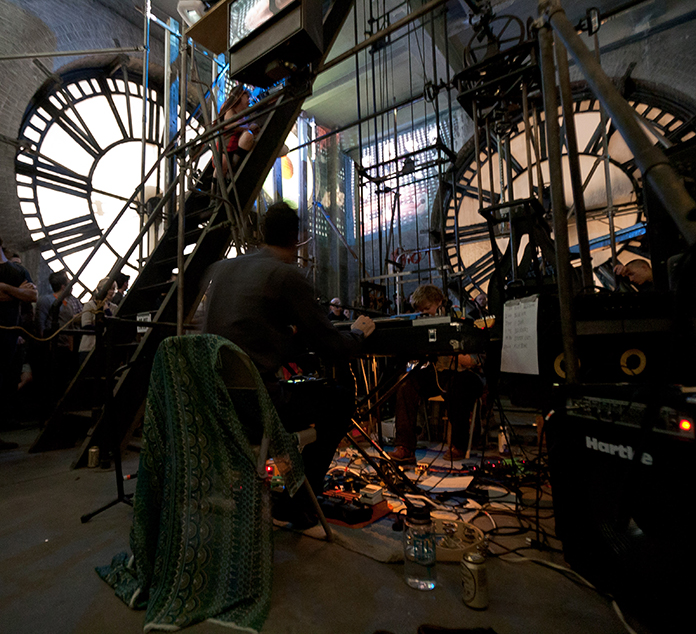 Peals underpinned these videos with continuous droning and carefully selected aural textures, until the show’s finale, when recognizable melodies finally peaked out from under the waves of ambient sound. Cashion and Willen sat in the center of the room, surrounded by clockwork and moving images, their minimal tones letting the audience focus their eyes on the optical feast of projected images and clockwork.
A surprising highlight of the performance was the periodic sparking of a large circuit breaker, or some such machinery. I was later told that these sparks had something to do with the elevator–which makes me wonder if all elevators have boxes of sparking electricity somewhere above them. The flashes of electrical current from this refrigerator-sized device punctuated the traditional instruments’ tones with audible crackling and served as a reminder that we were visitors inside a machine.
The music’s twinkling toy pianos and reverb-soaked guitars were familiar sounds that didn’t do much more than establish a mood, but it seemed that Peals and Friedman were both trying to conjure a transcendent atmosphere amid the building’s aged mechanics. The revolving milk bowls and moons of Friedman’s videos directed my attention to the Tower’s clock faces, focusing on the notion of time while Peals’ music suspended me in a wordless limbo. As ink dripped into the titular milk bowl, the performance’s swirling audio/visual menagerie posed a question: Could this transcendent atmosphere overcome the architectural confines of the clock chamber? Can something as impenetrable as time be suspended by a creative act? The minutes ticked away as the music whorled on.
I wondered if it was really possible for a contemporary audience to be transported into this kind of mystic headspace. The dancing objects in Friedman’s videos were animated by an otherworldly energy, but one that felt familiar, replete with the beautiful angelic music expected to accompany the sublime. Despite these traditional strategies, idyllic theatrics brought a sense of life into a space often seen and understood only from the outside.
The clock chamber was actually one of the more magical elements of the night. It’s astoundingly complex machinery served as a reminder of hidden mechanisms supporting the ordinary world, just as Friedman’s videos revealed an enchantment behind mundane objects. Milk Bowl drew attention to the aged beauty of the clock chamber, proving that the material could be just as transcendent as ethereal.
The BSAT clock chamber is a fantastic venue for installations and performances. I hope the Baltimore art community can continue to use similar sites to explore its relationship to the city’s architectural and industrial history. Milk Bowl represented a unique crossing of artistic fields, and Friedman’s art benefited from its separation from a gallery context just as much as Peals’ music did from taking a supporting role in an interdisciplinary event. Whether or not Friedman and Peals continue to collaborate, I hope Baltimore’s historic buildings can play host to similar events in the future.
—-
Benjamin Andrew is graduating this month with an MFA from the Mount Royal School of Art at Maryland Institute College of Art. His thesis project, The Chronoecology Corps, addresses ecological crisis through participation, humor, and journalistic research. Art Criticism in What Weekly is made possible with the generous support of the William G. Baker, Jr. Memorial Fund, creator of the Baker Artist Awards, www.BakerArtistAwards.org. Marcus Civin edits these art criticism articles for What Weekly. For more information, please contact marcus@whatweekly.com.
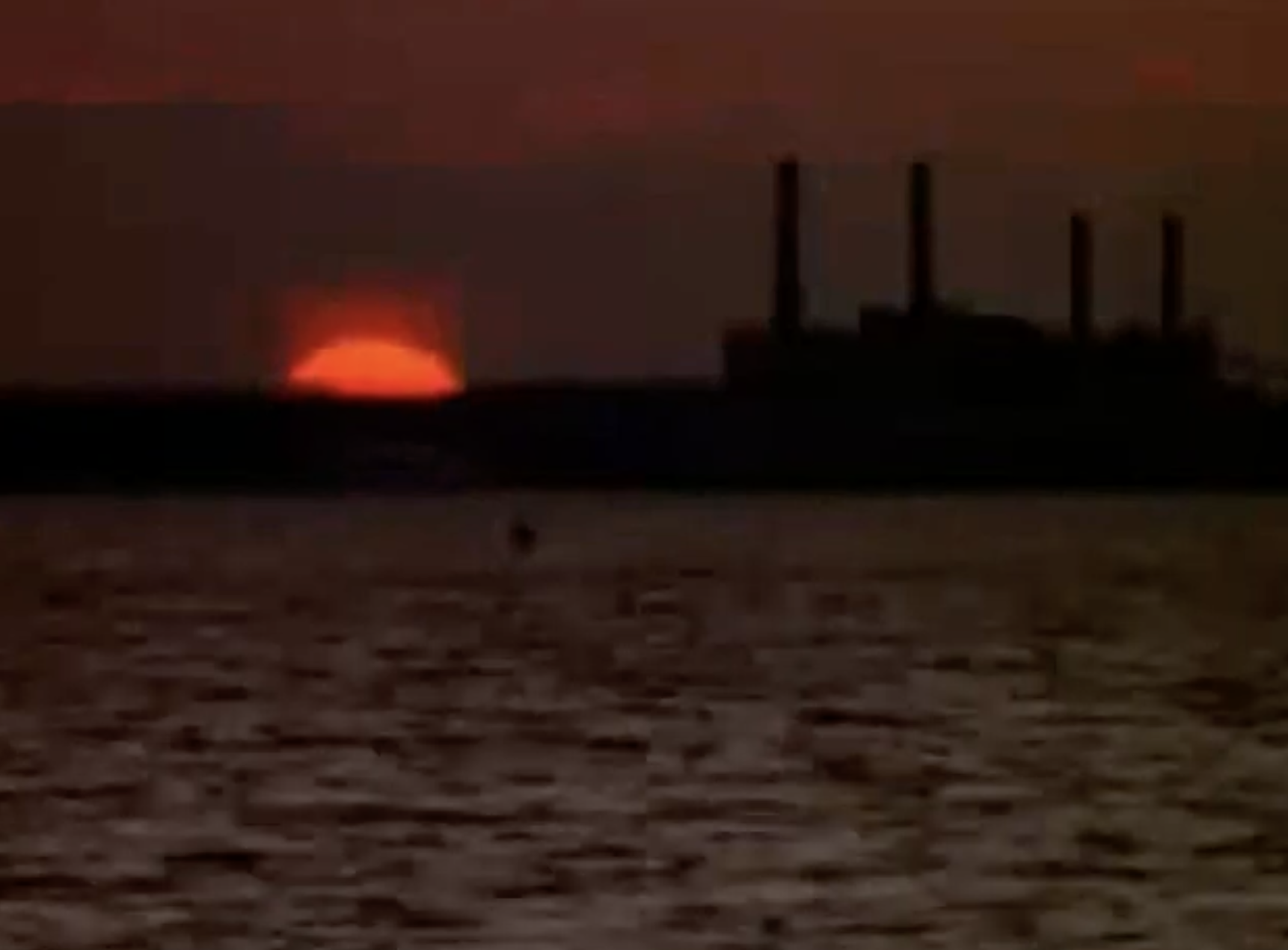
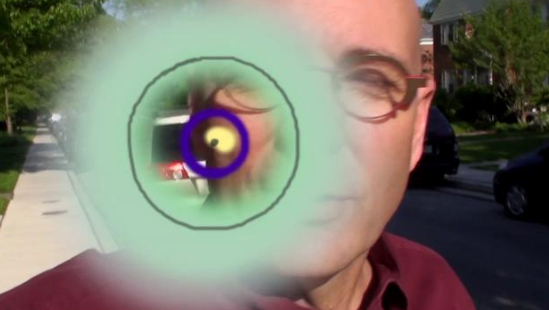
footage 07 from Zoe Friedman on Vimeo.
Belle Air from Zoe Friedman on Vimeo.