
by Robin Stevens Payes
Ultimate Block Party is coming to Baltimore this Sunday, October 2nd.
Back-to-School Night in most neighborhoods sees a rush of parents squeezing themselves into tiny chairs for a 15-minute rundown from the teacher on what he or she expects the children to learn in the upcoming year. Parents receive handouts, may run into neighbors, or even meet their child’s best friend’s parents. This well-rehearsed ritual each September treats parents as invited guests into school, but not as integral parts to the six or more hours each day when people of the appropriate size fit their little butts under the desks to engage in the very important job that school is supposed to equip them for: becoming capable and responsible grown-ups with the knowledge that will prepare them for life.
Meanwhile, a growing body of data shows what, intuitively, parents and teachers already know. When parents engage in learning WITH their child—both inside the classroom and out—that child is more engaged in class, better prepared to learn, and more likely to succeed.
Schools Need Families, Not Just Children
Children spend 70% of their waking time outside of school. And that’s not just hours in the day. Weekends, holidays, in-service days, and summer account for much of the time where children are officially off-the-school-clock. That’s a lot of hours where learning of some kind is taking place, but not necessarily the kind that helps young minds etch learning into memory.
Many families these days spend a great deal of that time ensuring that, beyond the school day, children’s lives are filled with organized activities. And because of long work hours, many parents have no choice but to find extended daycare, and have little energy – after work, chores, cooking and cleaning – to think about creative ways to engage in at-home learning.

Fast Forward to the Past
In the “good old days,” that halcyon time that parents of every generation extoll to their own children, it seems that summers were always more fun, neighborhoods were safer, and children, freed from the rigors of structured after-school and summer activities, were allowed to spend long days at play.
Today, “play” has become a four-letter word. The news from the playground is that America’s schools are failing. In a never-ending spiral of increasing academic expectations, society has gotten the message that, to maximize learning, the school day has little time for play. The kinds of learning activities that now permeate even the youngest of classrooms—where schools are increasingly focused on test preparation—do not recognize that, for young children, play equals learning. Through free and guided play, children learn to communicate, take on new roles and responsibilities, foster teamwork, and solve problems.
But learning does not stop at the classroom door, either. So while we are beginning to understand that play is key to learning—at least in early- to mid-childhood, it is incumbent on educators and parents to work together to create a state of play as learning, both in school and at home. And families that play and learn together are paving the road for higher educational success.
“Parents are our children’s best teachers,” observes noted play researcher Roberta Golinkoff of the University of Delaware. “When we play with our children, we are supporting them, and helping them to discover…”
Getting Ahead of the Curve: How Baltimore Is Promoting Family-School Partnerships
The results of parent-school connections are receiving wider notice. According to the National PTA , parent involvement in learning and in schools has proven benefits. In The National Standards Implementation Guide, the organization points to more successful outcomes based on school-home collaborations. It appears that parent involvement in learning beyond the school day is a secret weapon to bridging the achievement gap.
Students with involved parents are more likely to, earn higher grades and pass their classes, attend school regularly and have better social skills, and go on to post-secondary education.
Of course, the onus cannot only be on parents to get involved. Schools must put out the hand of welcome. If schools are not seen as welcoming places from the very first day where parent involvement is embraced and encouraged—not just in the occasional bake sale, but also in the classroom—then parents will not try a second time to reach in. Open communication between teacher and parent, and between the school administration and home, is essential to keeping the connection going.
What happens when families, schools, and communities work together? Again, according to the National PTA, student achievement improves, teacher morale rises, communication increases, and family, school, and community connections multiply. Out of this kind of collaboration, trust grows.
To their credit, Baltimore schools and educators have recognized the trend that collaboration with parents is the bridge to supporting healthy child development and stronger academic achievement. This past summer, the Family Institute of Baltimore City Schools embarked on a brand new summer learning program for young children and families making the transition into formal learning. This time, even when school was out, schools reached out to parents to find ways to help their children make those long summer days both fun AND filled with learning opportunities.
Baltimore City Schools partnered with dozens of institutions to launch its first annual “Pre-K at Play” celebration, in which all 4,800 of the district’s pre-k students descended on downtown for a day of exploration and discovery. As part of that event, with funding by PNC Bank, Baltimore pre-kindergartners were given copies of The Classic Treasury of Childhood Wonders, a book by Baltimore author Susan Magsamen filled with activities, poems, songs, and learning for the entire family. Over the summer, City Schools’ Family Institute organized Childhood Wonders “play dates” for families at library branches around the city.
The impact is already being felt in the classroom. According to Kerry Ann Malcolm, a teacher at Mary Ann Winterling Elementary School and a participant in summer workshops with parents and children, “The Childhood Wonders books have truly made an impact on the lives of our students and their families.”
Meanwhile, families are latching on to the idea that learning isn’t all about what goes on inside the school day. “Play opens up a whole new relationship between parents and children—it’s different, and meaningful,” observes parent Erica McCoy.
By the end of September, all pre-k, kindergarten, 1st-grade, and 2nd-grade students will receive copies of the book for use at home, courtesy of John Hopkins University.
Baltimore’s Ultimate Block Party
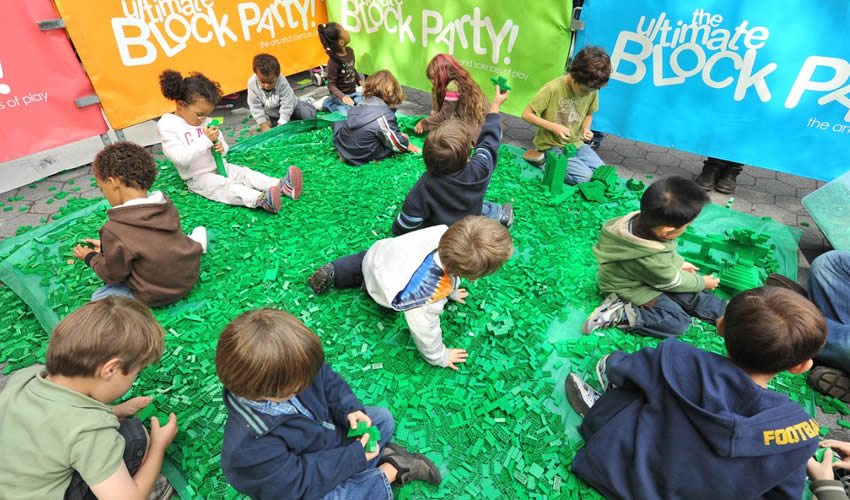
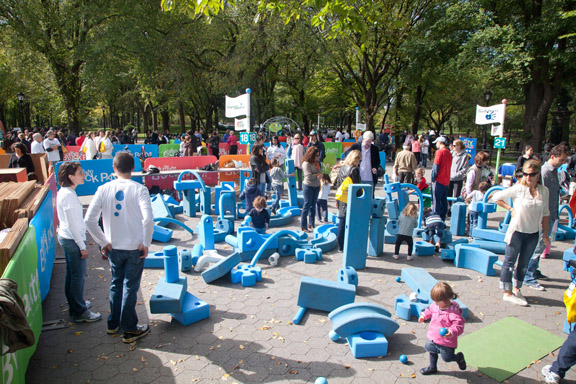
But the best is yet to come. On October 2, Baltimore City Public Schools is partnering with the Learning Resource Network, Johns Hopkins University, and a host of local and national sponsors to celebrate play at the Ultimate Block Party at Rash Field in the Inner Harbor from 11 a.m. to 5 p.m., a daylong offering of play-based activities for children from birth to 13, that are rooted in play and built on the science of learning and development.
The event comes on the heels of two other Ultimate Block Party celebrations—in New York City and Toronto, Canada—and makes Baltimore the third in a series of play celebrations in major cities across North America. Children and their families can take part in classic childhood pastimes—dressing up like railroad conductors, playing Four Square, flying paper airplanes, jumping rope, and making art from recycled materials. They can do yoga, make hip-hop music, play rock-n-roll baseball, and participate in any number of other fun, family-friendly games and activities.
“The Ultimate Block Party is a great way to help families practice things that will support their students’ achievement –while having fun,” said Michael Sarbanes, executive director of City Schools’ Office of Engagement. “We believe our parents and communities play an incredibly important role in our students’ academic success, and this day puts that belief into action.”
School and Beyond: Learning Year ‘Round
How can busy families ensure the environment at home continues and reinforces learning at school?
Read together. Play cards or board games. Play “I Spy” to see what your children can spy in their own environment with their little eyes. Talk about volume when measuring ingredients in a milk container. Or simply make sure to plan a family meal together once a week, where despite everyone’s busy schedule, there is an hour to share what they are learning with each other.
After attending the Childhood Wonders kickoff at Winterling Elementary, McCoy emphasized what’s missing in parents’ assumptions about school involvement. “Parents think getting involved in learning means helping with homework or going to PTA meanings. It’s so nice to learn that parents can spend quality time with their children—and be involved in learning—by playing with them at home.”
And that realization can spark unexpected consequences: renewed partnership between schools and home. Affirms classroom teacher Malcolm, “[Parents] are coming into our classrooms and interacting with their children more. The Childhood Wonders books have truly sparked a renewed interest in families reading and interacting with each other.”

Ultimate Block Party is coming to Baltimore this Sunday, October 2nd.