John Ruppert is known for using foundry-work to create “natural” or organic shapes. In the ‘Nature of Things,’ currently at C. Grimaldis Gallery, Ruppert deploys this technique to great aesthetic, and philosophical effect. In ‘Core With Rocks,’ a series of boulders surround an intense cylindrical layering of chain-link wire. Some of the “rocks” have been made from casts of the actual rocks around them. Only the seams, and the slightly more rusty patina separate art from geology.
The cylinder in the center changes everything. The gridded layers of wire overlap to create a visual warp, like heat rising off of the highway, reflecting gallery lights in subtle flashes that wash over the stones like water.
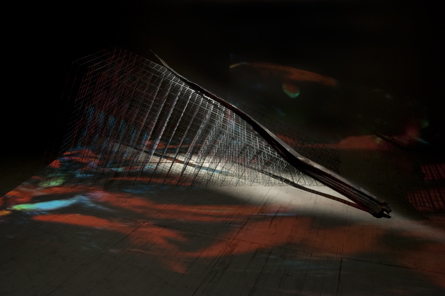
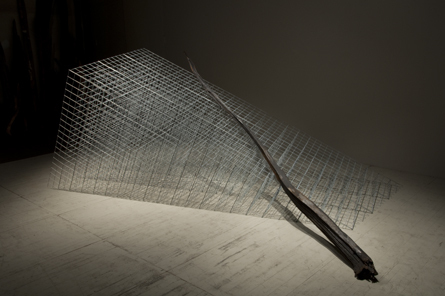
This effect is greatly amplified in the simply stunning “Sunken Grid With Strike and Koi Projection.” A steel casting of a tree that had been struck by lightning lay across a wedge-shaped bed of grid-wire. There is a remarkable verisimilitude in the tree shard, but it also looks like a metal filing under a microscope, highlighting what appears to be its cellular composition.
A film Mr. Ruppert shot of Koi fish in China is projected onto two walls and the floor. First, it provides a certain motion and rhythm to the piece. The film moves from a still bit of water with only a few fish, so that when one comes, it is startling and moves towards a visual climax as the fish swarm around the gallery amidst shimmering ripples. It surrounds and disorients the viewer. This is especially true as an orange ghost-koi swims across the floor and under the steel grid. The image seems to continue to move under it, while also moving upward, dividing further with each layer of interlocking metal.
This work asks the same questions that cubism did about space and time, and yet it also uses this multimedia installation to create the shimmering surfaces of Turner’s paintings.
Though this last comparison may be surprising given the nature of Ruppert’s work, it seems especially apt here, because “The Nature of Things” includes several land or seascapes obsessed with the play of light. In the catalogue essay Ruppert says that he sees the painterly surfaces of these photographs to be of a single piece with his foundry work. Returning to watch the projected koi turn into fractals of light dancing from the skin of steel, it’s easy to see how. The work is disorienting because it confuses representation and reality, not in theory, as so much work does, but in the act of perception itself.