The Hustle is a series where Ezra Winter interviews and features how people find success in creative ways in the digital age. This time we feature comedy writer Daniel Kibblesmith, who has just gone on tour with his writing partner Sam Weiner for his new book How to Win at Everything, performing with comedians like our friends Ben O’Brien and Alan Resnick from Wham City Comedy and comics from Saturday Night Live and Late Night with Seth Meyers.
What was your role at Groupon and how did it all start?
Groupon was my first professional job resembling comedy writing, I was one of the in-house humor writers for Groupon to help distinguish their brand from the competitors.
So this kind of work allows comedians to have a day job related to creative and humorous content?
It’s the necessity of needing to work. Given the option to do something closer to what you wanted to do rather than further. It’s a great opportunity for comedians to do something resembling their passion and a great opportunity for companies to bring in a new kind of talent and new kind of thinking.
Can you explain the highly popular GOP Teens account?

GOP Teens Twitter
When I saw that the domain name GOP Teens was available, I purchased it impulsively just because I thought it was so funny to give someone like me access to something seemingly official with my point of view behind it. And one summer day, I got bored enough to create the Twitter handle to go along with it, and it very organically grew into a ham-fisted lampoon of Republican outreach – which never works.
Why is this Republican outreach such an easy target?
At the end of the day, your source, whether it’s a person or a product, has to have some kind of foothold in the audience’s interests. You can’t generate interest just by using a fad avenue or a fad outlet for it. You can’t build interest from nothing by using a popular tool; you have to have some semblance of relevancy.
Who are the fans?
Most of my followers do appear to be actual teenagers. Kids that age are developing their identities – political and otherwise. It’s a searing of authority figures, just the fact that it’s so over-the-top and the humor does tend to be very broad. I don’t mean it to be as much trolling as setting them up to make their own jokes. A lot of it is just teeing up the kids to call me an idiot.
What are the pitfalls of brands using social media?
(tone deaf GOP Campaign) That was really funny and a hilarious real world example of what I try to lampoon with GOP teens, where if you’re coming from a certain direction, it’s just better not to reach out to certain people because you will always fall on your face.
The cooler you are the less money you have to spend?
Yeah, I think that’s entirely valid.
How did you get into The Onion?
The Onion moved from NY to Chicago, and through some kind of public post or referral, there was a cool call for staff writers and freelances and some of my friends from Groupon ended up landing a couple of the staff writing positions. It was a process of me applying as a contributor and then having more and more freelancing opportunities available.
I don’t think it was so much the Groupon pedigree as much that Groupon taught me how to do comedic writing in an office setting in a professional way.
There’s stuff out there – you don’t necessarily have to compromise as much as compartmentalize, depending on the client. If you’re interested in making money and working in a traditional way – which I totally respect – there ARE ways to pursue things closer to your interests.
Are there issues with balancing personal creative content alongside client creative content?
More just fatigue. I do a daily comic strip, and for the first time in a couple months, I’ve missed a couple days. It’s not the idea generation, it’s just having enough hours a day to maintain the consistency you need for a really engrossing online project.
With the kind of humor you do, where is that pop culture weirdness coming from?
Reaproppriation of pop culture is a big part of the weird art our generation makes.
It’s not our fault – it’s just the logical extension of programming. We’ve all had these characters and tropes driven into us, and now the cracks are just starting to show.
If the medium is the message what does digital and social media comedy say about you?
A few years ago, a lot of what I do would have taken the form of a Youtube video because that was the agreed upon outlet for something like that. And now it might be an ongoing experimental Twitter project, and next year it will probably be something that I’m not even aware of yet.
I think I’m officially too old to have a solid foothold in whatever replaces Snapchat. I might go aggressively in the other direction and just make zines or something. I’m increasingly aware of my own irrelevance. It’s only a matter of time before I become as old and out-of-touch as the thing I’m ostensibly parodying.
Hopefully I either survive or I’m replaced by something funnier and more thoughtful.
Tell us about your book: How to Win at Everything?
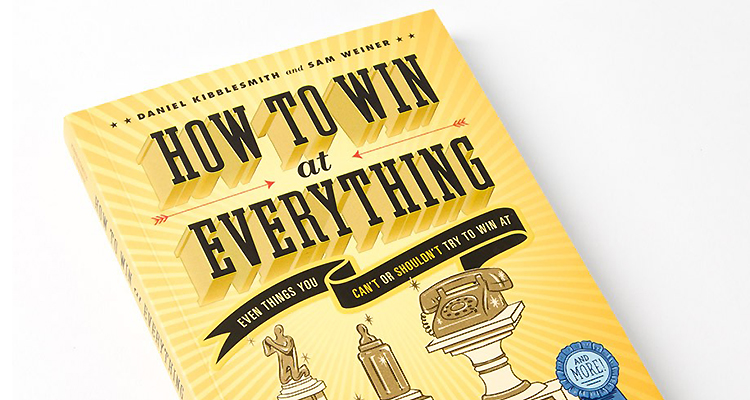
How to Win at Everything – Written by Daniel Kibblesmith and Sam Weiner
Sam Weiner is my writing partner. Sam and I worked together at Groupon, and he was one of the people who became a staff writer at The Onion. We were doing this kind of comedy and starting to outgrow the ability to do it at our day job.
So you wrote this somewhat serious guidebook?
There’s a humor spectrum of joke to factoid, and ours is heavily on the joke side. And we’re very excited to give our take on the genre and write a comedy book.
Any similarities with Stephen Potter’s Book: The Theory and Practice of Gamesmanship or The Art of Winning Games Without Actually Cheating?
This guy already wrote our book. I would actually recommend people buy this instead of our book.
What was your route to publishing?
I was appearing on a podcast, “How Was Your Week” with Julie Klausner, and she’s written some books, and she was able to put in touch with an agent who had a relationship with a publisher. And then it was just a matter of us having written enough material and having formed the right relationships to get a foothold in that world. So it really was this combination of luck and perseverance. So when the opportunity arose, we had already written a proposal and already had sample chapters and had already established a voice for the book. So the straight ahead traditional route. If we hadn’t been able to succeed in the traditional arena, we would have looked at the digital route. But this had been one of my and Sam’s goals as comedy writers, but we never assumed that world was closed to us. And we were able to navigate that world and work with experienced editors.
What did you get from a traditional publisher that would have been difficult otherwise?
There is so much that we don’t know how to do. We will write you a million jokes, but we don’t necessarily know how to circulate a press release or create vector graphics.
We have good relationships that we’ve formed in media and comedy so we’ve been able to do well getting copies to news outlets and blogs. Sam and I have representation that I believe extends as far as this book. I don’t have an agent in the way a comedy writer who works for a TV show has an agent.
Sequel?
We have started brainstorming a couple concepts, but it’s still very much up in the air.
Do you want to be in front of the camera more?
I think this is about right. There was a time when I was in front of the camera for almost everything I made, but then I realized there were people more flexible and talented than me, and I had no problem fading to the background.
I think there’s something very gratifying about knowing what you do well and then trusting other people to do their jobs.
For other aspiring writers, what do you see as the path to comedy success?
I think for sure the traditional path still dominates. I have friends who are stand-ups and actors, and it’s very fun to watch them on television. I don’t think the GOP Teens sitcom is right around the corner. If your goal is to be on television, I think far and away the traditional path of sketch and standup is the best option. Though SNL is carving out a spot for the new model with the digital shorts.
And what about Youtube channels and digital-only outlets?
Funny or Die and CollegeHumor are great accessible ways of reaching people, so it depends on what your definition of success is. They’re not mutually exclusive [with traditional channels]. It’s a question of hitting doubles and singles versus hitting home runs.
Does the geography of it still matter? Being in a first-tier entertainment city?
I think ultimately, before the internet, the goal was to tour nationally and appear on TV. So I think before the internet, New York or Los Angeles was the way to do it. But now with the internet, it is viable to have a day job that resembles comedy, which is not a bad thing at all.
If your goal is to do something personal and strange and build a great community, you can do that anywhere. I know people who have moved to Atlanta to work for Adult Swim or now Chicago has The Onion, formerly of New York. Gradually, the mainstream outlets are dispersing, but it’s so gradual that if your goal is to reach a wide audience you still have a big advantage by being in New York or Los Angeles.
How do you promote yourself?
You have to get hyper with self-promotion, but you also have to make sure you’re not promoting anything you can’t actually do. And really just find the medium that works for you. Social media is still tough as a career, but Twitter has been a great business card for anyone I’m going to work with.
And if you are a part of a network of community when opportunities arrive, you’ll be ready for it.
Daniel’s hilarity can be found on Twitter and Amazon! Ezra is also on Twitter and now Youtube and would love you to read some of his other interviews in “The Hustle” series including one with professional gambler Bart Hanson and one with singer Marissa Nadler.