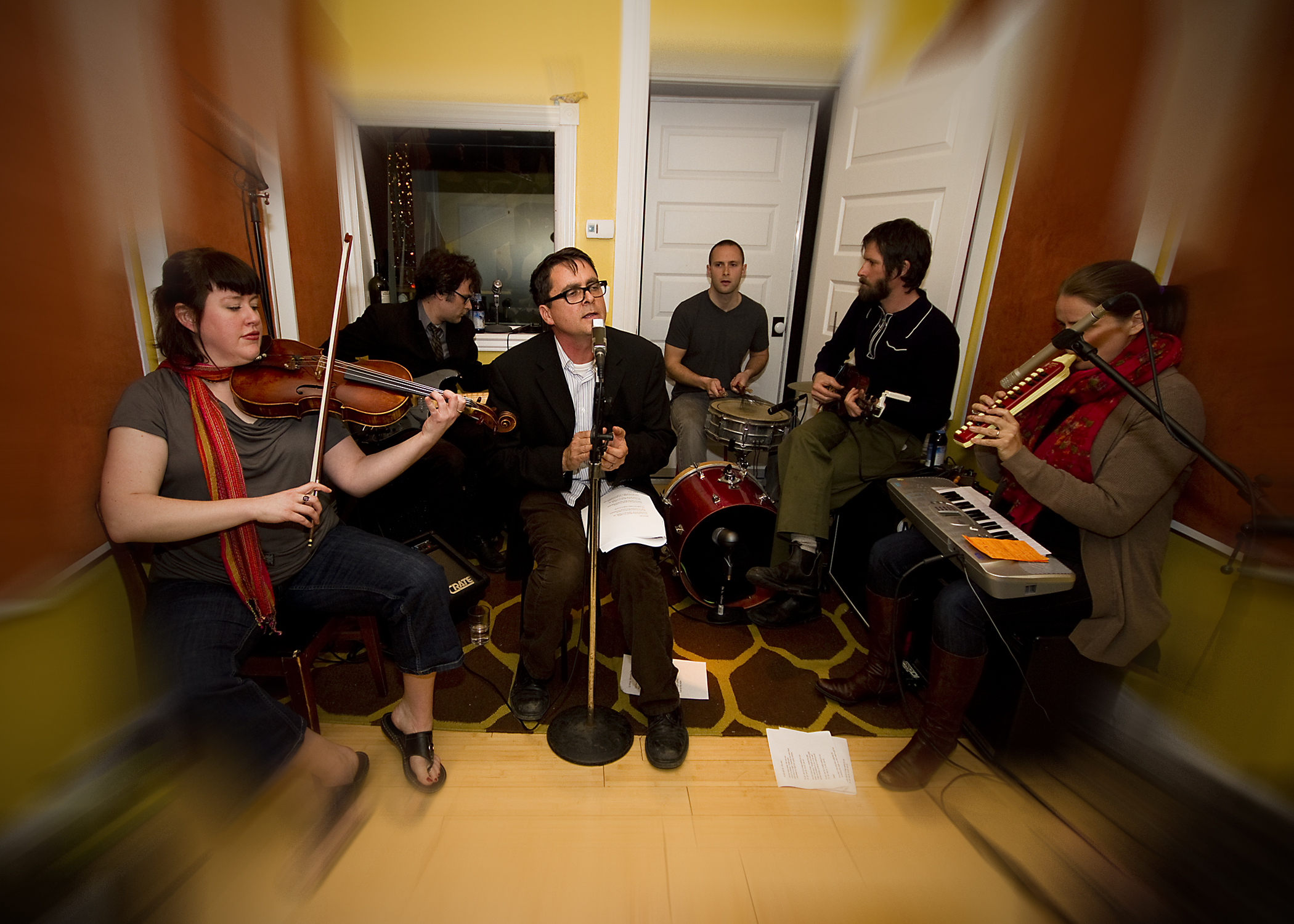

A Mobtown Microshow involves corralling a band, inviting in a small audience, and letting the tape roll. These performances hinge on, immediacy, playfulness, and risk. What’s produced is an important and lasting archive that speaks to the vibrancy of music being made in Baltimore.
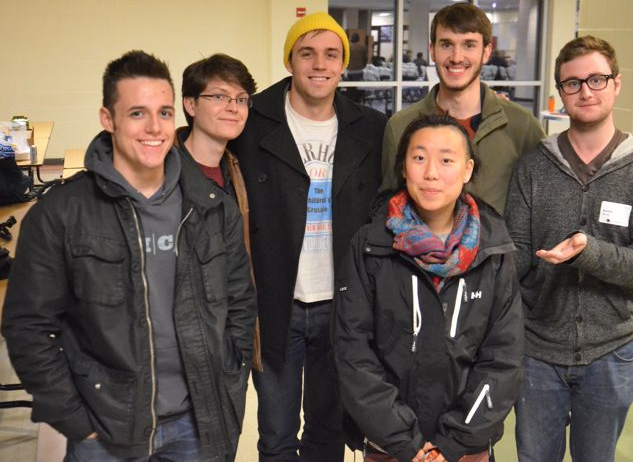
Lo Moda made for an absolutely intriguing Microshow choice because they are a big band (a sextuplet for those keeping score) that can work a groove which can often be dependent upon volume, and crushing volume just ain’t happenin’ at a Microshow.
Photo by Jason Bender, story by Michael Pursley

Lo Moda’s strength in this setting is their ability to work space and subtlety into their no wave/post-punk song structures, lacing them with Cale-esque strings and the guitar work of Christian Sturgis. His playing alternates happy melodic plinking with a good deal of pops and scratches. Into this musical scaffolding the vocals of Peter Quinn mix ambiguity with catchiness while orchestrating powerful crescendos.
Photo by Jason Bender, story by Michael Pursley

“We have quite a few quieter, prettier songs that we tend not to play because they don’t really fit into our setlist when we’re playing a bigger show. It’s really nice for the opportunity to play them tonight,” explained keyboardist Gillian Quinn, who performed with a diminutive electronic keyboard and a melodica that filled the room with spectacularly reedy textures.
Photo by Jason Bender, story by Michael Pursley

Lo Moda were in fine form, shaping tense buildups over Escher-step rhythms, finding slinky grooves to decorate with icy keyboard, dissolving melodica and Raili Haimila’s viola into stirring cloud cover, and occasionally belting out group choruses. But on a couple of gentle slow burners, Lo Moda revealed a sweeter side that relied less on syncopation and more on graceful chord movements and a plaintive falsetto from Quinn.
Photo by Jason Bender, story by Michael Pursley

Drummer Sam Hopkins used a drum machine and savagely paired down kit. Most fascinatingly, bassist Antony West handled the low end on a detuned violin- an amazing feat he pulled off with aplomb.
The calmer songs showcased the group’s versatility as they swapped the post-punk grid for lush environments that sounded grand and made the rhythmic pieces that followed all the more satisfying. And, in Mobtown tradition, a cover of a Baltimore-related artist was performed. Their choice: The Cars’ “It’s All I Can Do.”
Photo by Jason Bender, story by Michael Pursley

Without the boundary of a stage, a warm connection between band and audience was established during the performance. The point was driven home by Peter Quinn, who augmented his voice with finger snaps and claps and other natural percussions. At one point, vibrations from Quinn’s foot keeping time could be felt through the floor, bringing attention into the music and creating a moment in which the band and audience felt the same vibrations.
Photo by Jason Bender, story by Michael Pursley

Added bonus: Raili Haimila told pirate jokes.
Photo by Jason Bender, story by Michael Pursley

To listen to or download this or other past Microshows follow me this way.
Big in Japan will play a Mobtown Microshow on May 12.
Photo by Jason Bender, story by Michael Pursley