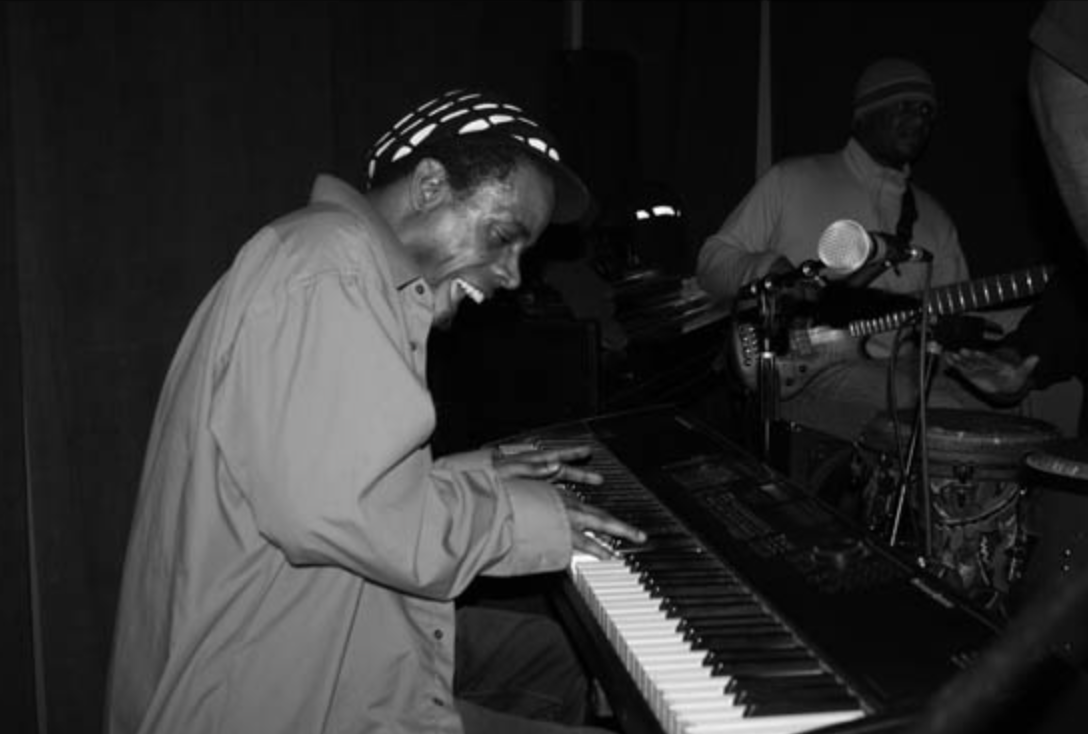
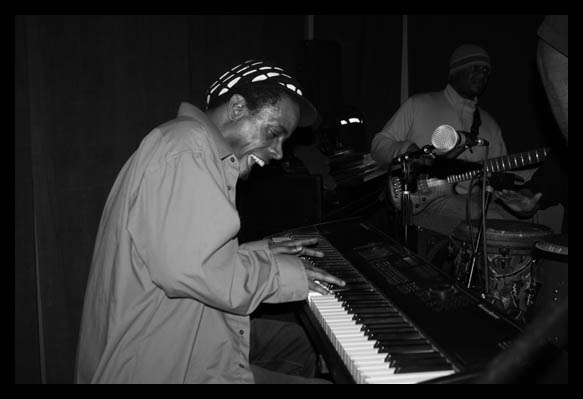
Photo by Baynard Woods
Creative Differences Presents World Premier Music Lafayette Gilchrist and The New Volcanoes – Duped Again The slightly shambolic looking piano player finished his solo and leapt up from the bench, almost like Jerry Lee Lewis, and pointed at the bass-player, signaling it was time to tell his story. “I don’t ever tell anybody to take a solo. That’s why so many jazz guys don’t work in my band. I want the song to be a character and I want you to tell me how your particular story fits in with the overall story.” Lafayette Gilchrist is a master of the piano, but like Duke Ellington, his real instrument is his band. Gilchrist, who didn’t begin playing piano until he was attending college at UMBC, told me “I got it from Duke. From the beginning I wanted to be a band-leader. In the beginning I wasn’t good enough to play with other people.” Now, he’s certainly good enough to play with anyone, but he still thinks of himself as a bandleader and composer. “I write all the music, but that’s only half the story because I write for the individuals in the band. Writing is setting up a framework and situations where they can each be their most individual self.” That’s as good a definition of jazz as any, and Gilchrist’s New Volcanoes certainly shined with intense individuality in a number of new Gilchrist compositions being recorded live at the Windup Space on Saturday, January 29. Photo and story by Baynard Woods. |
Photo by Baynard Woods
Guitar great Carl Fillipiak sat in for the evening. Gilchrist said that whenever they played it felt like “melting together.” Fillipiak not only added some great riffs, but an element of surprise. He is a master of tone and coaxed a seemingly infinite variety of sounds from his guitar. At one point, he made it squawk like a sax, and I saw Gregory Thompkins and Tiffany Defoe—the band’s two tenor sax players—turn and look to see who blew the note. The two tenor players each brought a unique sound to the band. Of Defoe, Gilchrist said “there are a lot of great soloists in jazz, but few people who really think in an ensemble fashion. Defoe, who also plays in the Belvederes, and the Baltimore Afrobeat Society brings that early rock and roll trumpet sound to the band. It was exactly what Gilchrist was looking for and when she took her first solo of the night it fit perfectly with the fuzzy tones Fillipiac was bringing on the guitars. Gregory Thompkins, the other tenor player, had a more classic modern jazz style that came out of Rollins and Coltrane. “He’s a sculptor,” Gilchrist said of Thompkins playing. His solos were fast and fierce in the higher register and would swonk and slide into the lower notes with a real power that Gilchrist framed with the angles issuing from his piano. Thompkins had a real emotional and sweet quality to his playing. Photo and story by Baynard Woods. |
Photo by Baynard Woods
In modern jazz, it’s striking the way that Gilchrist uses the horn section. Songs are structured around simultaneous horn riffs, like traditional jazz, but Gilchrist and the New Volcanoes focus that through the modal workings of Miles Davis and the carnivalesque careenings of Albert Ayler. Rounding out the reeds, (though only in the second set) was John Dierker on the clarinet. It was revelatory to hear Dierker, whom Gilchrist calls “the most original horn player to ever come out of Baltimore. Nobody is more honest.” Photo and story by Baynard Woods. |
Photo by Baynard Woods
You have to be original to play the clarinet in such a context. The clarinet was a staple in early jazz, but the speed and complexity of bebop resulted in the virtual absence of the instrument from all but the most traditional jazz for the last sixty or seventy years. Yet Dierker played outrageously complex lines that veered far from the snake charmer sound so often evoked by the instrument in jazz. Mike Cerri “one of the original architects of the New Volcanoes” played both the full sized and the pocket trumpet. When Gilchrist talks about writing for the band, he says, “I only know the trumpet through Cerri and so I write with him in mind.” Cerri, for his part, guided the horn section, counting with raised fingers as it was time for them to come back in, all together, after someone’s solo. As much as Gilchrist, he kept the band extraordinarily tight while allowing them to get loose. Photo and story by Baynard Woods. |
Photo by Baynard Woods
The rhythm section, of course, did a hell of a lot to drive things. Gilchrist’s piano playing—which is as infectious and charismatic as any I’ve ever seen; like Thelonious Monk, the way he emphasizes the odd note or timing, is more interesting to listen to than anyone who’s simply got chops—anchored the band, setting the speed and the mood for each song. But he was helped by the intense percussion of Kevin Pender—who a couple times brought the house down with his solos— the drums of Nathan Reynolds and the electric bass of Anthony “Blue” Jenkins. Photo and story by Baynard Woods. |
Photo by Baynard Woods
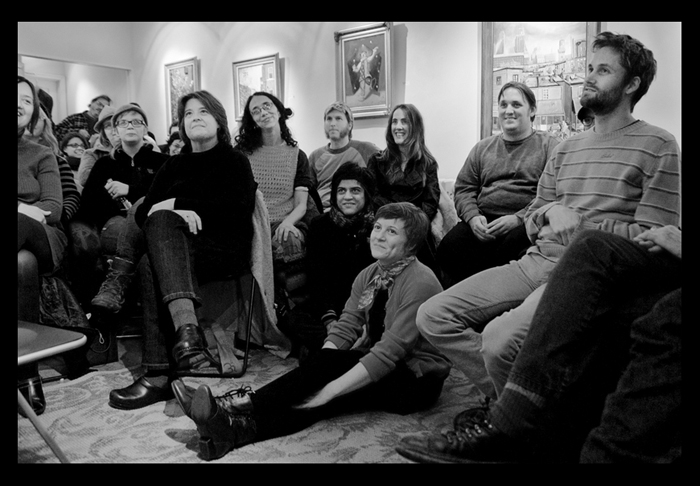
The Windup Space was full; some people listened almost academically, or reverentially, while others left their fold-out seats and danced around the stage. The compositions inspired both reactions. They were joyous and buoyant, while also intricate and careful. They were the perfect vehicles for this band. “Unscripted,” the first song is subtitled “The Baltimore Parade,” and you can hear something distinctly Baltimorean in the sound. If there is a Baltimore sound in jazz, Gilchrist is its prophet. “Plugged In” featured Defoe on tenor and it began with a funk riff that almost had a Pink Panther quality to it. But then Gilchrist came in and started to chop of the timing and it was as if two old jazz enemies—fusion and free—had become friends and brought out each other’s best qualities. Among the strongest compositions was a new suite in three parts. “Fast Car, Simmering, and Step Lightly,” the three movements, will likely become favorites of Gilchrist’s fans, and like all the songs the New Volcanoes played that night, demonstrated the continued vitality of jazz—playing and composition. Photo and story by Baynard Woods.
|
|
"It takes a village to unite the most divided people on earth." You’re Invited: Budrus film screening When: Wed, Feb 23, 2011 at 7:30 PM Where: MICA’s Brown Center. "This film will single-handedly change how many people view the conflict. It’s that good, and that important." The Boston Globe "The must-see documentary of the year." Nicholas Kristof, The New York Times Watch the Budrus trailer. |
The Deutsch Foundation supports individuals and organizations committed to testing new solutions to enduring challenges, protecting society’s assets, exploring new domains of knowledge and social innovation, and advocating for the common good. |