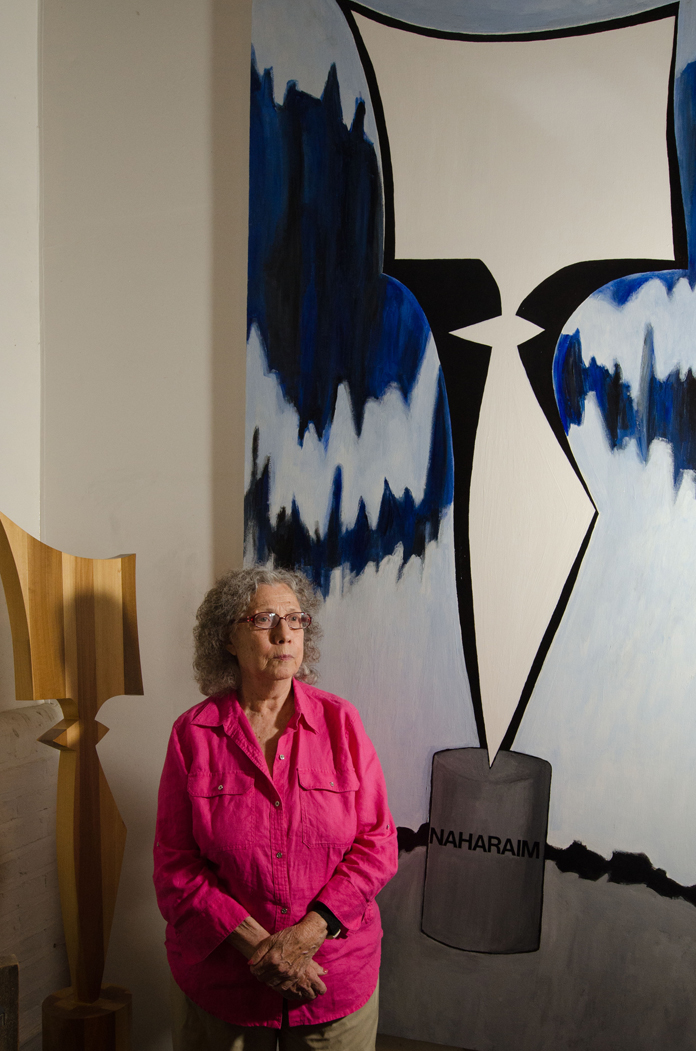
Gigi McKendric has been a professional artist for more than six decades. Her work spans many mediums, including poetry, sculpture, film, paintings, life masks, and beyond. And though her work may vary from project to project, her mission seems to remain the same – to give voice to those whose voices have been ignored, or worse, taken away.
Gigi was born in Romania, and moved to Baltimore over twenty years ago. Though her work often addresses great human tragedy, her goal is to inspire reflection and offer hope.
Over the years, Gigi has made work honoring victims of the Holocaust, the Kent State massacre, the Troubles of Northern Ireland, South African Apartheid, 9/11, Darfur, and the 1997 Island of Peace massacre in Israel.
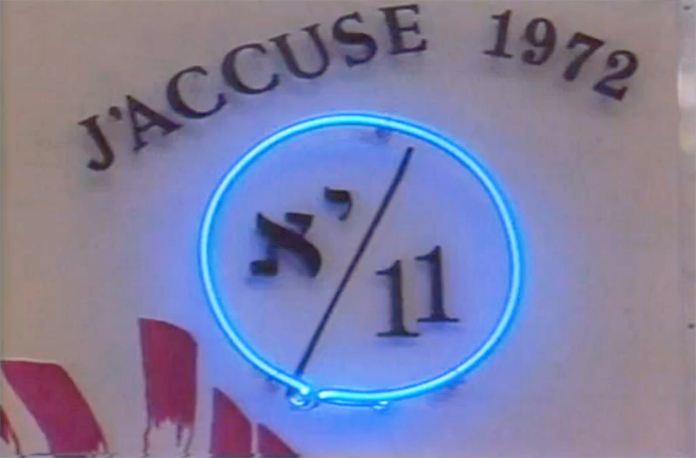
We could easily fill pages upon pages with Gigi’s stories, her work, and her passion for art which calls man to see his senseless inhumanity towards other men. However, when I met with Gigi at her home in Northeast Baltimore, a converted firehouse which has served as her residence and studio for over 25 years, she made something clear to me that I was not to focus on her story, but rather to spotlight a piece of work she had made 40 years earlier, in the aftermath of the 1972 Munich Olympics tragedy, and in doing so, tell the story of 11 innocent Israeli athletes who lost their life.
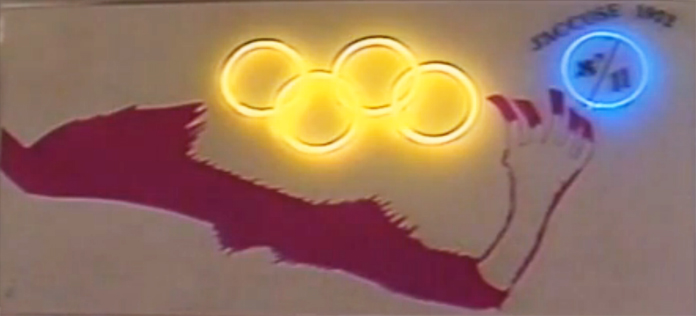
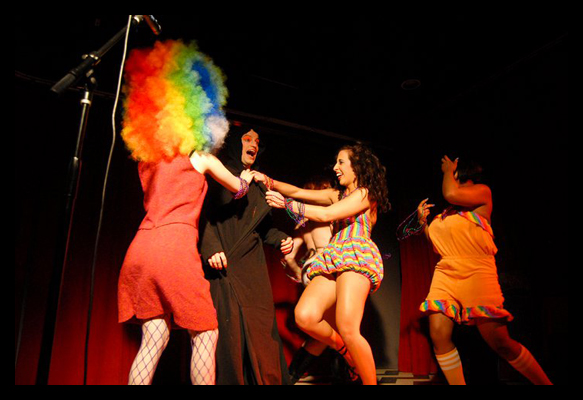
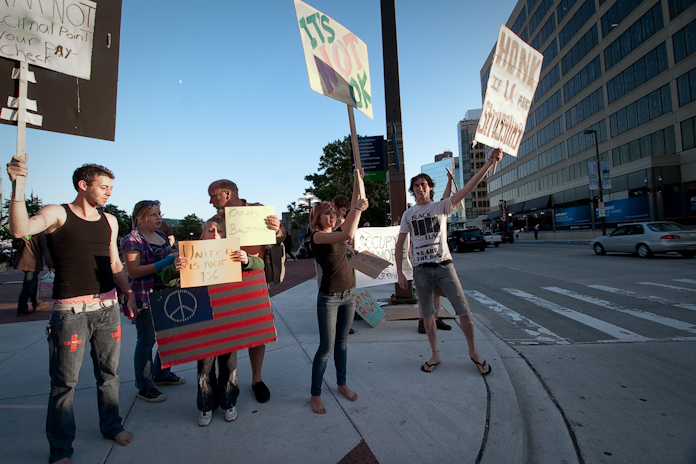
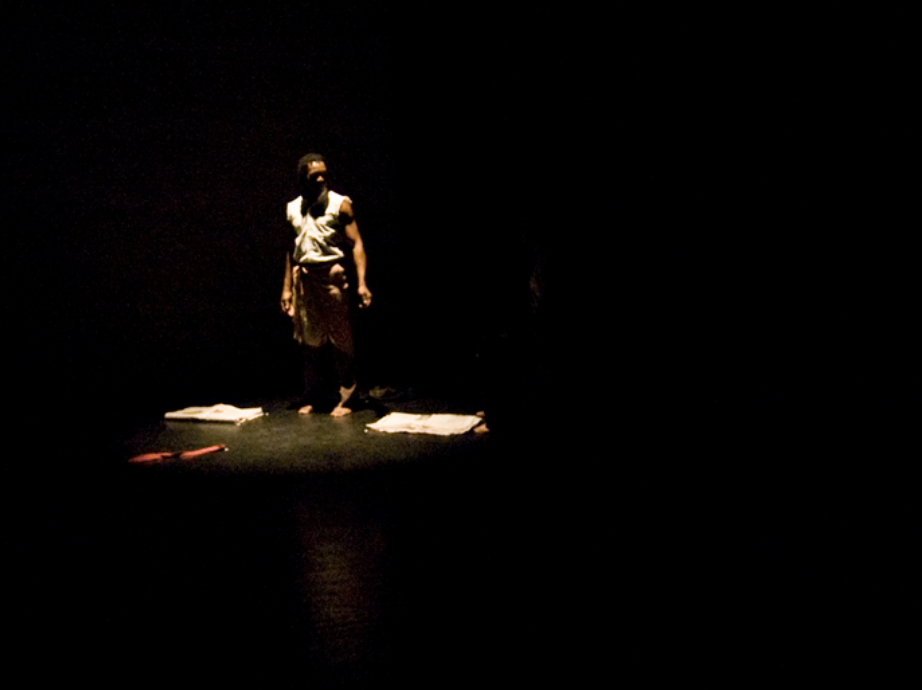
Screen capture from Gigi McKendric’s J’Accuse – Munich Olympics
* * *
In August 1972, the twentieth Olympic Games began in Munich, the first time they had been held in Germany since the Nazis hosted in 1936. In an atmosphere of tension, the Israeli team was particularly apprehensive, many of them having lost loved ones in the Holocaust some thirty years earlier.
Early on the morning of August 5, members of the Palestinian terrorist organization Black September broke into the Olympic Village and kidnapped nine Israeli athletes, mostly wrestlers. One wrestling coach and one weightlifter died resisting. The terrorists barricaded themselves in the apartment compound, demanding the release of 234 Palestinians jailed in Israel. After a day of negotiations, the terrorists were taken by helicopter to an airport, where they expected to escape. When ambushed by German police at the airport, the terrorists shot and killed all nine hostages.
Last weekend, millions watched as the 2012 Olympics kicked off with its always dramatic and spectacular opening ceremony. Gigi was outraged to learn that the International Olympic Committee (IOC) had refused to hold a moment of silence during the ceremony for the 40th anniversary of the Munich massacre. Despite a petition signed by over 100,000 individuals, including President Barack Obama, the IOC refused the minute of silence at the opening event, citing that it was neither the right time nor place, and that “their hands were tied.”
There’s a bitter resonance there, pointed out Gigi. The Israeli victims of the Munich Tragedy also had their hands tied.
In a recent article in The Jewish Times, Gigi was quoted as saying, “By not having a moment of silence, they’ve been murdered twice.”
* * *
 Front page cover of the newspaper “L’Aurore” of Thursday 13 January 1898, with the letter “J’accuse”, written by Emile Zola about the Dreyfus affair.
Long before the Munich massacre, Gigi had already begun using her art to address the frustration and sadness surrounding those whose lives were cut short by human injustice. In the 1950’s, she painted a reflection upon the Holocaust, for which she cites many personal reasons surrounding her selection of this black period of modern history. Although she did not know it at the time, this painting, entitled J’Accuse, was to be the first in a series of the same name.
J’Accuse, which means “I accuse”, comes from an open letter published in a French newspaper in 1898, in which the writer Emile Zola accused France’s president Félix Faure of anti-semitism, including the unlawful jailing of French Jewish Officer Alfred Dreyfus (Dreyfus was accused of espionage). Zola was then accused of libel, and fled the country to avoid persecution.
At the time it was made, the Holocaust reflection was not intended to become part of a series. However, as time progressed, Gigi continued to witness tragedy, and was compelled to respond. After the Kent State shootings in 1970, she completed the second piece in her now official collection of work.
Screen capture from Gigi McKendric’s J’Accuse – Munich Olympicss
Gigi could not have guessed that just two years after Kent State, she would be making the third in the series, this time for the 11 slain members of the Israeli Olympic Team in Munich. You can watch the video below.
Two installments of the J’Accuse series came later, and included the South African and Northern Ireland tragedies. All five of these were originally large scale paintings, but in the early 1990’s, Gigi translated J’Accuse into film with the support of MICA President Fred Lazarus, who provided the space for the film shoot. Combining poetry, music, and video montage, she was able to create something entirely new, as well as to share the work with a larger audience.
As Gigi states at the end of her J’Accuse DVD, “The hope is that the impact of the series will not only serve as a representation of these individual events, but of the daily inhumanity which man must cope with and learn to control.”

Gigi’s Vimeo page now receives visitors from around the world. All five of the J’Accuse films can be seen there, as well as other filmic works, along with videos of performances. Her profile on the Baker Artist Awards site also has a meaningful and representative collection of her creations which stand up to injustice, and call to give voice to those who have lost their ability to speak.
I can assure you that this is not the last you will see from Gigi McKendric within the pages of What Weekly. We have only begun to scratch the surface of a lifetime’s body of work consumed by a call to conscience. And until we all learn to respect each other, and treat one another with dignity and humanity, Gigi will continue to use art to stand up and comment on human tragedy, and provide points of reflection on human loss.
“To be silent is to acquiesce. I chose to speak through the language I am most familiar with…ART.” –Gigi McKendric
https://vimeo.com/16709892
Poem from the video:
“But it all begins again with the sound of the Entrada. A fanfare, a musical flag, if you wish. Trumpets loud and clear, announcing the many happy faces that soon walk together around the Olympic circle in harmony and unity. The old ancient games are soon to begin. Was that circle reality? The clouds of violence hover over the Olympics and the five circles of unity are broken. 11 Israeli lie dead in cold blood. Murdered. There are no more trumpets to herald a beginning, neither peace nor unity. We are all on one piece of earth holding all of us within these delicate boundaries. Is there a sense of why?”
Click here to visit Gigi McKendric’s Baker Artist Award Profile