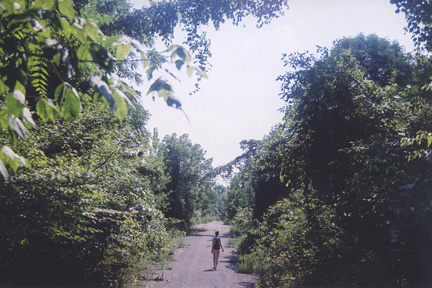
We turn off a twisting highway onto an unmarked road narrowed by the encroaching jungle. My guide is a teenage girl. Teenagers know this place: The Lost City. The road opens up into sections of parking lot. Trees and weeds push up through the asphalt. We hide the Jeep in a far corner. We walk up to a sagging chain link fence. The “No Trespassing” signs are unconvincing. There’s a padlock on the gate, but it is not, at the moment, locked.
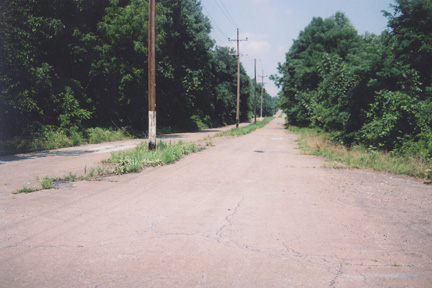
Soon we’re walking down a dual lane highway with telephone poles in the median. There are dead streetlights and intersections with rusted stop signs. The jungle envelopes low-lying buildings with busted-out windows like hollow eye sockets. It’s a post apocalyptic movie set, Cormac McCarthy’s The Road. We’re here because I have this idea for a movie that is sort of haunting me, but it’s more of a feeling than an idea, and I’m thinking if I see the right location I’m going to know what the movie is. Where do ideas come from? What troubled dream has brought this one on?
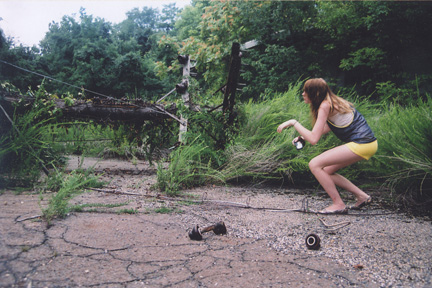
We take a side road laced overhead with crazy vines clinging to powerless power lines. The rotting pavement leads us into a forest with tree trunks the diameter of human limbs. There’s some kind of structure interwoven with the trees: terraced, horizontal boards in a vast grid—bleachers—bleachers 70 rows deep, with aisles and sections. Seating for thousands. They go on and on through the forest, encircling an arena of jungle. Ghost spectators watching a ghost contest. We walk on. What’s under our feet is never quite earth—even in the woods it feels like concrete is just under the surface. We’re about to cross the ghost highway when we hear a roar. A semi truck appears. WHAT? We hide in the bushes, not sure if we’ve been spotted. My guide doesn’t want to get caught.
We enter a weird building with a sagging roof. The institutional hallways are a deathtrap of collapsed ceilings, hanging wires, and broken glass. One room is a torture chamber, another an abruptly abandoned laboratory—mad scientist stuff. In another, we find crooked handwriting on a wall:
Hostage Situation
Contain the Event
Remove Bystanders
Set up Perimeter to contain initial event
REPORT Event to Higher HQ immediately
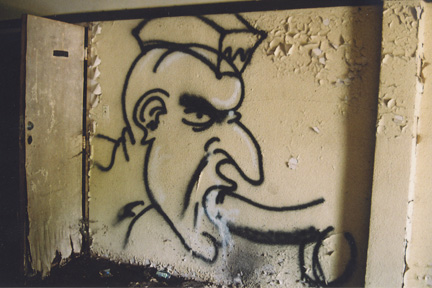
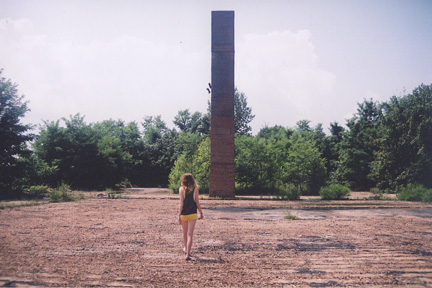
On another wall, a nicely rendered cartoon of a man boiling in a giant pot, with the slogan: Keep Out of Hot Water. Also, some spray-paint porno. Walking on, we come to realize that some of the structures are like palimpsests over older, skeletal structures. A brick chimney rises fifty feet above a rubble-strewn courtyard the size of a football field. We find a square hole—an abrupt drop-off into a cavernous underground system. Scary.
It’s been several hours, the water’s gone, and it’s time to make our exit. When we get back to the Jeep some men are standing around a semi-truck, and a few pick-ups. “You’re not allowed in here—what are you doing here?” They want our names. We’re not talking. They call the police. We split.
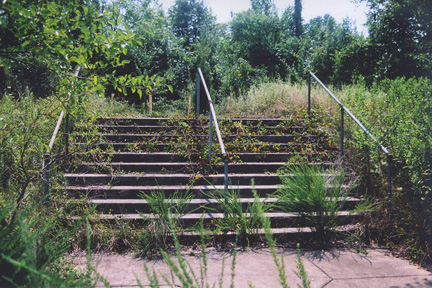
The Lost City is near the Susquehanna, and it’s pretty cool, but I realize it is not the location I’m looking for. Only later did I figure out the place has a name, and that fifty thousand people lived there. (If you want to know, start with www.usntcb.org.) It’s great history. And the guys that called the police? They were giving semi-truck driving lessons.
In bed that night I’m thinking, “I want a void, a labyrinth, a world right in front of your nose that no one ever tries to penetrate, like going behind the looking glass.” And that’s when I start thinking about the cornfield. I’m going to shoot this movie in a cornfield.
If you go to the Lost City now you’ll see guys driving gators around with strange tools, or pick-ups with robotic arms punching holes in the unnatural ground. Stimulus money is being spent. EPA spooks wading through weeds. And speculators. The Lost City will become a palimpsest over a palimpsest over a palimpsest. Some day, you might even live there.
— David Warfield