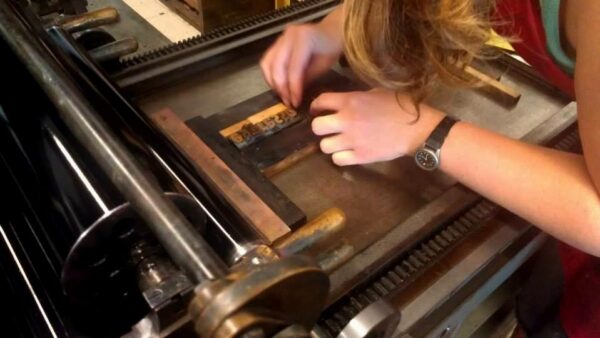
Without meaning to, Ink Press Productions co-founder Amanda McCormick compared handmade books, which are Ink Press’ specialty, to transubstantiation. When asked about what makes handmade books special, she said the process “gives the work that we produce body and blood.”
We had a good laugh about how Catholic she made it sound, but she’s right: handmade books are special objects. Often re-purposed from other materials, handmade books are more than just an vessel for their content. They are meant to be held and examined, and they have stories behind them that communicate with what’s written in them.
That is one of the many reasons why Amanda, along with fellow writer Tracy Dimond, started Ink Press Productions in 2012.
While Ink Press is best known for their DIY approach to bookmaking, they also publish a journal called Espresso Ink, host a writing group called Gin & Ink, and organize readings and related events whenever scheduling allows.
As of this writing, they’ve published/produced four books: Tracy’s Sorry I Wrote So Many Sad Poems Today, Tim Paggi’s Work Ethic, Mark Cugini’s I’m Just Happy To Be Here, and Lisa Ciccarello’s Chief!, which won Ink Press’ first micro-chapbook contest.
I got a chance to talk shop with Tracy and Amanda earlier in September, and it’s worth noting that writer/artist/frequent Ink Press collaborator Joseph Young was hovering around the perimeter of this interview for a bit, then disappeared upstairs to sing along with his stereo, blissfully ignorant of the fact that we could hear it. It was adorable.
That’s another story for another time, though.
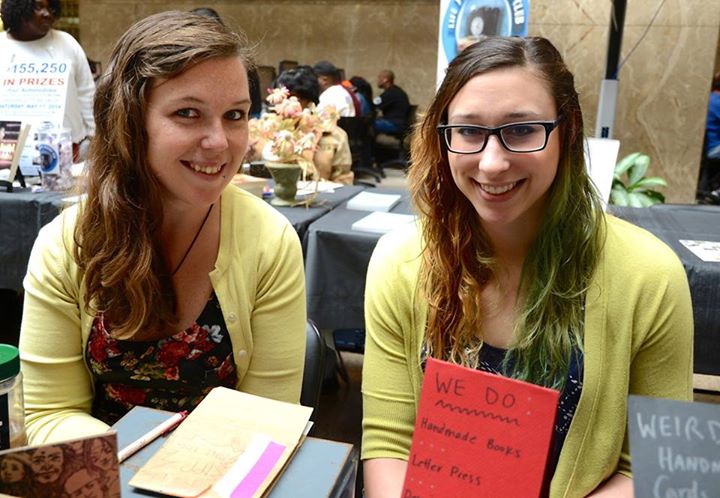
Returning to the topic, Tracy and Amanda were first-year students in the University of Baltimore’s Creative Writing & Publishing Arts graduate program when they met, and they quickly realized that they were working on similar projects with the word “Ink” somewhere in the title. They’d also both taken part in a bookmaking workshop led by Rebecca Childers, which got them excited about the artistic possibilities of small press publishing.
Armed with this knowledge, they combined their individual efforts into Ink Press.
“We worked together because we wanted to,” Amanda said. “If we pooled our resources, we could make something awesome.”
Tracy agreed, adding that “we did it backwards…[we] started a press and then figured out how to do it.”
In some ways, they’re still figuring it out, and that sense of exploration is built into how they take on new projects. Ink Press approaches books as artists first, publishers second, which leaves them flexible enough to be spontaneous and jump into new projects as they arise.
This flexibility is evident in Ink Press’ books. While all of IPP’s titles have a few similarities—namely minimalist layouts/designs and sparse front covers to streamline production—each one is unique. For example, Cugini’s book design includes cover flaps. Tracy and Amanda work closely with their authors during the creation process (not unheard of among independent presses), and they both agreed that each author’s manuscript informs the materials and how they’re assembled, folded, and bound.
“Maybe we’ll make vessels, maybe we’ll make books,” is how Amanda described the difference between traditionally-printed or perfect bound books and handmade books, and it ultimately explains why they chose their current direction.
“We did what we felt was right,” Tracy adds.
Ink Press sounds like a press that operates based on its whims, and it kind of is, but that takes a lot of work. Amanda hand-sewed all 70-something copies of Tracy’s book herself, and the full run of Tim Paggi’s book took them ten months to produce. I had to ask them what it takes to maintain a press like theirs longterm.
“Enthusiasm and energy,” Tracy told me. “If you don’t enjoy the process, you’re not going to make it past a book or two.”
That’s another interesting thing about homemade books—the author isn’t the only one putting him/herself out there. If each book is its own piece of art, then its creators are more visible and vulnerable than a printer, or even a third-party designer. There is no buck to pass when and if a handmade book is criticized or found wanting.
Luckily, Ink Press has found a lot of support in Baltimore. “Baltimore is made from a bunch of old friends,” Amanda said, recalling her first impressions of the city upon moving here from Florida. “These people want me here.”
Tracy, who is originally from New Jersey, was immediately drawn to Baltimore’s interconnectedness. “Something’s always happening,” she said. “You can start something grassroots if you’re serious about it, and people will be interested.”
They make it a point to bring Ink Press to book festivals and small press fairs whenever possible, and they’re constantly exposed to (and inspired by) other book artists and their work, but they still pull the most strength from Baltimore’s arts community, which Amanda described as “like a sponge.”
And of course, their own creative partnership keeps them motivated, too. “Tracy’s book reshaped my entire life,” Amanda said. “I have a different path now.”
Learn more about Ink Press and their current/future book projects on their official website, and also their Tumblr.