Editor’s Note: What Works Studio, the publisher of What Weekly, is proud to have Shannon Light Hadley on our team, who is also the kickass Marketing Director for the Baltimore Rock Opera Society.
The Inner Workings of Baltimore Rock Opera Society’s “The Electric Pharaoh”
A lot has changed for the Baltimore Rock Opera Society since their inception in 2007. What began as a spark of weird ambition for a small group of friends and whoever they could conscript into joining them has become a touring theatre company with five original productions under their belt and hundreds of volunteers.
In fact, BROS has grown at such a rate that the organization is being restructured into departments and transitioning into a full-fledged non-profit company.
Change—even good change—is never easy, but BROS has as big a reputation for embracing and barreling through obstacles as it does for loud, beer-soaked fun. Their upcoming production, The Electric Pharaoh, is proof of this; even though BROS is undergoing structural changes that would give pause to any other arts organization, they are gearing up for what has become their most technically-complex show to date.
In the interests of full disclosure, this writer has been a BROS volunteer since 2011, and is a member of both the script and set teams for The Electric Pharaoh. To at least try and retain some objectivity, my focus will be on the departments I haven’t interacted with all that much: directing, stage movement/combat, costumes/creatures, music, and video projections.
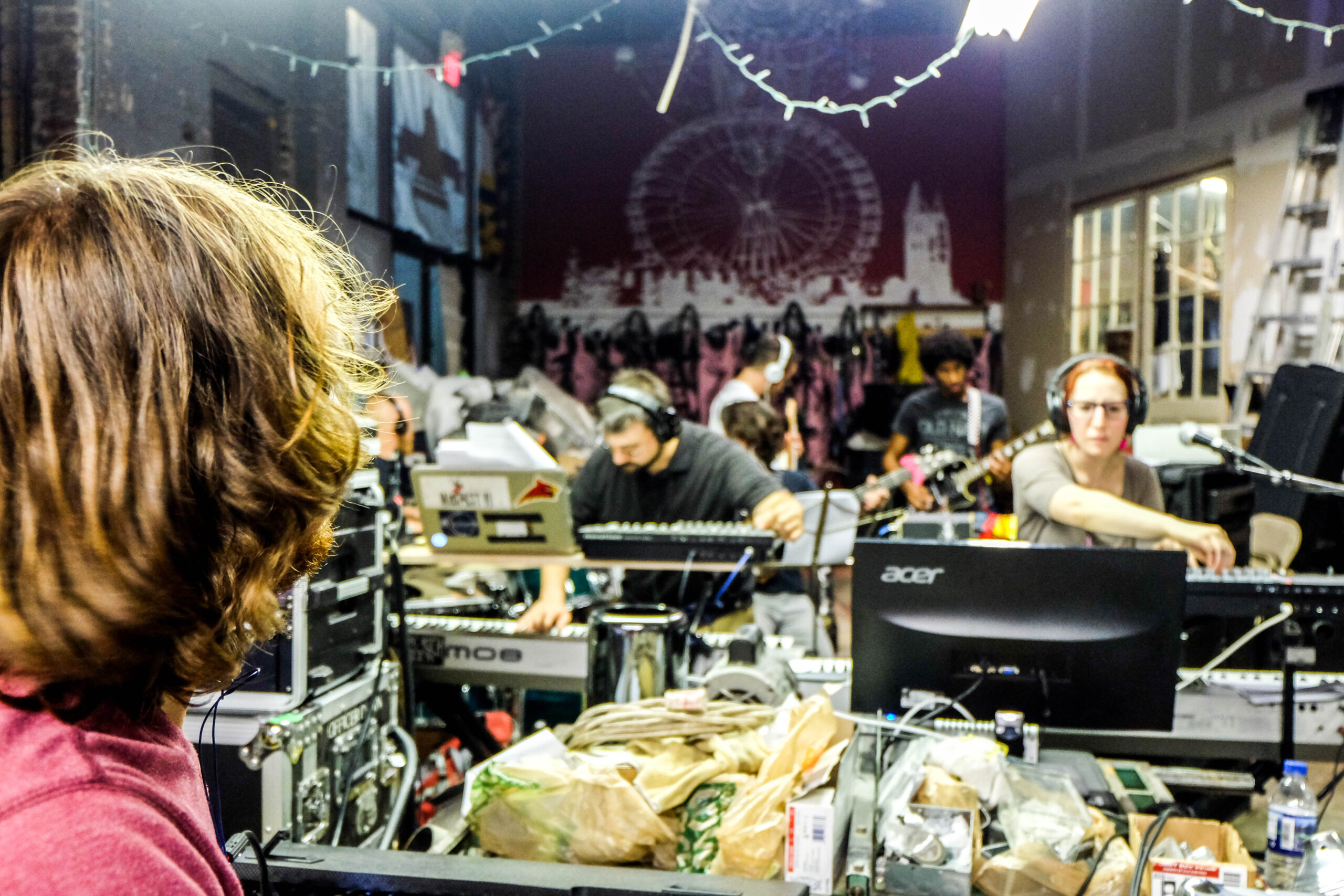
The band rehearses live with the cast for the first time in BROS HQ. Photo by Derek Vaughan Brown
Hell, the original idea for the show came from a piece of tech that lead writer Chuck Green (aka Typhoonicus) wanted to build. “I wanted to make an Egyptian Daft Punk helmet,” he told me, “and the story flies out from there like an eagle.”
The Electric Pharaoh is set in a post-apocalyptic city modeled on ancient Egypt, and centers on a young man torn between caring for his ailing mother and joining a budding revolution against the city’s Orwellian government. In keeping with BROS’ reputation for lavish stagecraft, the show incorporates projection-mapped sets, illuminated costumes, and a soundtrack that blends heavy progressive rock with electronic music.
Oh, and lasers. “I always felt like there was a need for a show with more lasers in it,” Chuck said, “[so] why not write one?”
It sounds awesome, and it will be, but this level of spectacle is highly demanding, physically and mentally. Nearly everyone I spoke to about this show balances their time commitment to their department (20+ hours a week in all cases) with a full-time job, and as we head into tech week—defined here as the time when all the lighting, stage direction, props, costumes, and acting comes together, and known colloquially as “hell week”—that number is likely to increase for everyone.
Take costumes, for example. BROS’ costume department is probably the most industrious group of people in the entire company, and they took on three additional sub-departments—Creatures, Wigs, and Armor—for this show.
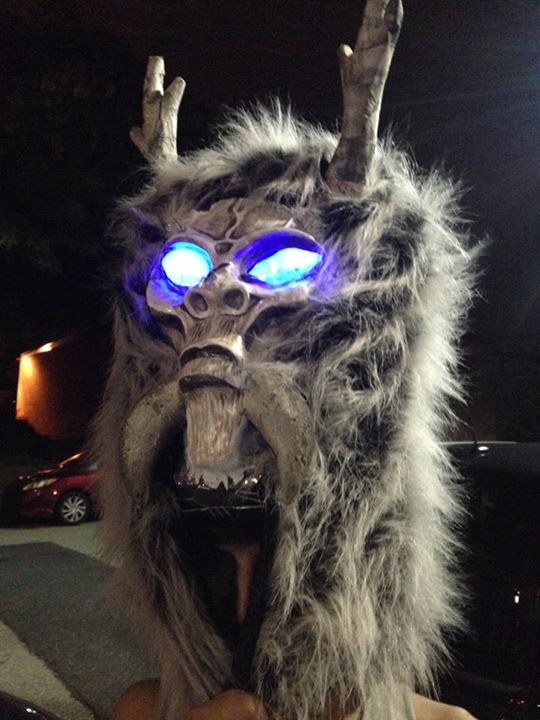
Creature costumes with LED elements. Photo by Samantha Polinik
Under the watchful eyes and skilled hands of Naomi Davidoff, who has helmed the department since Valhella in 2012, Costumes is responsible for designing all wearables for the cast, executing those designs, leading sewing and stitching workshops for new volunteers, making sure that what they’re doing syncs up with the directing and stage movement teams, and handling the costume lighting.
“Murdercastle (BROS’ 2013 mainstage production) had eight light-up costumes, The Electric Pharaoh has thirty,” Naomi told me, “including three ensembles. Every costume is being programmed to respond to lights and choreography.”
For this show, the issue of costume lighting has been delegated to Miles Pekala, who insisted that his official department title was “Lighting Wizard.” His vision, which he has been working on since Murdercastle’s run ended, was to make costume lighting that could be controlled remotely to respond to the actors’ movements, as well as live music. To that end, he has been working on configuration and control units (also known as CACUs) that communicate with a remote control system to power the lights in individual costumes.
Since this show requires so much more costume lighting than Murdercastle (which only featured light-up costumes in one dance number), Miles has spent at least 40 hours a week improving his designs to make them safer, more reliable, and more robust, a responsibility that Miles summarized with the endearing, self-deprecating motto of “eh, it’s better than last year.”
The integration of lighting technology is also a vital component of the Creatures department, led by Margaret Peterson. Margaret, who generally goes by Meg, has done front-of-house, props, and street performance with BROS before, but wanted to get more involved for The Electric Pharaoh after reading the script.
As the “Almighty Creator of Creatures,” Meg and her crew of volunteers are designing and building four creature costumes (including a yeti, pictured above) for the show; Meg is in charge of designs, budgeting, and finding volunteers, as well as communicating with the Costume department and the choreographers.
“Theatre is a lot like cooking in a restaurant,” Meg told me. “Some things take longer than others; prioritizing is very important.”
The creature costumes are made from a variety of materials that are lighter, more flexible, and friendlier to integrated tech than previous BROS designs. Along with integrated costume lighting, Meg’s mask and face designs make liberal use of vacuum forming, i.e. stretching heated plastic over a single-surface mold and forced against it by a vacuum.
The leap from peripheral volunteer to department head is a big one, and Meg credits her success in this role to the support of the BROS community, which has helped her recognize the importance of follow-through on a project of this scale.
“There is no turning back,” she told me.
Multimedia and Projections specialists Kevin Blackistone and Patrick McMinn feel the same way, and they are similarly modest about the Herculean tasks before them. They’re in charge of the projection mapping that will be heavily featured in The Electric Pharaoh’s sets; for the uninitiated (such as myself), this means designing images and landscapes to be projected onto modular display surfaces. Used properly, projection mapping can add dimension and the illusion of movement to static objects.
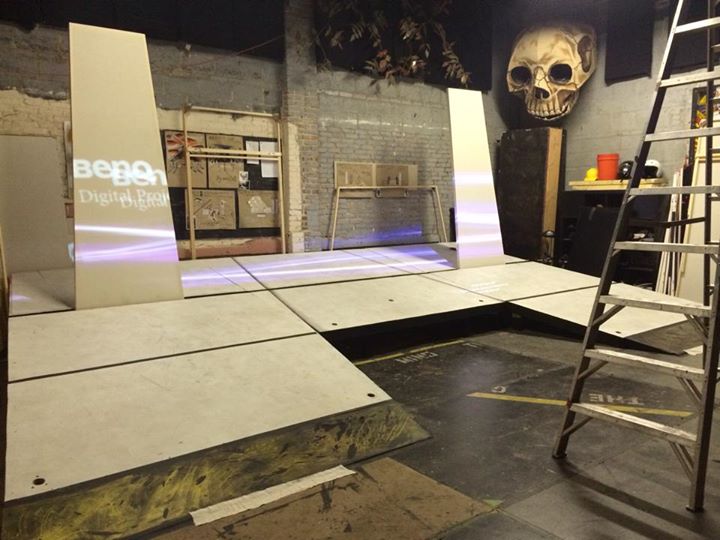
The stage will serve as a canvas for various projection mapped elements. Skelmo from Murdercastle watches the progress. Photo by Zachary Yarosz
BROS has talked about using projection mapping in shows before, and the importance of its role in the production process cannot be overstated. There is always one seemingly-insurmountable obstacle in every BROS show; in Valhella, for example, it was Yggdrasil, the Tree of Life that was the set’s centerpiece and focal point. Murdercastle’s multi-purpose set pieces required a custom-built crane to move around the stage. For The Electric Pharaoh, that obstacle is the tech, to which projection mapping is central.
Part of the BROS experience is the journey from “how are we going to do that?” to “how did we just do that?”, and the company’s ability to welcome and retain people whose skillsets aren’t an obvious fit for theatre has a lot to do with their creative successes.
Kevin and Patrick are two examples of this. Kevin, who is a member of 2640 Space and an occasional BROS helper, is in charge of designing the content. Patrick, who has never worked with BROS before, will sequence and map the content across the set pieces built by the Sets department. Patrick is also responsible for building a network through which the required tech elements can communicate.
Patrick’s job for this show is delicate and complex, but he admits that “the unknowns and impossibilities are on Kevin,” whose design job requires a knowledge of the show’s color palettes, set architecture, and music, which is a 20 hour/week commitment without factoring in rendering time.
The final frontier for tech, and in many ways the show’s nucleus, is the Music department, headed by Stephen Frank and Erica Patoka as music director and assistant music director, respectively.
Neither of them are new to BROS—Stephen contributed sound effects and soundscapes to Valhella and Murdercastle, and Erica has been a band member, vocal coach, and songwriter/lyricist for multiple BROS shows, as well as the Music Director for The Terrible Secret of Lunastus—but the integration of live rock and electronic music is something BROS has never attempted before, and that is not without its challenges.
“We have five synthesizers,” Erica told me.
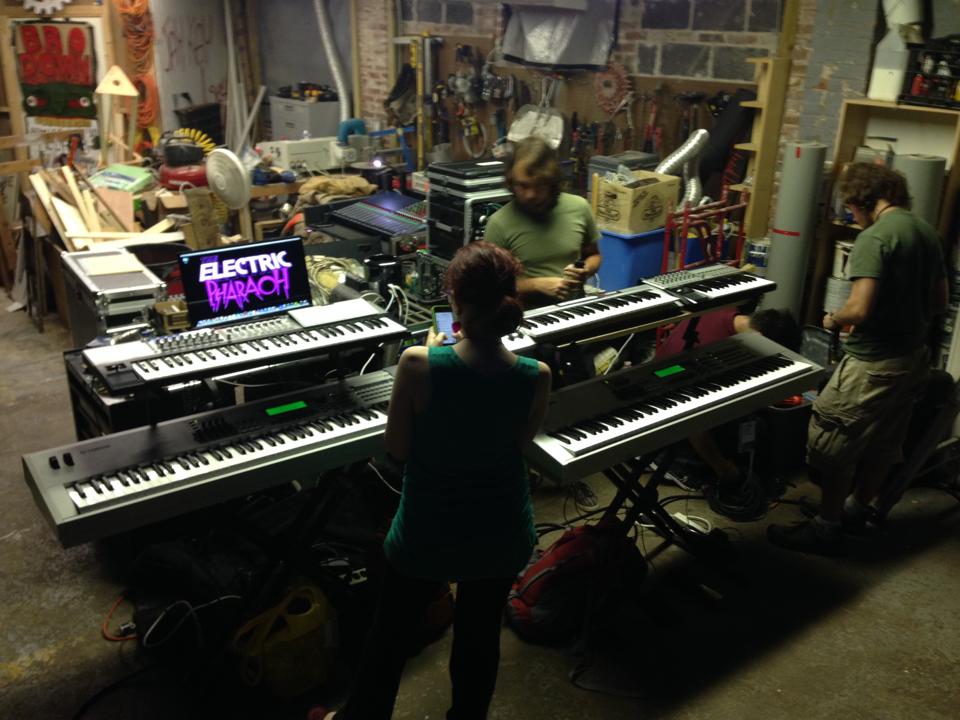
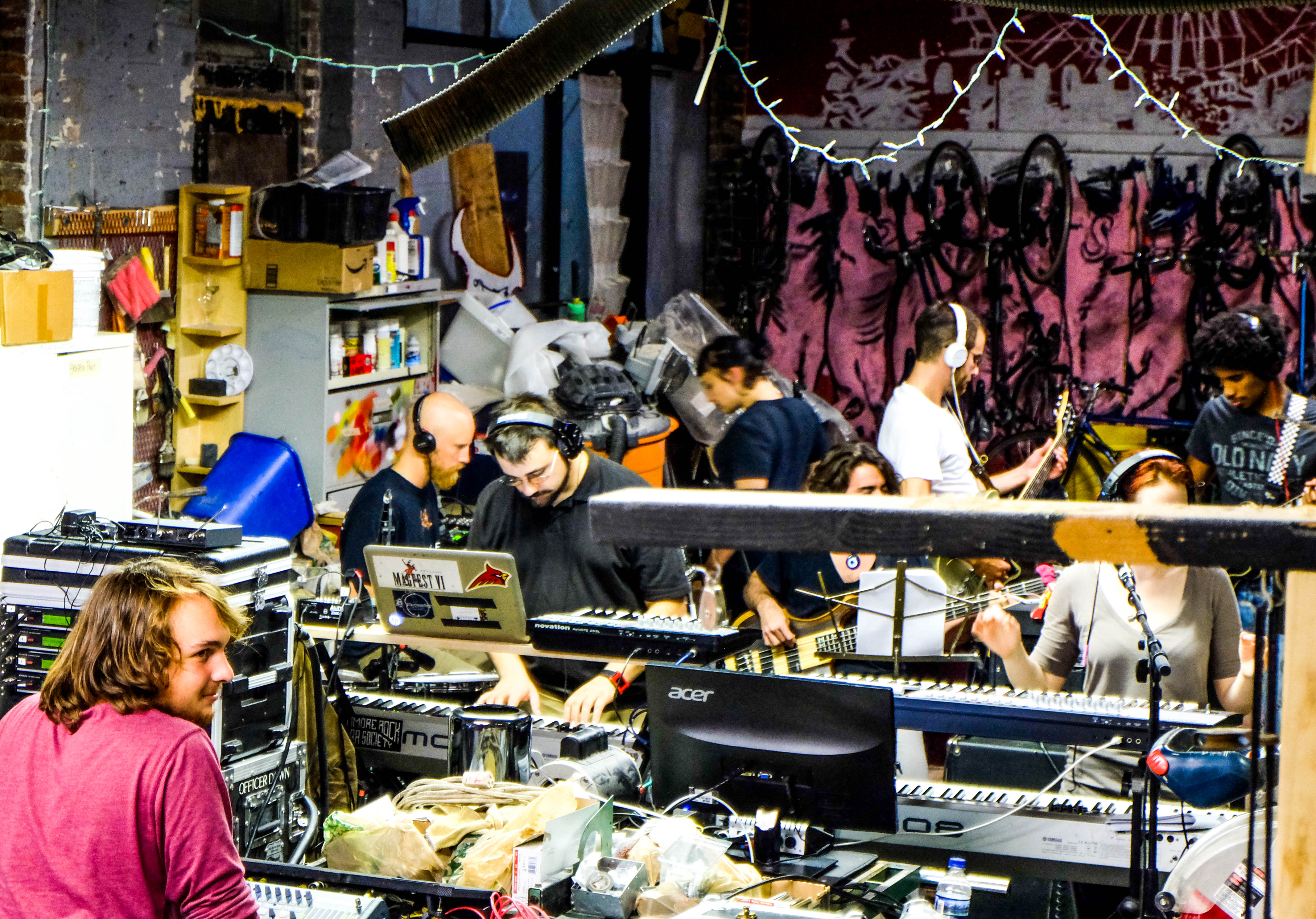
The band features “all the synths.” Photo by Greg Bowen
Stephen’s role as music director is to sculpt the overall sonic landscape of the show, and to delegate song writing and composition among his department. He and Erica were also responsible for auditioning band members, another BROS first.
When asked what the most difficult part of his job was, Stephen said that the integration of his programming and sound engineering software with a live band has been tough because the show’s music crosses so many different mediums (yes, this includes dubstep).
Erica agreed with this, and added that the song compositions are more complex for this show than previous ones, which put extra pressure on the live band and vocalists to adjust to electronic music. Both of them gave the band major credit for running their own rehearsals and being great in general, and both mentioned that the auditioning process (which was necessary because some of the BROS band regulars are taking time off for other projects) allowed them to handpick musicians who could be molded into the band this show requires.
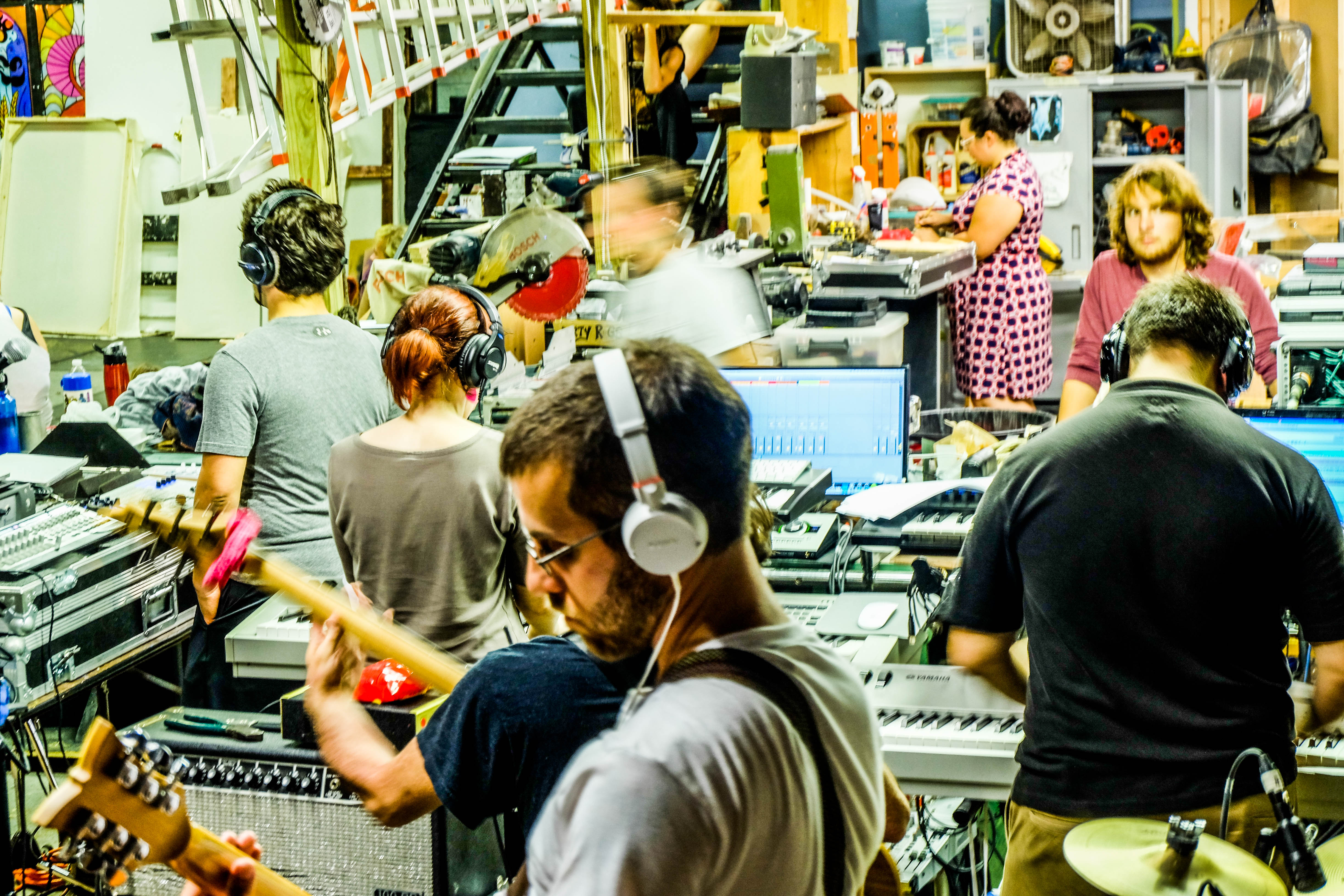
The band is crammed into the BROS HQ Scene Shop for the first Sitzprobe. Photo by Derek Vaughan Brown.
Believe it or not, tech isn’t the only source of innovation in the show. Movement Team leaders Judy Kurjan-Frank and Sarah “Flash” Gorman handle dance and fight choreography, and this show has required them both to expand their horizons.
Judy has been a choreographer for, and a dancer in, previous BROS shows, and was excited about this show’s use of dance as a narrative element instead of a purely ornamental one. Her choreography, which is written out with sections of music, takes elements from ballet, yoga, whirling dervishes, Balinese dance, and Buddhist ritual dance, as well as modern contemporary dance. Since Judy was dealing with torn ligaments in her foot for the bulk of the production, she credits her dance captain Marissa O’Guinn with guiding the dancers through the physical movements.
Sarah, who is part of the show’s ensemble, is the “Lady of the Fight,” and handled fight choreography for Murdercastle and the 2014 touring version of Gründlehämmer. Trained in hand to hand, rapier/dagger, and quarterstaff stage combat, Sarah wanted to add martial arts elements into the show’s movement, and facilitated Krav Maga and Tae Kwon Do training for the cast. She also oversees weapon handling on stage, battle/riot choreography, and stage death.
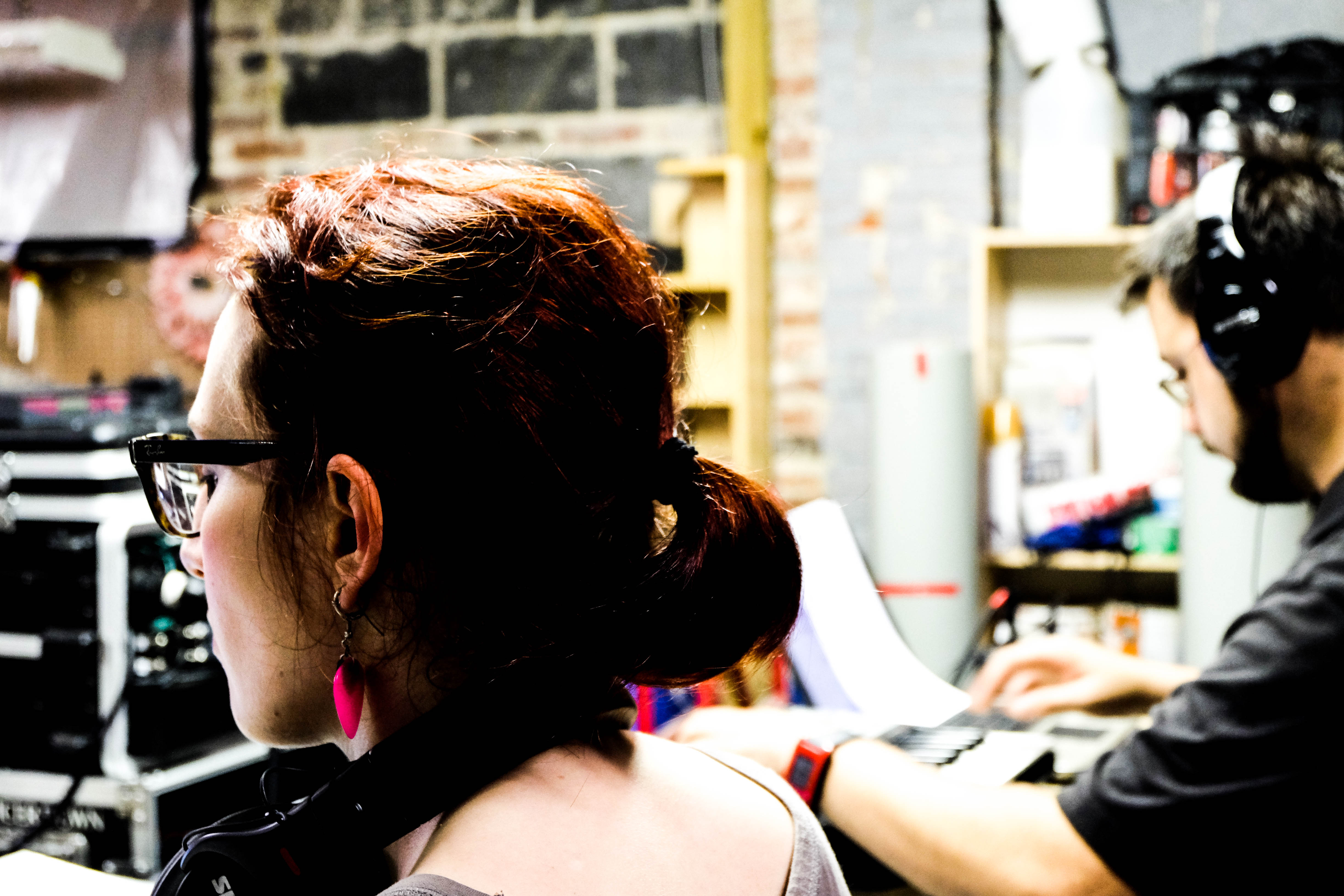
Vocal Director & Asst. Musical Director Erica Patoka (foreground) plays keys and synth alongside Dominic Cerquetti. Photo by Derek Vaughan Brown.
“This show is the most fight choreography I’ve ever done,” she told me, before saying that her job was made easier by the cast taking to it quickly, and because of her Fight Captain Lucas Gerace’s help with combining traditional stage combat and martial arts.
Everything you’ve just read—all 1000+ words of it—is being overseen by director Mason Ross, who brought a knowledge of touring theatre and DIY performance to this show, as well as a lifelong appreciation for science fiction. His job, simply put, is to bring the script to life, stay current with the other departments’ progress, and manage their perspectives and interpretations of the material with the intention of the script.
Between the aforementioned costume lighting, projections, music, and more common tech needs like stage lighting and sound engineering, Mason understands that tech communication is “a huge thing” looming over the show, so his other mission was to “get the play to the point where it could survive without tech.” The word survive is telling of how technology has been integrated into not just the stage effects and costumes, but the spirit of the show itself.
Laid out like this, it’s a lot to digest. I’d even call it overwhelming. But the beauty of live theatre is the synthesis of hundreds of individual moving parts like these into one organic, living whole. The process involved is a testament to the social contract; the levels of trust and skill and hope and determination poured into every performance, every night, are almost irreducibly complex.
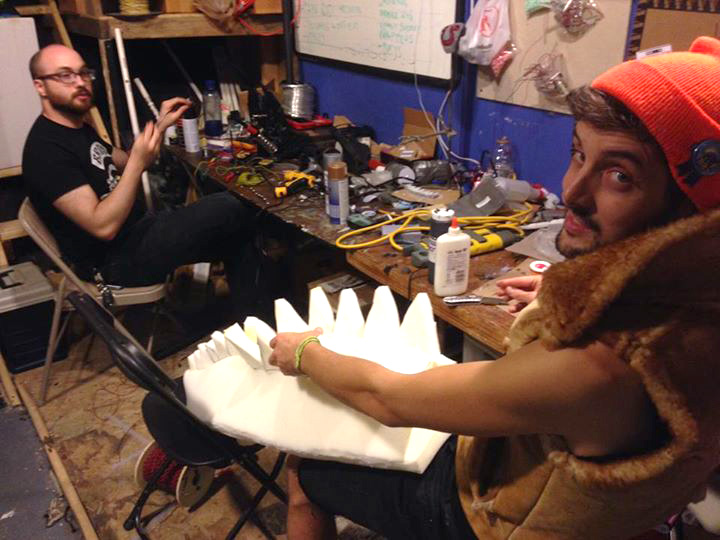
Props (Jack Sossman) and Creatures (John Marra) working side-by-side. Photo by Chuck Green.
All the tech in this show cannot drown out the heartbeat pulsing through it, through the cooperation of its moving parts, the people who give their time and talent to building community through the performing arts.
The Electric Pharaoh will be at the Lithuanian Hall on October 17-19 and 23-26, the Atlas Performing Arts Center in DC on October 31-November 2, and at Plays & Players in Philadelphia on November 14-16. Tickets are available at baltimorerockopera.org.
Check out more theatre in What Weekly here.