The curtain opens and you have options. There are three metal, backless chairs stacked in a tripod sculpture; Nick Horan’s careful, studied movement could be a modern dance sequence; the beginning of his opening monologue—“But you have friends. You have a lot of friends. What do you offer your friends to make them so supportive? What do you offer your friends to make them so supportive?”—is spoken to himself, to a ghost sitting next to him, to no one in particular.
When Che Lyons and Katie Keddell enter the space on opposite sides of Nick, they do so as parallel voices, as their own characters, and as visual counterweights. Thus 4.48 Psychosis —which kicks off the 2014-2015 season for Iron Crow Theater—sets the tone for an interrelated experience of sculpture, dance and theater within a minimal and streamlined space.
Written by Sarah Kane, 4.48 Psychosis documents the author’s struggle with depression, a struggle that ended with the author’s suicide after finishing the play. And as an abstracted, free verse document of a personal and torturous descent, it lends itself to unlimited interpretation and delivery. There are no characters; the script contains no stage directions. There is little punctuation pointing the way. The text is akin to a modernist poem. The voice—the ever-present voice in the center of the psychological turbidity—shifts, splits, and hides.
Memories are recreated with this multiphonic voice—therapy sessions, doctor visits, medication lists and side effects—and a portrait of inescapable pain emerges. It’s raw, it’s disconcerting, it’s funny and beautiful and it mirrors so well the everywhereness of the brain, the way we think of (and stress over, and recalibrate) multiple things at once. The brain is rarely linear; rather, it’s more a floating mosaic of near memory and rooted emotional landscapes and spikes of realization and confusion and despair.
Remember the light and believe the light
An instant of clarity before eternal night
don’t let me forget
Director Ryan Clark described the rehearsal process that followed an organic, embodied path. After retyping the script and delineating three distinct voices (two female, one male), as well as going through the more traditional aspects of production (the set and costume designers bringing their ideas to the table), Clark approached the work almost as if it were a devised theater production:
“We just improvised within the space and we were playing with a couple chairs and rope and paper, and these actors they just started making choices and
improvising—trial and error, trial and error, trial and error […] There’s been this wonderful collaborative process where no one person has ‘owned it’ so that we are really serving the piece.”
All of the design elements came out of what the actors were creating in rehearsal. Everyone was present for and participating in the laying of the production’s foundation. Digital projections play a large role in the piece, and, according to Clark, have really “anchored the piece” within its minimalist design.
And at times the voice is taken off the page and reworked through soundscapes that offer yet another lens for the work, which truly is less a piece of theater and more a shifting, transforming work of art that, calmly and deliberately, unwraps and reveals existential torment.
“We will create something improvisationally in the room, physically,” Clark said, “and then Nick [Horan, who is also the movement director] will go in and refine that and clean that and make some decisions and he’s been able to step out of the role of the performer and look at it from a movement director perspective.”
How can I return to form
now my formal thought has gone?
All three actors were already fans of Kane’s work, and described in similar fashions the experience of appreciating the text as a reader and how radically the words changed when they stepping into them and gave them life. Lyons said that the process has been on of the most collaborative of her career.
“I think loving and reading and experiencing the text as poetry is then a great transition into how is it a body, how is it an action, how is it a story,” Keddell said.
“We came into the process with a really clear idea of what we wanted to do,” Horan said, “but then being in the space with everyone—meeting other artists and seeing what they’re bringing to the table—and I think we’ve landed on something that is incredibly simple and impactful.”
Iron Crow’s new season is also the beginning of a redefinition of the company. Known as Baltimore’s only queer theater company, Artistic Director Steven J. Satta spoke of how the company is looking to expand the definition of queer as a means to broaden their community:
“We do a lot of same-sex love stories, which is fantastic, those stories need to be told and the community needs to see that and have that affirmed. But we are looking at what is a queer aesthetic, what is a queer sensibility.”
“We’re five years in,” Satta said, “and it’s a great moment to step back and go, ‘Who are we? Who have we grown up to be?’ A lot of the original driving forces of the company have moved on to other things, so suddenly we had all this fresh energy, these fresh voices. The mission has been refined, the aesthetic eye has been refined.
We’re looking at doing a lot more devised, original work, whether it’s a brand new play or plays like [4.48 Psychosis] as well as keep our hand in the ‘queer classics’ and not forgetting our past. We are who we always were, only more so.”
Satta explained that the company wants to highlight those who are normally left in the peripheral of society and its art. Mental illness is often stigmatized, and Satta sees a parallel between that discussion—how do we evaluate and contextualize mental illness; is it even an illness to begin with?—and discussions of queer identity vis-à-vis society at large.
Iron Crow is also working to expand their community outreach, and there are plans to work with the GLBT Community Center of Baltimore and Central Maryland. The theatre company is putting together a youth program in the spring with the aim of helping the GLCCB evolve.
“The gay community in Baltimore is a little segmented. We’ve been trying for five years to connect deeply to the community, which isn’t as unified as it could be,” Satta said. “So, we’ve started to think more about not just serving existing community, but how to become a force that helps unify community.”
Hatch opens
Stark light
A table two chairs and no windows
Here I am
and there is my body
dancing on glass
Iron Crow is opening its season with something bold, profound, and outside the comfort zone of traditional theatre. Narrative realism has hit a high water mark in television and film over the past decade. Clark sees no reason why theatre should try to win that fight; rather, theater’s live, unpredictable element and unlimited capacity for abstraction and surprise is what sets it apart and allows the creation of worlds wholly unique to the theatre and its texts.
All three actors believe this play is full of takeaways for the viewer. There is so much being offered at such a high degree of presentation and delivery, it’s impossible not to be affected by the creation.
“[4.48 Psychosis] is the type of piece that you could completely lose yourself in; you become awash in this sea of memory and beauty and sadness and hope and light and darkness,” Horan said.
What came before was just the beginning
a cyclical fear
that’s not the moon it’s the earth
A revolution
—
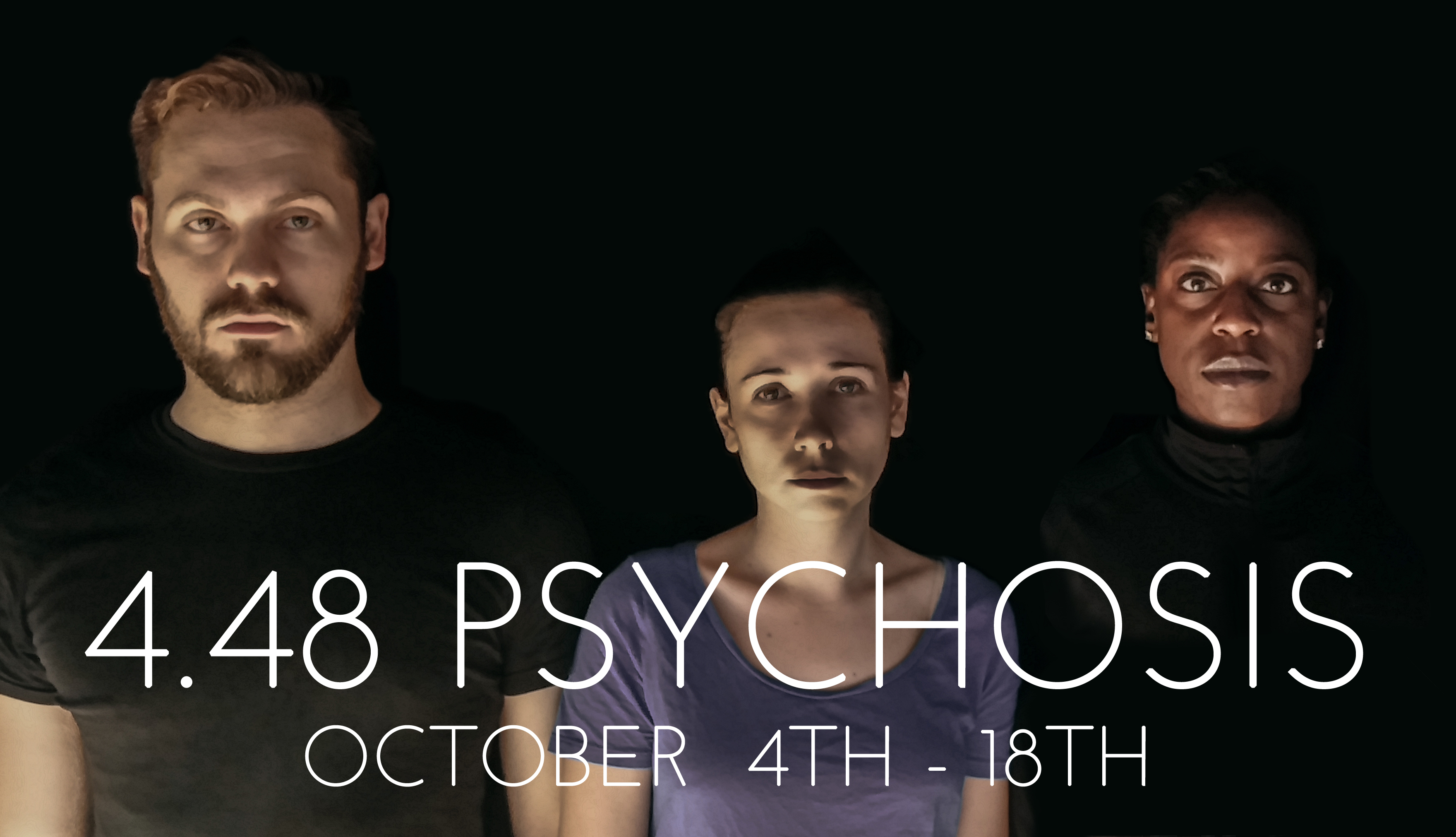
4.48 Psychosis will run from October 4th—8th at the Baltimore Theater Project.
Watch the trailer here.
Presented by Iron Crow Theater.