Steve Butz is one of the founders of Social Solutions, the leading provider performance management software for human and social services.
It was announced—between the live interview and this publication—that Social Solutions has entered into an agreement to be acquired by Vista Equity Partners, a leading private equity firm with approximately $11.5 billion in cumulative capital commitments in software, data and technology-enabled services companies. While Steve is no longer leading the company (past CEO and Chairman of the Board) he is a visionary leader with insights to share.
At the time of this interview Steve was Chairman of the Board.
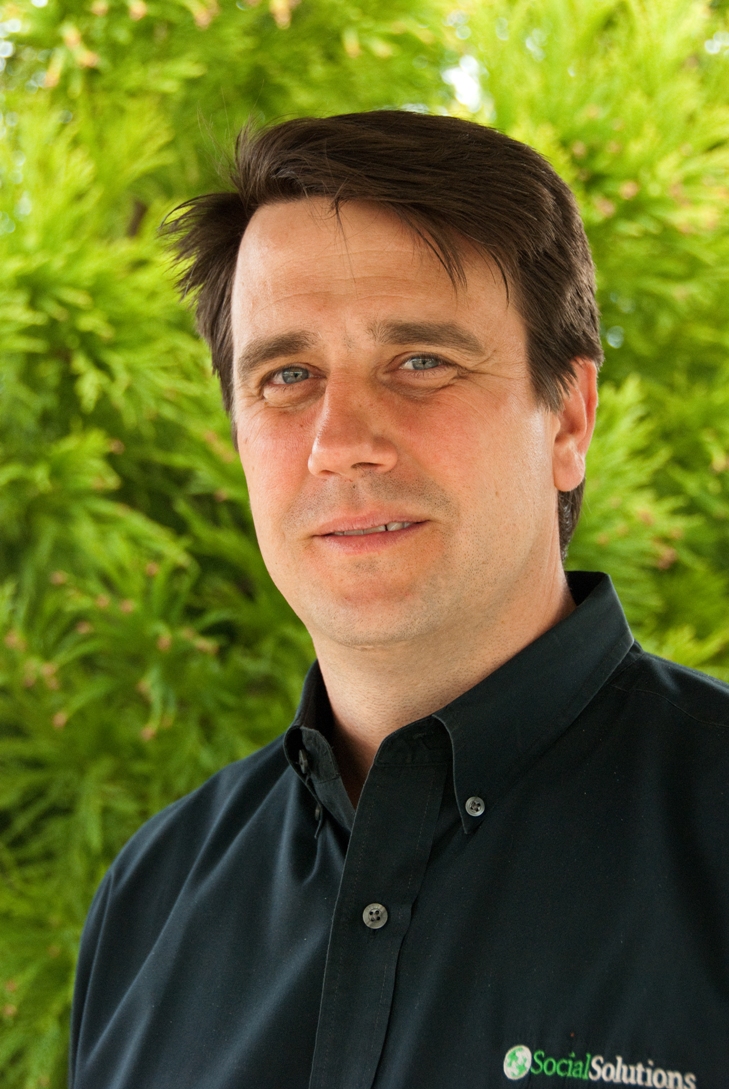
Steve Butz, Founder and Chairman of Social Solutions
Peter
Who are you leading and where are you taking them?
Steve
I’m leading a group of people that self select and subscribe to a vision. If you have a clear vision about where you want to go you do not have to constantly check to see who is following you. That’s not how my company came to be the leader in this space, in terms of performance management software. It’s of interest that our competitors look exactly like us and they mirror everything we put up on our website. It’s flattering, but it’s not something that we cultivate or care about. You have to care about what you’re trying to achieve and go after it with tremendous passion. And you will attract people based on that.
Peter
What nucleus of skills, talents and personal characteristics work together to make you an effective leader?
Steve
I’d start with humility and the belief that I don’t have all the answers. And if there’s a better idea out there I will quickly check my ego in order to embrace the better idea and hold it up as the idea we will go and achieve. From my standpoint, that skill — of not being stuck to one thing that I came up with, but to let even an idea become an amalgamation of a number of people’s inputs, and to collectively own it and go after it — is something I think a leader has got to have, first and foremost.
I definitely have a passion for customers. Anyone who is involved in a transaction where they are putting faith in my company to deliver something, I want to make sure that we are delivering to the best of our ability all the time. In terms of founding and running a business, that has driven me more than anything else. Engagement with customers, watching customers doing exactly what you intended to do with the software. Watching them make that a reality, that fires me up more than anything else.
Then I would say a willingness to work really hard, even if I sometimes make mistakes. I would put hard work above everything else. It affords you the ability to make a few mistakes. If people see you working hard they will continue to support you.
Peter
You and your company have evolved over the years. What has been constant?
Steve
The constant has been the level of effort, which speaks to the hard work. There are a number of different times in the company where you reach an inflection point. You change your strategies, you course correct, and you sometimes change personnel. It’s not always the same people working with you at the top of the organization. But the one constant is the willingness to put everything in, to be all in. And to work with passion towards whatever the goal is. Understanding the goal might change.
Peter
What is Social Solutions’ higher purpose and how do you demonstrate that?
Steve
Social Solutions is embodied by ETO software. The purpose of that product is to put front and center social service work. The outcomes or objectives of a direct service worker and the participants they work with, to put in front of that service worker objectives and indicators that allow them to understand whether they are successful or not.
This is the most important thing my company and our software is contributing to society. I believe that in ten to fifteen years all social service organizations will have something akin to ETO software that drives them, so they can understand how staff are working, how effective they are, and they can drive their staff’s interactions with intentionality. Understand whether the needle is being moved or not for the participants they are working with. Whether it is ETO software or it’s a product inspired by ETO software, this, to me, is our contribution to society.
You show it matters when you make decisions that are in line with the vision. Decisions that sometimes put the company in a position where you are making an investment that is not necessarily profit motivated.
As a practical example, if you feel like your product is not living up to its moniker, the practical implementation of the product, or living up to inspiring social workers to do better work or being more intentional, then you challenge yourself to double down on the concept and say, guys we have to find ways to make our product resonate more with end users.
Last year we changed the underlying architecture of the software so that the pieces of functionality that people would put data into are all completely rewired and reconfigured. And the reporting engine was reconfigured. These were big improvements and lots of customers thought the more flexible path was just fine. But when I really looked at it, what was missing from the product was this feedback loop for the end user, the ability to understand what kinds of things are correlated with success. And so, rather than invest in some area of our software that probably would have netted us more customers — because we are on the cutting edge in the market — we doubled down and put a lot of energy into ETO Insight, which is a reporting object inside our software that helps case managers and program managers understand correlations better.
Our customers were not looking for that. Case managers weren’t looking for that. That is me saying we have to stay true to what our mission is, what our higher purpose is. That was a significant portion of our investment in development in 2013.
Peter
How does a founder and visionary know when it’s time to let someone else run the day to day operation?
Steve
I think you have to have a recognition when you are burned-out. I wish there was a better word. I’ll give you an example that tells me when I’m done. When I need to take a break and let other people push harder.
I’ll be involved in a customer conversation and I will not be able to summon the same empathy and patience that I’ve had for years and years. That customer deserves that same level of empathy and patience and explanation as every other customer where you’ve been willing to give it to for a period of years. When you’re unable to summon that from my stand point, that’s when you say I’ve got to get other people in here to carry the torch. Customers deserve it. They’re buying that.
* * *
My goal with the leadership column is to create a bridge between the up and coming cultural creatives and entrepreneurs driving the Baltimore Renaissance and established leaders who have made an impact in the world. We have much to learn from each other.
# # #
If you liked this interview you can read more from our 5 Questions That Matter series here.