There is nothing that I cannot stand more than boastful filmmaking. You know the type. These are films that assert that their stories are going to be so much better than their peers’, that their tale is so worth hearing that you will realize not just how important the stories you just witnessed were and how elegantly they were told, but also how weak everything else you’ve ever seen has been by comparison. It is always hard for a film to live up to such lofty boasts.
The Fault in Our Stars begins with exactly that sentiment. Shailene Woodley’s Hazel lies on her back, staring up at the stars, as we hear her voice-over narration explain to us just how much audiences deserve better than a contrived happy ending. How, just like in her life, “pain must be felt” instead of smoothed over by the sounds of Peter Gabriel. These are words that I agree with wholeheartedly. I cannot begin to express just how many films, particularly American ones, opt for the happy ending instead of deciding to go bold and choose the better, often unhappy, ending. Hazel asserts that this story will be different; that The Fault in Our Stars isn’t like every other teenage romance you’ve ever seen!
However, it’s one thing to say something and it’s another thing to do it. Sure, The Fault in Our Stars is a weepy tale with an ending designed to make audiences cry that does not feature Peter Gabriel on the soundtrack, but that’s only because the filmmakers opted for the modern alternative of M83. Despite evading normal teen movie subject matter by focusing on characters with cancer, The Fault in Our Stars is just as safe and painless, if not more so, than the typical Hollywood fare.
The film tells the story, by way of voice-over narration, of Hazel (Shailene Woodley), a teenage girl with the tragic circumstances of having been diagnosed with not only thyroid cancer but also terminal lung cancer. She’s a strong and cynical fighter (who could blame her) who strongly wheels an oxygen tank wherever she goes. She wears the connective tubing from the tank proudly, as if it were just another part of her fashionable clothing and perfect hair.

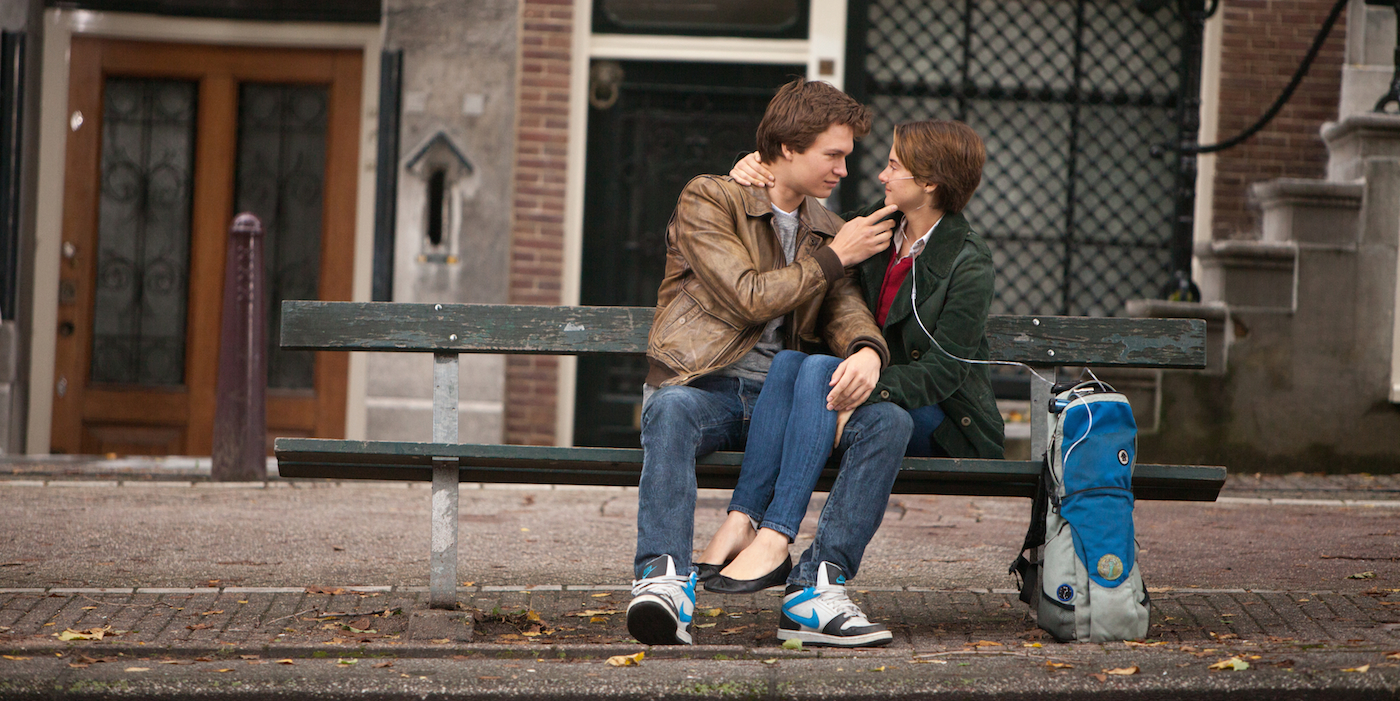
Still of Shailene Woodley and Ansel Elgort in The Fault in Our Stars (2014) Photo by James Bridges – © 2013 – Twentieth Century Fox Film Corporation.
One day, Hazel’s parents (Laura Dern and Sam Trammell) force her to attend a survivor meeting at a church that Hazel mockingly refers to as the “literal heart of Jesus Christ.” There she meets Gus (Ansel Elgort), a cancer survivor whose right leg has been amputated from the knee down but whose attitude suggests anything but fear or sadness. He’s clad in a leather jacket, as our newest James Dean wannabe, complete with cigarettes in his breast pocket. For some reason, Gus is drawn to Hazel like a moth and thus begins their quick courtship.
Other than a brief scene in Amsterdam, where the couple meet up with the disgruntled author of Hazel’s favorite book, played by the always wonderful Willem Dafoe, the script by Scott Neustadter and Michael H. Weber (500 Days of Summer, The Spectacular Now) is completely devoid of tension. The leads are instantly smitten with each other and continue on to spout corny lines lifted straight from new-agey self-help books. It’s fitting that Gus’ house is littered with motivational posters, because that’s about all either of these characters know how to speak.
Every scene in the film focuses heavily on how Hazel and Gus are dealing with how their lives have been affected by cancer. I have never had cancer and I have been fortunate enough not to experience it in my immediate family, but I have a passing awareness of just how terrible the effects of it can be. None of that is expressed here, outside of how it affects the topics both of these characters’ address in the film. Cancer is a hell, every single day, here it is a passing reminder that eventually the plot will call on Gus and/or Hazel to die.
The Fault in Our Stars’ script continues to hit audiences over the head with overt symbolism that would be cringe-worthy already if the characters didn’t feel the need to point it out. Children play on a giant skeleton, Gus balances an unlit cigarette between his teeth, and the two visit the Anne Frank museum and none of these metaphors goes unremarked. Comparing cancer to the Holocaust is one thing, but having a random crowd burst into applause at the sight of Gus and Hazel’s kiss in the solemn museum encases the film in an inescapable layer of sap.

Still of Shailene Woodley, Nat Wolff and Ansel Elgort in The Fault in Our Stars (2014) Photo by James Bridges – © 2013 – Twentieth Century Fox Film Corporation.
Shailene Woodley does her absolute best to ground the film in any way whenever she’s allowed to emote beyond her lines. When Gus initially stares her down at the survivor meeting, Shailene does a wonderful job of responding nonverbally to his strange behavior. It is only when they step outside to recite lines that it all begins to fall apart. While she’s wonderful in both films, her role and direction in The Spectacular Now allowed her the room and flexibility to push her talents further to find a far more rewarding and complicated performance.
While Shailene does the best she can, there is no avoiding the terrible characterization of Gus by costar Ansel Elgort. His character is a faux bad boy whose acting choices come from the school of Disney’s Goofy. His attempts at wooing Shailene are so forward and aggressive that he comes off as rather terrifying. He feels like a ticking clock that’s headed towards some kind of sexual assault. The character does nothing but pine after Hazel while parading his cocksure attitude around town. He constantly spouts sage advice and cheap poetics, as if he’s lived a thousand lives, yet still acts like a young child when boarding a plane for the first time. Who is this character? I’ll tell you who he is… he’s the Manic Pixie Dream Boy!
Somehow the real and cynical Hazel falls for this, or so we’re told and shown, but their unbalanced relationship never makes sense. The supporting cast’s characters are just as flimsy, serving the plot whenever they are needed. Hazel’s mother, Laura Dern, maintains an eternal perch at the entrance to Hazel’s door so that she might burst in whenever dramatics call for her. At one point she rushes in, in seconds, claiming that she was taking a bath but somehow made a land-speed record-breaking sprint to Hazel’s room and managed to dry herself as well. Almost every moment is full of unintentional comedy as characters appear in scenes just to deliver bad news before slowly and uncomfortably sneaking out of the room.
The film’s director, Josh Boone (Stuck in Love), seems to have provided almost no direction at all to The Fault in Our Stars. Scenes feel endless and the style of acting varies from actor to actor, to obviously mixed results. However, the visuals feel the most phoned in. Every scene features one of two things: characters sitting in a location or characters standing in a location, and little else. Boone’s camera sits still, focusing on simple coverage shots, and only moves when it absolutely has to. There is no inventiveness to the imagery at all. In a montage sequence that focuses on the star-crossed lovers (pun intended) texting to each other, a novel concept for a modern love scene that is rife with dramatic and visual potential, Boone’s camera just lazily drifts past the couple over and over again.
For a film that asserts that “pain must be felt” and is clearly out to inflict sadness upon its audience, The Fault in Our Stars takes absolutely no risks and reaps none of the rewards. It is a shame because many of the messages about young love and sexuality in the picture are quite progressive, a rarity amongst modern YA adaptations, but the film is handled with a big hunk of melodrama.
Summary:
The Fault in Our Stars is feel bad cinema that aims for putting tears in its audience’s eyes. My eyes were too busy rolling to notice. 1.5 Stars
Read more film reviews and movies news from What Weekly here.