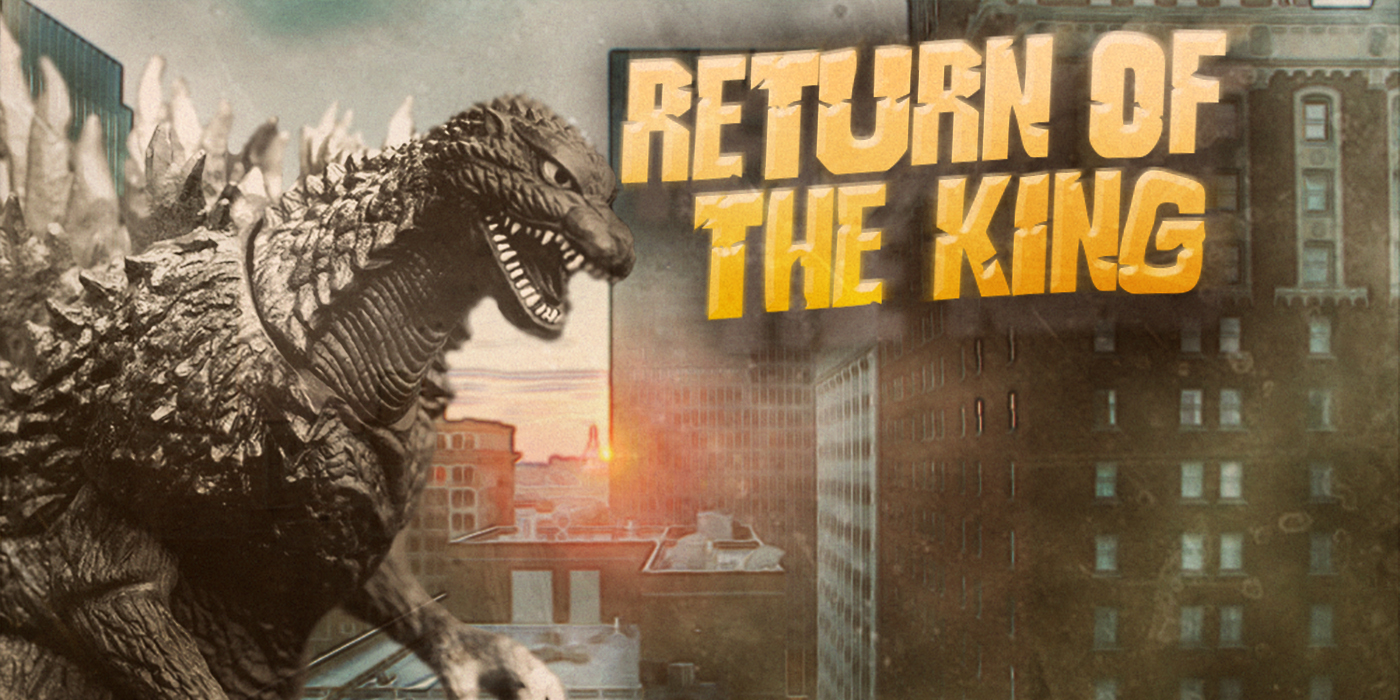
Something miraculous happened this weekend: I turned into a five-year-old again. My dad hated Barney. He thought the show was ridiculous and its pacifist message trite and infantile. However, there is a place in a dinosaur-obsessed five-year-old’s heart for a person in a rubbery suit stomping around, so my dad found the original Japanese Godzilla movies: G-rated, poorly dubbed, black and white, hour and a half-long romps full of monsters punching each other, miserably unconvincing special effects, and model-town carnage on an unprecedented scale.
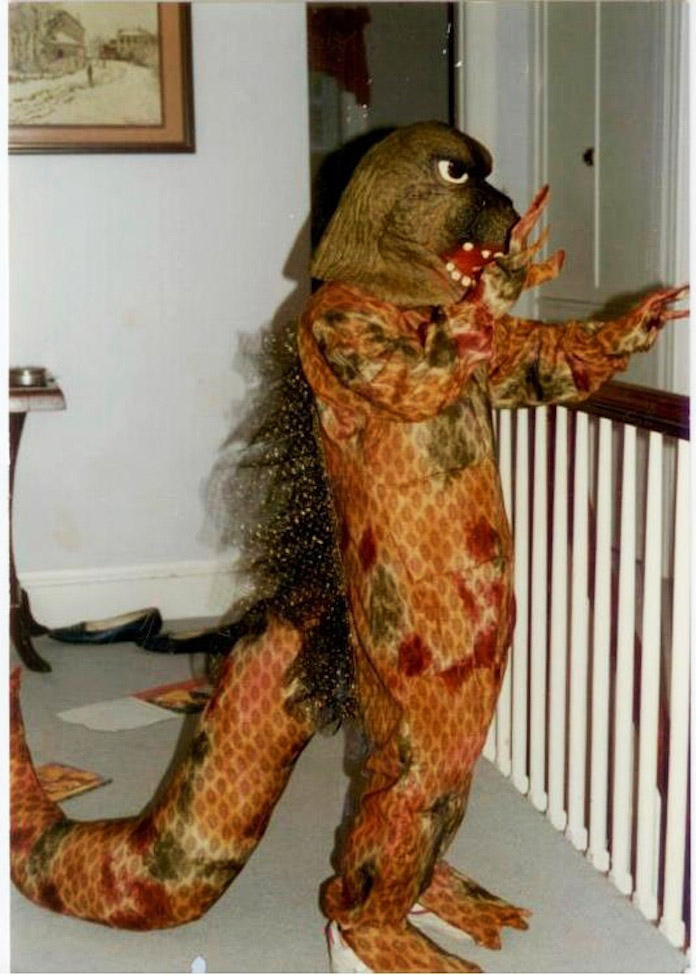
But five-year-olds are undemanding audiences: my sister and I ate up the Godzilla movies, starting with 1954’s Gojira and continuing on to such greats as King Kong Vs. Godzilla (1962), Ghidorah, the Three-Headed Monster (1964), and my personal favorite, Destroy All Monsters (1968). Watching giant monsters beat each other up and destroy long-suffering Tokyo never really got old. My family even got so into it that we went to a Godzilla convention in New York City, where I entered a costume contest wearing the inspired Godzilla suit my mother created. I took first prize; you can see why below:
So you can say I have a bit of a history with Big G. As I grew up, I started to demand a little more in terms of special effects, backstory, and overall acting (as in, I’d like to see some), but Godzilla remained in my heart. At least, until last winter, when I learned that he would be returning to the big screen.
My first thought was, “Don’t fuck this up. This is my childhood you’re messing with here and if you want to see fire breath you should make a shitty summer blockbuster-bait movie that everyone roundly and deservedly pans, just like that fucking iguana in ’98 (looking at you, Roland Emmerich).”
It certainly took long enough to get our first full-frontal of the King of the Monsters in Gareth Edwards’s Godzilla (2014) – probably too long. I recognize that Bryan Cranston is so hot right now, but I spent far too much time watching words come out of his mouth and not enough time watching monsters punch each other into buildings. This issue continued throughout the film, and it’s one that plenty of other people have gone on about at length, so I won’t say much more than that there were too many humans and not enough monsters.
The film curiously positions Godzilla as a kind of ecowarrior, arising from the watery depths where we sent him back in (oh hai) 1954 to bring balance to a world unbalanced by human nuclear experimentation. I won’t get into it too much, but this is not the position Godzilla usually takes. In Gojira he’s unequivocally a force of destruction, a radioactive incarnation of Japan’s anxiety regarding the Atomic Age. As the franchise went on, he did often arise from those watery depths to save the world, but it’s not as the movie paints him: Earth’s defender that, because of his monstrous form, is hard for us humans to accept. Instead, Godzilla saves Tokyo because he wants to destroy it, and Ghidorah or Gigan or Mechagodzilla is horning in on his turf, dammit! He’s an antihero, albeit a playful one, from before the concept was really articulated. You rooted for him often because he was the least-worst answer, not because he really cared.
It’s highly interesting that most of the major monster showdowns take place in environments of modern American decadence: first a resort in Hawaii, that tourist paradise; Las Vegas, which doesn’t really require explanation; and San Francisco, height of today’s technology boom, where people build apps to sell empty parking spaces and speak in hashtags, while a housing crisis is going on as we speak. The film references none of these things, and yet these are the cities that get leveled. Coincidence? I think not!
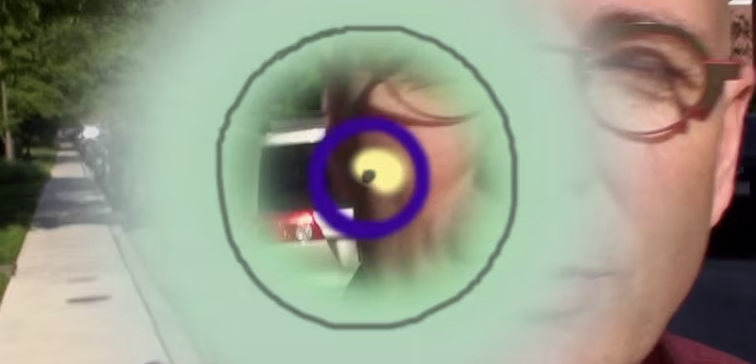
There’s a moment when, taking a beating from the movie’s actual enemies, Godzilla is falling to his knees, and the movie’s main human, Ford (Kick-Ass’s Aaron Taylor-Johnson), standing on top of a building, finds himself at eye level with Big G. Godzilla isn’t looking at him, per se, but you can see a grim, ancient tiredness in the tiny yellow eye; he’s a thousand years old, and this is not his first rodeo. While this film’s universe is a reboot, the start of something new, and only briefly references its source material, in that moment Godzilla carries the gravitas and history of sixty years of Godzilla movies.
So, there’s way too much footage of humans talking, humans running, humans discussing battle plans that ultimately go to shit. The narrative convenience also runs hella strong: somehow Ford and his father always seem to arrive just as things are about to go down (I would say the nick of time, but they don’t generally affect the outcome too much; monsters are gonna fight, and that’s what we came here to see). But all of that doesn’t matter. It doesn’t matter that Ken Watanabe’s screen presence is relegated to delivering grim oracular clichés; it doesn’t matter that far too much of the camera focuses on Walter White and his generic beefcake of a son.
It doesn’t matter because you’re five years old again, and the monsters are going to fight.