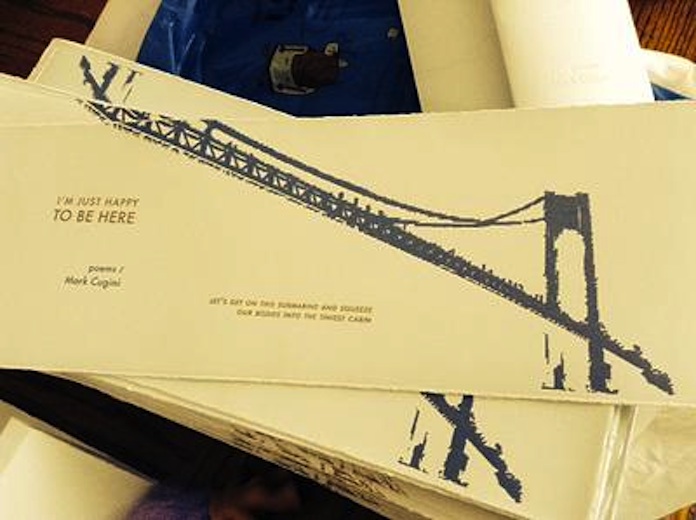
D.C. poet, publisher, and all-around tornado of enthusiasm and goodness, Mark Cugini, is alive and happy about it. He wants you to know that you are alive, too. In his new collection, I’m Just Happy To Be Here, forthcoming from Baltimore’s InkPress Productions, he drops tender reminders, words and sounds like needles jumping across the loose beat on a worn record. Have I mentioned I love this guy and pretty much everything that he does, whether as host of his Three Tents Reading Series in Washington, publishing his excellent journal/small press, Big Lucks, or blasting charmed and rollicking audiences at area-events, Cug is a consistent force of love and freshness on the local literary scene. Enough from me. Pre-order his book at the link below and read the interview. Mark is fantastic. If you don’t already know him, get on it.
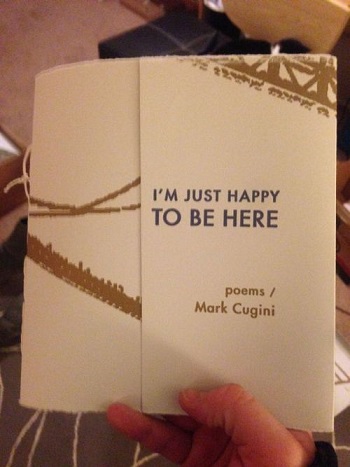

(I’m Just Happy To Be Here, Ink Press Productions: http://www.inkpressproductions.com/#!product/prd1/1725879715/i’m-just-happy-to-be-here%2C-pre-order)
WW: This is a fun book, Mark. What’s up with that? You trying to make poetry fun or something?
Cug: Oh, wow, thanks so much for saying that. I was definitely trying to write a fun book of poetry. I studied fiction for most of my adult life and–even though I took numerous poetry courses in undergraduate and graduate school–I was never really drawn to poetry. I think a lot of that has to do with who I was reading in these courses–Eliot, Pound, Keats, friggin’ Milton–and the manner in which my peers discussed these poems. The academy really has a nice way of taking a shit on anything that’s supposed to just be really fun–like, I could give a fuck about symbolism or context or meaning. So I wanted I’m Just Happy To Be Here to be less like a thought experiment and more like a foam party. I think all poetry should make you feel like you’re at a foam party–if your audience isn’t sticky and sweating and suffocating, I think you’re doing it wrong.
WW: I like that idea a lot. It would make a good book title or band name, too – Foam Party…Okay with music on the head now, I want to talk about rap and poetics. So you and I are friends and I know you love the hip-hop music. This poetry collection is full of cultural references to hip-hop as well as stylistic nods to the aesthetic itself, for instance there is tons of hometown NYC love, “I am” statements, nostalgia for an urban youth, et cetera. Since hip hop itself is so lyrically focused – a kind of poetry itself – it is interesting to read a free-verse, contemporary book of poems that not only celebrates hip-hop but at times feels like it is actively participating in it, like it is a kind of new rap music – or an extension of rap music – without rhymes. Does that make any sense? Tell me your thoughts. I want to hear you talk about hip-hop and poetry basically, Cug. Shoot.
Cug: Oh, yeah, that absolutely makes sense and thanks for saying that. I don’t see much of a difference between poetry and hip-hop–they share so many of the same literary devices, formal structures, and emotional sentiments (for real, is there any difference between “Howl” and Kendrick’s verse in “Control?”). But hip-hop has a much larger cultural carbon footprint nowadays, and I think that has something to do with accessibility. Hip-hop speaks to a set of ideological state apparatuses that is familiar to a general audience–all of us, regardless of class and culture and privilege, have to create social constructs for ourselves that grant us a licence to the ideology of Starting From The Bottom. Now, I recognize that a lot of poetry is trying to do the same thing. But is there anything accessible about “experimental” poetry? If my dad read it, would he understand? I’m not sure. And that was my objective–to write a book that anyone could read and relate to. I feel like part of the reason I love hip-hop is because anyone can be a participant–whether they’re dancing on singing along or Tumblring or Tweeting challenges to Wale. Everyone’s invited. Everyone’s invited to my book, too. Take it to prom. Take it to the dentist. Take it to the corner bodega and buy it a 40.
WW: That’s good. I can dig that for sure. The poems totally have an open, accessible vibe to them. Like I said when we started, they are fun – but they are so many things. Humorous, bittersweet, triumphant and proud in that fragile, human way…They reference and address the culture of poetry in a cool way too. I am especially thinking of “All Gold, Everything”, which turns the cliche of “the color poem” on its head, using gold primarily as a material and really exploiting all the layers of meaning built into our ideas about gold. References to Wallace Stevens, William Carlos ‘Williams, Kenneth Koch that feel like shout outs as much comments about. I loved the way you turn James Tate’s How The Pope is Chosen” on its head in “You Damn Lames” too. Who are some of writers (and musicians, too; whoever is relevant, really) that influenced you as you were putting the book together? Who’s writing makes your hair stand up and curl like it is bowing in appreciation?
Cug: Mike Young is a very, very big influence on me–reading him has changed the way I see the world in so many ways that it feels impossible to articulate. Sampson Starkweather and Dana Ward helped me understand that poetry is 40% myth-making and 60% of being the dopest, most honest version of your poetic self. Nick Sturm and Sasha Fletcher gave me the license to write about uninhibited joy; Amy Lawless and Seth Landman gave me a vocabulary to write about sadness and loss. Carrie Lorig showed me how to make a word boom//bloom. I wouldn’t have finished this book if not for those beautiful people. I love each of them so much.
I like that you read those Stevens and WCW lines as shout-outs. I can appreciate that reading and I love those bros, but that wasn’t my intent. It’s 2014, you know, and you and I, we’re alive. I want to be alive. My poems want to be alive, and they want to be alive and screaming with other living people. Stevens and WCW and Whitman were alive once, too, but it’s 2014 and they’re not alive anymore. I’ve been in bed with T.S. Elliot and we’ve had a lot of raunchy nights together. But it’s still 2014 and we off dat. I don’t give a fuck about continuing in some literary tradition. I don’t give a fuck about the preservation of verse. It two-thousand-and-fucking-fourteen. Let’s bling this shit out. Let’s get ratchet. Let’s dip this shit in gold.