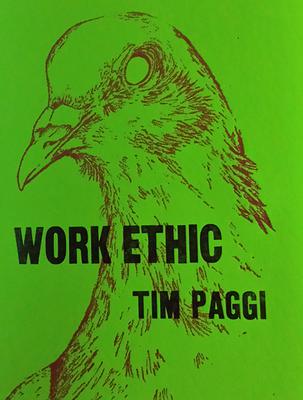
Poetry is not always concerned with standing at intersections in yellow woods or chasing repetitious ravens from your chamber door, sometimes it is a lot of hard work. In his new book of short poems, Work Ethic, Tim Paggi takes us there and beyond with a gentle hand and a strange, off-kilter wit. It really is a charming book.
InkPress Productions is releasing a beautiful, hand-bound, letter-pressed chapbook of these poems and you should do yourself a paper and pick up a copy. The release party is at The Crown on Charles Street, January 30th, with music, cake, dancing and, of course, great-looking books. Choose between varying pink and green inside covers! Here is a link to the Facebook Event Page: https://m.facebook.com/events/593827677358900/?context=create&ref_dashboard_filter=upcoming#
Work Ethic is also available for purchase on the InkPress website, here: http://www.inkpressproductions.com/#!product/prd1/1414268521/work-ethic
Tim was cool enough to chat with me online about the book. Here is what happened:
What Weekly: So tell me a little about the title, Work Ethic, and how the book came together?
Tim Paggi: Work Ethic is the title of one of the poems, and Tracy suggested it as the collection’s title during one of a few discussions we had about the manuscript. It’s an apt name for the book, a lot of which is about the many kinds of “work” I do. Working at various jobs, sure, the poems do talk about that–but more so, like, the actual writing of the poems, to me, became about dedication. To love, mainly. But also about facing fear, working though it, which takes a lot of unpleasant effort for pretty much anyone.
In terms of it coming together, Amanda [McCormick] — who runs InkPress with Tracy [Dimond] –asked me if I wanted to produce a chapbook after a poetry workshop we had together at UB. We’re both in the MFA program–which has become something of a hub for the Baltimore lit scene–much more so than Hopkins ever has been, at least (ZING!). Of course I said yes. They’d just put out Tracy’s book, which not only contained some of the brightest poetry I’d seen in a while, but also it was a, like, really real and artfully made book. So I went back and forth through a few manuscripts with them, until we chiseled it into the mean, lean poembeast it is. I’m so stoked about the book, they’re doing a great job with it. The interior cover illustration is by my good friend and longtime collaborator Kaitlin Murphy, and it’s quite striking.
WW: I like that, about the title. I often think it is interesting artists refer to their creations as “works” and to their process as “working.” I feel like we can sort of choose or not choose to think of anything as “work” or something. Here’s a question folks might like to know the answer to: How did you pick the words in the poems in Work Ethic (i.e…tell me a little about process, technique, all the stuff that will make non-poets click away to check their Twitter.)
TP: The words, the words. My writing begins process begins in intense free-writes in a moleskine. My journal looks like the journal of the lonely janitor who never talks or had friends and then after he dies people find his journals and they’re like, “wow, this guy WAS crazy.” It’s just solid text from top to bottom. Anyway, my actual poems are pretty structured. So I’ll comb through the free-writes and pick out interesting ideas, fragments, words, lines–something like “I am dao with the clown” or “a penguin stares to its feet, and sees no precious stone.” From there I add pieces to it. For this collection, each poem is 14 lines, and each line is eight syllables or less. The restrictions help me envision a final product, help me convince myself the poem is finished at a certain point.
WW: Word. One of the things I think you do in a neat way in these poems, in a way that I find really intriguing, is finding new, unexpected purposes or meanings for words. Like, you verb nouns and noun verbs or something. Does that make sense or do you recognize that in your work? Care to say anything about playing with the function of words?
TP: Thanks, I’m glad you noticed that. With lines like “Soda me gently/into death’s dark cradle” (Victim of Delicious) or, “I am kittened into your blank document” (My Ow Mix), I’m trying to, in a way, write gesturally–to think of each individual word a bit more like a stroke of paint than, like, strictly a lego of vocabulary that signifies a specific meaning. That said, it’s important to me that a sort of layered meaning has the opportunity to emerge from this attempted invention–like the idea of being “soda-ed” to death by society, to me, is like cutting through the bullshit and finding an efficient way, a poetic way, of stating a very real terror: that cheap sweetness is rotting me physically and spiritually and that I am aware of and complacent to that fact. Am I sounding obvious yet? B) A lot of times I’m just having fun with the words. “Kittening” myself into someone’s “blank document,” well, that’s even more of an abstraction of a concept. And I feel satisfied with lines like that, because when it does and does not achieve meaning simultaneously, it achieves poetry!
WW: So, fuck the poetry for a second, Tim. Let’s find out about you. Where are you from? If not Baltimore, what made you choose to marry us (or at least make us your mistress) during this part of your life? And also, if you were to start a street gang, sorority, or professional sports team, what colors would you wear?
TP: Me? I’m from Vermont. I grew up in the towns of Burlington and Stowe. My street gang colors: glow in the dark pink and blue. Or orange and purple, my favorite color combination.
WW: Vermont, eh? What brought you to Baltimore? And you mentioned the UB program earlier; how did you get involved in that?
TP: Well, I moved to Baltimore to go to Goucher College (I studied creative writing with Madison Bell–at the time I was writing a lot of darkly whimsical, quasi Dickensian fiction). I really didn’t know anything about the city at the time. It took me a couple years to discover the weird music and theater and lit scenes hiding in the corners–and it was those scenes that eventually kept me here, and convinced me that, true to title, Baltimore is the “Greatest City in America.” For a few years out of school, I wrote plays for community theaters and made a good living–a better living than I’ll ever make again, perhaps–writing advertising copy for Agora–I quit all that and eventually met up with the people who would become Annex Theater and started working and traveling with them, doing shows inspired by Wham City and Missoula Oblongata, and Grotowski’s Poor Theater. I am of the opinion that the Baltimore Art’s Scene is the finest in the country, there’s no way I’d trade it for NYC, not for a million bucks.
WW: Dig it. I grew up here so I am always interested to find out why folks from out of town end up here and thrilled whenever they dig deep enough into the city to find out how cool it is and want to stay.
TP: Going to UB to get an MFA seemed like a logical thing to try. It’s basically in my backyard, why not go? And let’s face it, while being a big pain in the ass and expensive ordeal, school is also a lot of fun, and gives you the opportunity to think and work at the subjects you’re passionate about in an environment of structured activity. I like doing things and meeting random people, and grad school offers opportunity for both. I try not to let it dominate my personality, it’s just something I work at a few nights a week.
WW: UB’s program is pretty fun too. They make it fun and practical. When I first went there, I remember just being so excited that there was a writing program that existed at all – much less here in town – with courses in design and publishing, etc. I had no idea…Okay. One more question: When i was a kid I used to read interviews in skateboard magazines and they would always ask the skateboarders to give “shout outs” at the end. Is there anything in the universe that you would like to “shout out”? Your response may be directed either at or to the subject of your “shout out.”
TP: I got to give a shout out to reptilian conspiracy theorists, rite aid cashiers, freestyle slam poets, new age doctors without degrees, real estate agents, jam bassists, Facebook friends, “Trancegod,” Waldenbooks, and Yau Brothers. Peace!