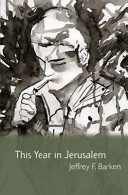
This Year in Jerusalem is a collection of interconnected short stories by Jeffrey F. Barken. The book contains beautiful India ink and acrylic illustrations by Diane Muller. The stories take place in the US and the Middle East and reveal the sometimes deeply overlapping and other times just barely touching links in the lives of a group of world travelers. You can pick up a copy right here: http://www.amazon.com/This-Year-Jerusalem-Jeffrey-Barken/dp/0989302903
Liam called me on a Thursday. He said he would be down on Saturday to pick me up. To tell the truth, his call caught me off guard. A month had passed since we’d met at the King David Hotel in Jerusalem and I was sure that he and Lilly had gone back to London.
“You’re where?” Liam wanted to know. I told him about the kibbutz where I was volunteering and my work as a landscaper.
“All right, that’s grand,” he said. “I’ll look it up and be down to fetch you. I’ve got a car rented.”
At that, he hung up, leaving me with no idea what time or even where I should meet him.
When Liam called again the next day, I started to realize that this was his manner of organizing. Liam liked to build up hype.
“Gaza!” he said. “Have you any idea how close you are to Gaza?”
I laughed and said I could see the besieged Palestinian city from my window.
“Jesus. Well, I want to get as close as an Englishman can get. I want to see the guns in Gaza. Gaza, Gaza, Gaza!” he said, loving that word.
To save time and phone credit, I quickly gave him all the necessary details that our previous conversation had lacked and said a mocking, “Cheerio,” before hanging up amidst his wheezy laughter.
On Saturday, I found Liam exactly where I’d said to meet. He had rented a cheap blue Fiat and parked in front of the kibbutz gate. As I approached, I found him standing in the shade of a date palm, finishing a cigarette. We shook hands and Liam made a funny smirk.
“You thought I’d be late, didn’t you, Myles?” Next, he led me to the car. I threw the cooler I’d packed in the back seat and fussed with the seat belt. Meanwhile, Liam continued his speech on tardiness. “A little history lesson for you: After all, you of all people ought to know that it’s the Americans who always
show up late.”
He was talking about the War, of course. We had only met a few times, but as far as I could tell, defensive patriotism always colored his conversations. Even now, he couldn’t help boasting that, for a moment, Britain had stood alone against the Nazis.
Liam looked tense, gripping the wheel, twisting his neck, fidgeting about. I offered him his cigarettes from the cup holder in the front and then asked, “Where’s Lilly?” The two of them were doing Christian peace work, teaching English in an Arab school in East Jerusalem. It was all Lilly’s idea to come to Israel and I knew that the drunk in Liam disagreed sharply with the mission statement of their sponsoring organization. From his disheveled hair and stubbly chin, I gathered that they’d had a fight.
“My favorite subject,” he said, rubbing his hands together and laughing. “We had a little tiff, that’s all. I’m sure she’ll call. Soon as she’s over it.”
I noticed the pillow and sleeping bag in the back. Liam’s crusty toothbrush had fallen on the floor. Apparently he had been sleeping in the car.
“What’s funny?” he begged to know about the smile that had suddenly crossed my face. It was absurd. I was only thinking he looked a bit like a rooster, indulging his confidence in himself like this and with his greasy hair tuffed that way.
“You are,” I said, wanting him to let both subjects go easy. “You’re very funny.” Then I asked if Lilly was on her period.
This lit him up like a Kassam rocket. “Jesus! Yes, yes, yes!” he laughed. “I didn’t think of that. Seriously, though, Myles, Lilly doesn’t have to know what we do this weekend. All right? Let’s go somewhere and get drunk. Come on, what do you say? Let’s go down to Eilat for the weekend. Let’s cross into Jordan and have an adventure. We’ll find some girls. We’ll get drunk.”
After that, Liam smoked cigarettes and I drank beer out of the cooler. That’s how we broke silences. We’d talk about beer and cigarettes. Later, Liam had some questions.
“What do the people on the kibbutz say about living so close to Gaza? Jesus, it must drive them mad. Do you know anyone who has seen a rocket attack? What does everybody do? What do they say?”
I told him about the Israeli helicopters we’d seen hover over the wheat and garlic fields, conducting training missions, and the explosions we’d heard when we were out digging canals for irrigation or trimming date palms. I told him about the traumatized families we’d met whose children had gone back to wetting the bed in the wake of rocket attacks. Then I repeated exactly what I’d heard my boss and so many of my friends on the kibbutz say. “They all say Gaza is fucked.”
Through the window, I could see the yellow sun and the bright blue sky. There were cotton clouds and the fields were a patched quilt of green and brown. On the right, there was the white weather balloon the Israelis had fitted with cameras and floated above the desert field that lay between the road and Gaza. Then we entered the no man’s land of the undeclared war.
For a space, there was only the lonely highway stretching out in front of us. Closer in, we saw the barbed wire and green paint of a military base. Two Israeli tanks kicked up dust as they made practice maneuvers in the desert sands. Several helicopters hummed and trafficked overhead. In the guard towers, soldiers manned posts. At the end of the road, there was a walled-off, dead-end border. No passport could grant us access to Gaza without special permission and security, nor would we want to enter. American and British tourists were prime targets for kidnapping. To avoid provoking suspicion from the patrols, we quickly turned around.
“All the guns and rockets come in through the tunnels,” Liam explained what he knew about the new Hamas government in Gaza. “It’s a fucking mess. Nobody knows what they’ve got inside there now,” he rambled. His jaw was clicking back and forth like a windshield wiper as he mulled so many thoughts. “A rotten jam we’re in, Myles. This. Too bad a bloke always has to have an opinion these days, doesn’t he? If it’s on the bloody telly then you’ve got to have an opinion.”
I didn’t answer.
We found a little park off to the side of the road anddecided to stop. There was a playground there and a place to grill, but we chose to sit at the edge of the lemon orchard and eat the turkey sandwiches I had packed. We could still make out the dirty, white domino high rises of Gaza City, crowding from the sea to the wall. To the south and ever widening, we saw the fault that zigzagged the fear-shadowed desert between the strip and Israel.
“It’s going to be a fireworks show, isn’t it?” Liam was very dire at times.
“A real fourth of July,” I said, egging him on. Behind us, children pressed the buttons on informational plaques next to stone monuments. Bits of obvious Israeli propaganda, recorded in English, played on repeat. The messages explained battles fought against the Arabs and honored those who had fallen for the Jewish State. I was sure Liam wasn’t, but I thought I’d ask him anyway, “You’re not Jewish, are you?”
“Nah,” he shook his head. “Not me. But you are?”
I hesitated and then I explained why my feelings were complicated. In America I didn’t always feel accepted as a Jew. For that reason, I had a lot of sympathy for Israel. Now that I was living in the “homeland,” however, I was torn. When I looked out at Gaza I became impatient with the Israelis for not compromising with the Palestinians. On the other hand, the Palestinian rocket attacks and kidnappings were a menace. The stubbornness of both sides frustrated the West.
“I can frame the whole conflict for myself,” I said, shrugging my shoulders. “But at the end of the day I’m an American here. I can’t really side with anyone else.”
Liam stood up and stared long and hard at the scars of war he saw along the horizon. His striped collared shirt blew and fluttered around him and he still looked tense. Tense like a boxer before a fight.
“We fucked up here, didn’t we?” he said, glancing back at me. “It’s as bad as Belfast.” He seemed determined to play British ambassador and to make a summary of the conflict.
“What does Lilly think?” I asked, hoping for more details about their argument and an end to his rhetorical questions. Liam didn’t want to talk about Lilly though. He grew silent and stared past me. After a while I mumbled some optimism.
“There’s still time for a lot to happen here,” I said. “Maybe some good will come?”
Liam gave me a push. Suddenly he was roaring with laughter and spouting Monty Python lines. “You Americans always know how to look on the bright side of life. Don’t you, Myles?”
Walking back to the car, there was hardly anything else to say. We kicked pebbles in the dirt and both agreed that we could use a drink. The wind blew in from the west and across the parking lot. I could feel how near we were to the sea. It even smelled a little salty there. I watched Liam drape his arms over the car door to stretch his stressed limbs and back. He tapped his fingers on the window while he waited for me to catch up with the cooler.
“She’ll call,” he asked about Lilly as we climbed back inside.
“Won’t she?”