by Michael Farley
Tony Shore: Harry
Maryland Institute College of Art
Pinkard Gallery: Bunting Center
January 25 – March 17, 2013
Tony Shore’s retrospective, Harry, at the Maryland Institute College of Art (MICA), includes a quarter century of paintings that depict the artist’s late father. These paintings on black velvet are like black holes absorbing light. The matte darkness of the velvet endows the paintings with strong presence, at times implying weight, at others, absence. This special brand of black is macabre and luxurious, as are the piercing chiaroscuros and subtle carefully-observed detail.

Booper’s Table, Tony Shore, Courtesy of the artist and Maryland Institute College of Art
Shore received his BFA from MICA in 1993, and went on to Yale three years later to pursue his MFA. While at school, his father was hospitalized. Dad (1996) delicately depicts the artist’s father in a muted, naturalistic palette that captures the eery lighting of a hospital room at night. Harry lies crumpled in bed, breathing through a tube. The point of view isn’t the perspective of someone standing over the subject, but an angle suggesting a sleepless night spent in a bedside chair. Over the sleeping figure, the darkness of Shore’s velvet clusters… a cloud, imminent doom, a hanging sword of Damocles.
In the painting, Home (1997), Shore uses velvet as the foreground of a back-lit tableaux. A stifling naples-yellow sun pours in through a window, outlining still figures in a dark living room. Harry naps on a sofa while the silhouette of a young girl gazes at two shadowy figures sharing a nearby armchair. Given the scale of the work, I feel like I could step into the young girl’s silhouette and take her spot. I would take in the scene and with it, the stuffy summer that velvet and naples-yellow paint seem to suggest.
Through paintings spanning another decade, Harry looks at times gruff, at others amicable. He cooks a meal on a hotplate, smokes cigarettes, and usually looks pensive or preoccupied. These are the kind of loving-yet-honest un-romanticized portraits that could only be painted by family. As the younger Shore’s representations become more skilled and lifelike, the life fades from the older subject like some cruel irony from the mind of Oscar Wilde.
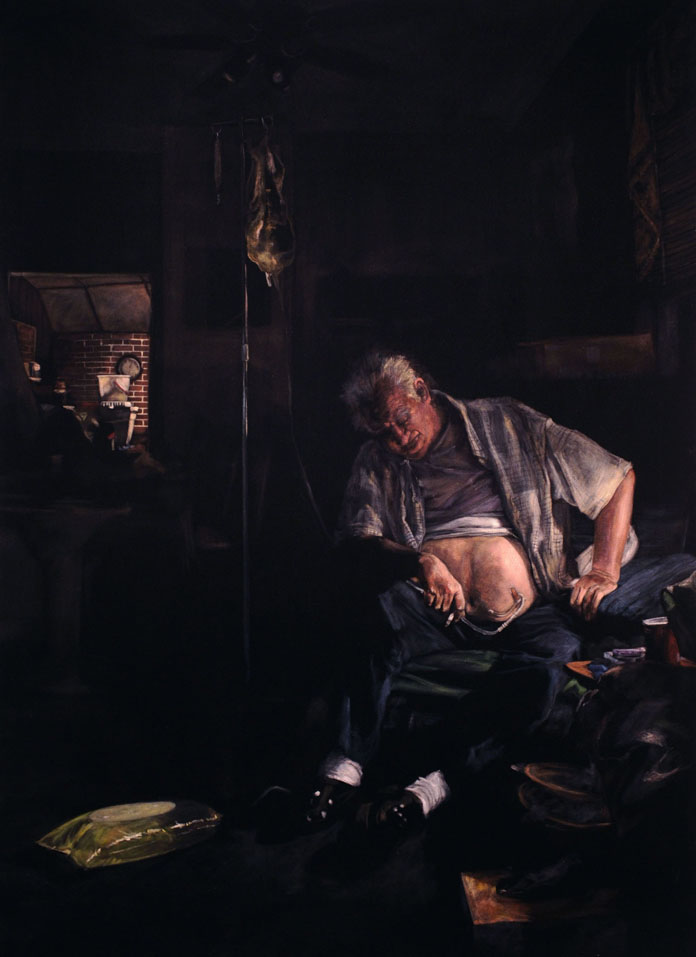
Dialysis, Tony Shore, Courtesy of the artist and Maryland Institute College of Art
Dialysis (2007) is one of the most moving paintings in the show. Harry sits slumped with an IV, a figure gently sculpted in excruciating detail. Dialysis highlights the harsh realities of the human body. The light falls brilliantly across Harry’s exposed gut and onto a sack of fluid, presumably urine, in the lower left corner of the canvas.
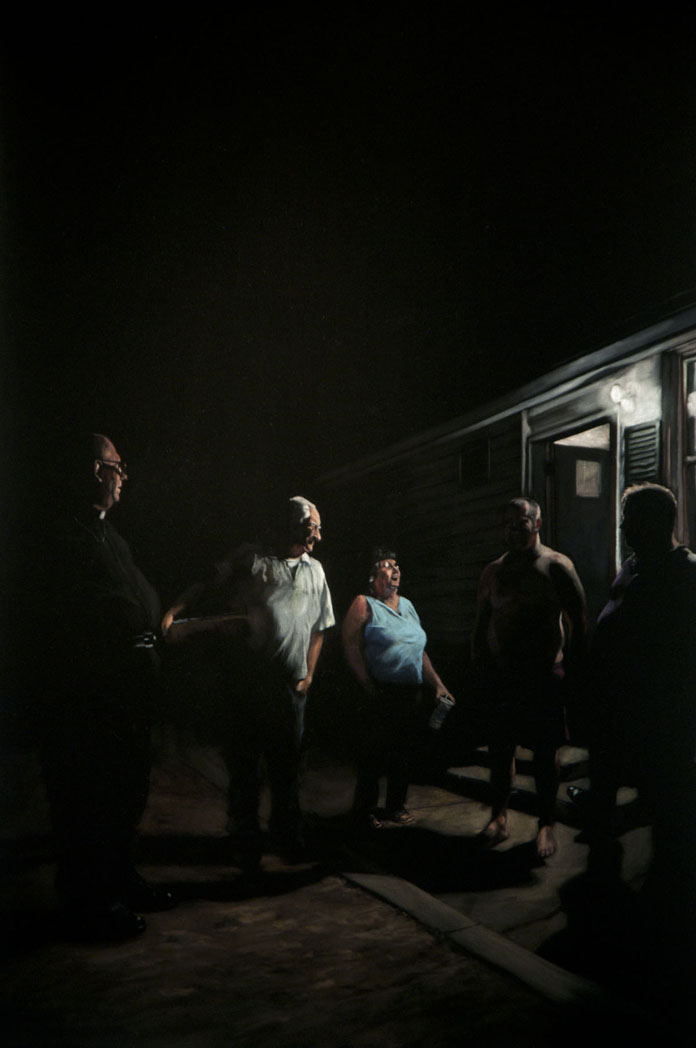
Booper’s Yard (2007) depicts Harry and a group of friends or family standing in a semi-circle, laughing. They are illuminated by porch light, centered around a well-lit jovial woman. With the exception of the woman, the figures are defined by slivers of light. Paint suggests outlines of bodies, clothing, and happy faces. One of the figures appears to be wearing a clerical collar. The figures, the siding of the home, and the ground fade into the background. Booper’s Yard feels vaguely monumental; the panel towers over the figures who occupy only the bottom third of the composition. They are either emerging from or fading into the infinite void suggested by the velvet. The painting is a vertical column of mysterious, powerfully present black. The small tableaux of figures feels like a footnote or epitaph indexing a small, happy moment facing the expanse of the unknown.
There is a certain generosity of spirit in Shore’s work. He dignifies his subjects through careful observation. It is one thing to look at another person. It is another to really see them. Seeing can be a way of honoring. Harry offers a rare insight into the intertwined lives of two men, the personal life of a father as seen through the artistic practice of his son.
Booper’s Yard, detail, Tony Shore, Courtesy of the artist and Maryland Institute College of Art