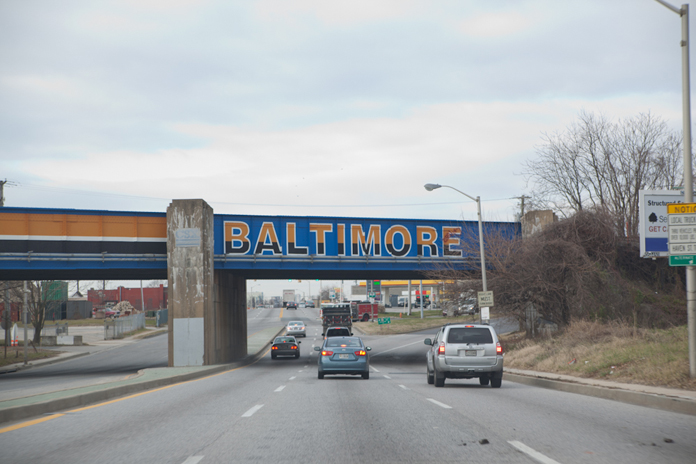
If I squint hard enough I can see past the dirt of the windshield and manifest the outline of the city 40 miles ahead. It floats there above a tableaux of shopping centers and stop lights. Grey, boney trees hug either side of the four lane road. This is Rt. 40. Follow its path and it will take you straight through Baltimore and possibly even further. The ideals of this road were to connect eastern and western Maryland while also connecting Maryland to a larger circuit of interstates, going to far away locales such as Ohio or even Indiana.
My parents moved to the suburbs of northern Maryland the same summer I moved into a live/work space in the H&H building at the corner of Franklin and Eutaw Streets. This move meant my parents and I were now connected by a single road. In only two turns out of their driveway and 35 minutes on Rt. 40 I could be at my front door into the H&H. My cruise. It was a pathway to an alternative.
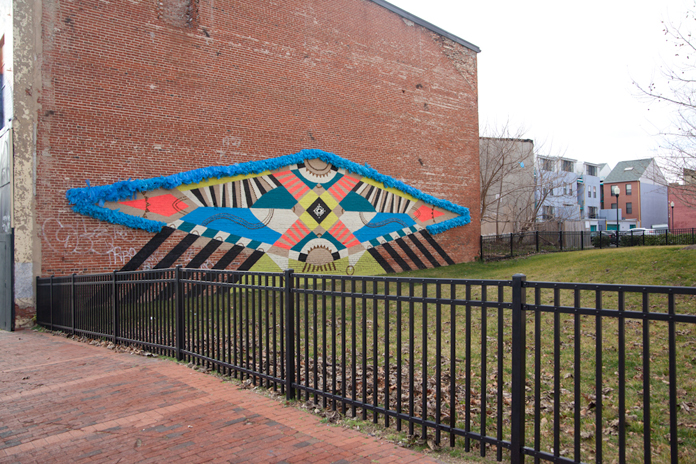
Mural on the North Wall of 416 Howard Street, Jesse Unterhalter & Katey Truhn, Articulate Baltimore, 2012. All Photos by Megan Lavelle, 2013.
This road is a transition of lifestyle, circumstance, and happenstance.

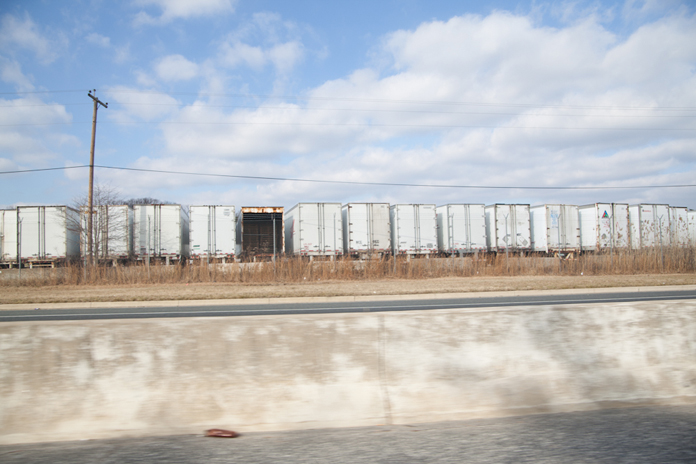
On my right is a small strip mall consisting of a post office, a sex shop, and a dry cleaners; they hug together. Everything is a pale palette of grey, blue, yellow and red. There are pay-by-the-hour motels, with TVs! Fenced lots with front-loaders and construction lifts. Air-propelled creatures become the new used car-salesmen, their movements mimic the sound of an anxious dog panting. Storefronts of decoupaged keno, lottery posters, and cigarette ads are followed by chotchkie-spattered lawns. Rows of sheds and trailers pattern the landscape, bold colors and shapes intersect along the side of the road. A diner appears every 1.23 miles. Houses stick their backsides out in denial of life outside their quaint cul-de-sac-y village. A gentlemen’s club is followed by pit beef BBQ.
 This route is an odd gradient. The further I go, the more condensed space becomes. Buildings are stacked instead of sprawled. I pass under a blue railway bridge with a bold “BALTIMORE” painted along the side, welcoming me into the city. Grey trees and strip malls are replaced by strips of red brick row homes. Each vacant home is like static arbitrarily interrupting a tune. Occupied? Yes, no, yes, yes, no, no, no, yes, no, yes, yes, yes. No pattern is visible and no reason manageable. I keep going.
Beige and grey paint attempt to cover up voices; layers of sun-bleached and painted-over posters build a deteriorated decoupage of the city’s own. Windows are colored-in, facades are dismantled, and ceilings cave in. The surface of an empty building becomes a theatrical shell. Backs of houses no longer turn away, they sing out.

I left Baltimore in the summer of 2011 for San Francisco. The Rt. 40 loop now has a heightened presence as my time in Baltimore is more precious. Since moving I see Baltimore, and Rt. 40 in particular, as my feedback loop. I am able to articulate and clarify choices, studio practices and relationships in ways unachievable when I lived here. The loop presents me with my actions in real time. For the first time I see a practice of art becoming a practice of life and vice versa. It grounds me.
As a military brat, I lived for years in base housing. I remember putting my head on the floor, draping my back along the seat of the sofa and resting my legs against the wall behind me. From this angle, the ceiling of our suburban home became an entirely different world. I created new narratives, wrote new scenes with new characters. Beams and corners manifested new pathways and I realized the simple, transformative power of turning upside down.
Near the H&H building, bold murals treat buildings like the canvases they have always been and moments of life sit atop ages of decay. Replacing the sex shop/post office/dry cleaners union 40 miles earlier there is now an art gallery/nail salon/paternity testing laboratory/storefront church/and abandoned building. The top four floors of the H&H have housed artist live/work spaces since the late 90’s and now include Nudashank, The Whole Gallery, Gallery Four, Fifth Dimension, and Floristree. Over the past five years other art spaces have opened up in the five block radius such as Current Gallery, Sophia Jacob and the Coward Shoe.

The front entrance to Current Gallery. Current Gallery is co-directed by Michael Benevento, Monique Crabb, and Andrew Liang.
At this moment in the journey, I begin to see an alternative, artist’s using the resources they have to turn situations upside down in a practice similar to Theaster Gates’ Dorchester Projects. In what he calls “development that thinks like an artist,” Gates uses repurposed materials, grants, and his own past experience in urban development to transform three buildings into an archive, a meeting place for his “Soul Food Dinners,” and a Black Cinema House. Blighted abandon transcends to lighted function.
In Baltimore, Current Gallery has transformed two abandoned buildings into functioning galleries, artist studios and gathering spaces; the Coward Shoe and Floristree bring amazing music; Nudashank, Sophia Jacob, and Gallery Four have upped the curatorial ante for the rest of Baltimore.
The alternative is an articulation of a lifestyle without a script. I make the turn onto Eutaw Street and then another onto Mulberry. I continue back the way I came to feel this gradient in reverse.

Born in Scranton Pennsylvania, Megan Lavelle lives in San Francisco and visits us in Baltimore. Megan spent her years in Baltimore curating house projects including projects she developed as one of six resident curators at Gallery Four in the H&H building. What Weekly’s Art Criticism Column is made possible by the generous support of the William G. Baker, Jr. Memorial Fund, creator of the Baker Artist Awards, www.BakerArtistAwards.org. Art Criticism in What Weekly is edited by Marcus Civin. For more information about this column, please contact marcus@whatweekly.com.