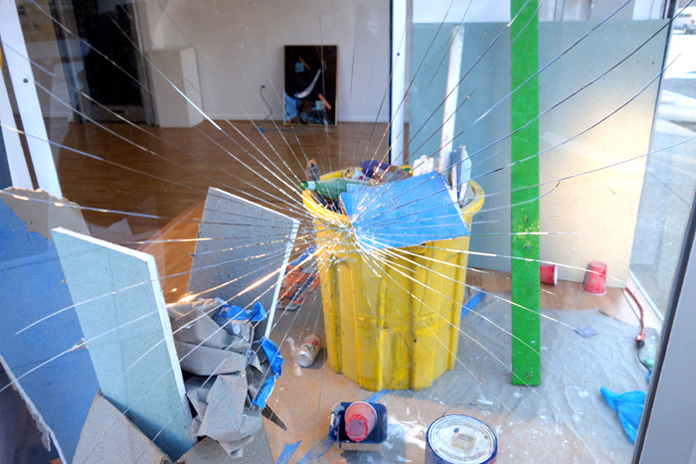
Shaun Flynn, Sludge Factory, 2012. Image courtesy of Nudashank.
Gran Prix
Nudashank, Gallery Four, Charles Fish & Sons Building, 425 North Eutaw Street
November 16th – December 16th, 2012
Gran Prix seems to suggest that rather than Baltimore being a place where artists tread water before decamping to the promised land of Bushwick, both Baltimore and Brooklyn are bedroom communities from which culture producers and consumers commute to the internet. Of course the Baltimore artists in this show produce work with similar concerns and aesthetic sensibilities as the New Yorkers. So do artists in Richmond, San Francisco, Chicago, and countless other places. But the paradigm is no longer that we all look to New York, it is that New York, along with the rest of the world, looks at Tumblr.
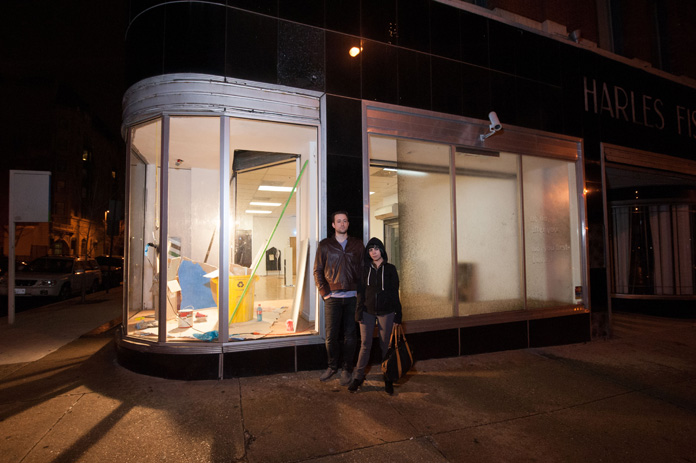
Alex Ebstein and Seth Adelsberger, Co-Dorectors of Nudashank
Gran Prix, a collaboration between Baltimore staple Nudashank and New York-based itinerant curatorial project Gresham’s Ghost, sprawls from Nudashank’s H&H Building home base, to Gallery Four (upstairs), to two storefronts: one in the corner of the Charles Fish & Sons Building, and one at 425 North Eutaw Street down the block. If 28 artists from two cities, spread across four galleries, curated by a long-distance collaborative team sounds like a dizzying, ambitious, thematically and spatially nebulous show, that’s because it is… which, I would imagine, is exactly the organizers’ intent.
Many of the artists in Gran Prix address the lag between the production of material culture and the ever-accelerating velocity of information barrage. Turn-of-the-milenium artistic practice, so very much grounded in appropriation, borrowing, and collage, and dependent on context, must adapt to today’s frenetic rate of change. We see a new generation of artists attempt to paint a cultural landscape with unstable topography and fleeting monuments. Gran Prix is less a snapshot of the art scenes of two cities and more a pixelated hiccup in the buffering livestream of contemporary culture and commerce.
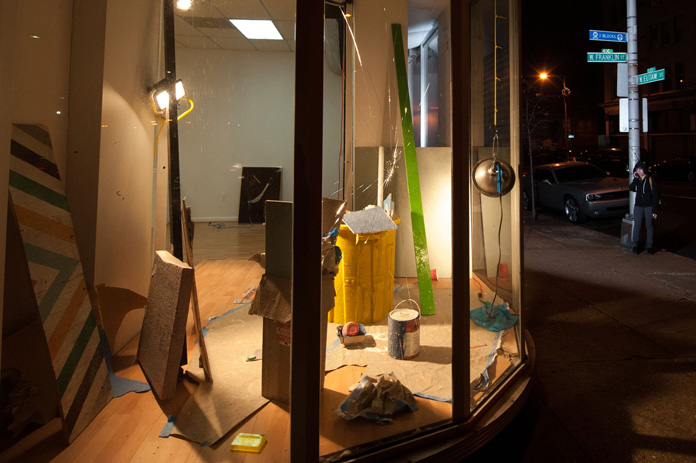
Shaun Flynn, Sludge Factory, 2012
The few pieces that exploit the site-specific, or at least encourage different interpretation based on their locations, are mostly in the storefronts. Neighborhood resident Shaun Flynn’s installation in the Charles Fish & Sons corner window is a cornucopia of construction debris and a recycling bin coated in a pearlescent, grainy glaze. The broken drywall, flourescent light tubes, and beer cans conjure narratives of the neighborhood’s work-hard, play-hard DIY scene and the frustration inherent to creative process as well as the area’s slow-creeping gentrification. Here the detritus of the metabolic consumption, renovation, and destruction of space and resources is quite literally crystalized in a moment that is both contemplative and flippant. The lifecycle of this trash is in a sense slowed-down; frozen in place in a display window, of uncertain origin and uncertain destination.
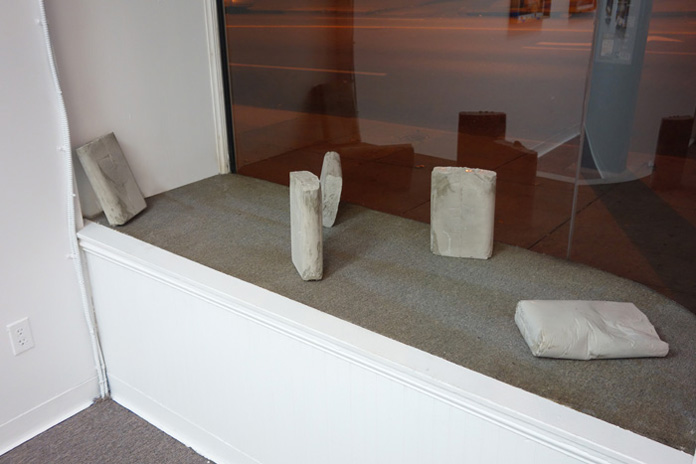
Colin Benjamin, Untitled (Corn Pops), 2012. Image courtesy of Nudashank.
Down the block at 425 N Eutaw, Colin Benjamin’s cement casts of bags are reminiscent of bygone goods offered for sale in a dilapidated window display. The lumpy grey forms, each about a foot high, lying here and poking up there, seem casual and ritualistic at the same time. Some stand upright, enticing window-shoppers with their deliberateness while others lay toppled, almost evoking pity. Collectively, they function as a sort of sad Stonehenge; a fossilized memorial to the concept of commodity. They are appropriate and yet out-of-place in a derelict storefront-cum-gallery space.
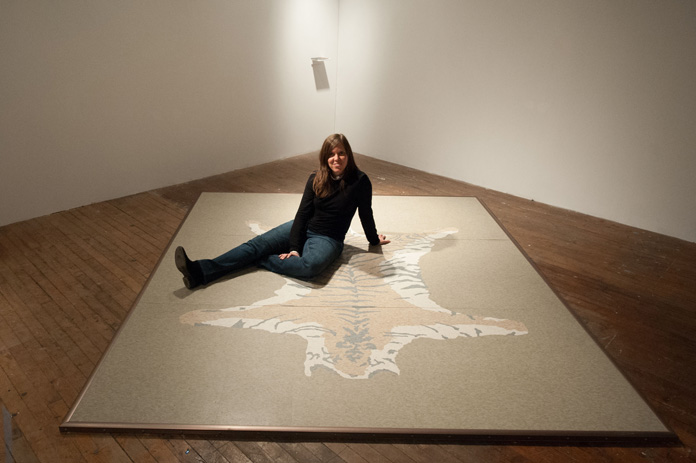
Lisa Dillin, Tiger Tiles, 2012
Lisa Dillin’s work is a different, though no less true, depiction of late capitalism’s built environment. Equivalent Formation, two life-size snake plants in marble planters, are actually photographic prints Dillin assembled to mimic the iconic interior décor staple. They could be transposed into many a shopping mall, waiting room, office lobby, or airport without arousing any second glances. Nearby is a less subtle linoleum floor inlaid with the image of a tiger-skin rug–also linoleum. Both pieces are a humorous nod to corporate architecture–her tiger evoking a missing sense of luxury or primal substantiality in the mass-produced interior. Dillin’s work applies sarcasm to the blathering viral landscape of cubicles, high-traffic flooring, and fluorescent lighting.
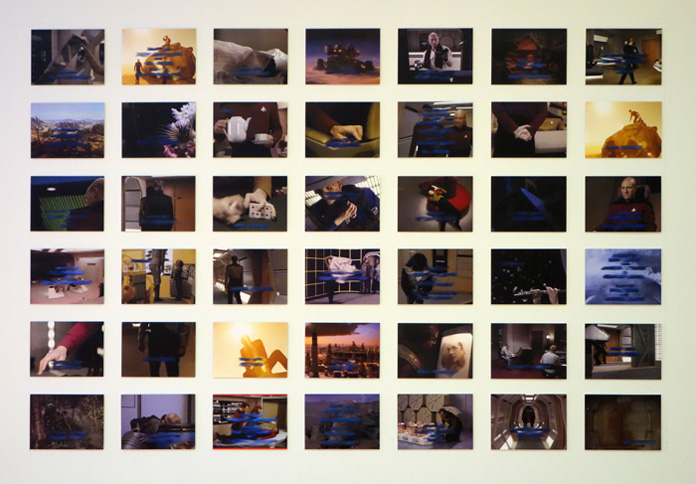
Dina Kelberman, Blue Cloud, 2012. Image courtesy of Nudashank.
My favorite work in Gran Prix, Dina Kelberman’s Blue Cloud, is a grid of 42 modified stills from Star Trek: The Next Generation. In the prints, the credit text or title card blurs into a blue haze over episode openings and a few “To Be Continued” scenes. Kelberman censors the credits, removing the most obvious indication that the scene is a fabrication. It is one small step toward suspension of disbelief in a utopian future for mankind. The text becomes a benevolent new character, a gaseous life-form happily bobbing from one panel of the storyboard to the next. The viewer can choose to see Jean-Luc Picard, without having to think about Patrick Stewart. It is a humorous gesture, but in a strange way it pays tribute to all the earnest optimism of Star Trek. Kelberman seizes on a Netflix-inspired whim and develops it into a piece with depth and nuance. She is one of the artists who best represents what I love about Baltimore; the eagerness to find beauty in the uncool and meaning in the absurd.
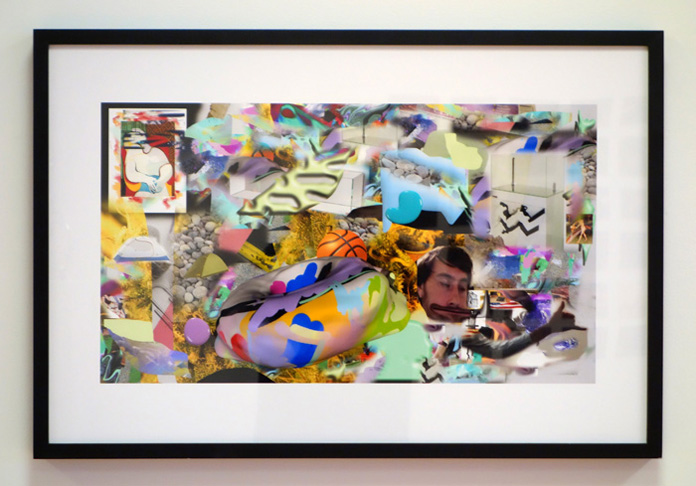
Opposite Kelberman, Justin Kelly’s digital prints collage CGI abstractions, snippets of obscured data, webcam photos, and various photoshop minutiae. Kelly creates an image that reads as a pattern devoid of content. It surrenders to image overwhelm. In one print, I see what I am guessing is a self-portrait distorted amongst stock-photo pebbles, digital pen marks mostly obscuring the image of a Picasso, and a 3D-modeled donut–all in various states of translucency and competing with splotches of fashionable hues such as mint, teal, and fuchsia. The prints are trendy enough to grace streetwear or float in the background of a Rihanna music video. In a way Kelly’s prints serve as a nice microcosm of Gran Prix. Similarly, John Bohl, Lesser Gonzalez, and Nick Vyssotsky combine a commercial language, a timely saccharine palette, and ironic nods to the digital in a sort of “medium is the message” surrender to zeitgeist.
Justin Kelly, Untitled, 2012. Image courtesy of Nudashank.
Despite the aesthetic and/or thematic currents that run between nearly all of the pieces in the show, I found that the Baltimore artists’ work was more memorable in general than that of their New York peers. I don’t mean to be inhospitable. I did not arrive at this conclusion with a conscious prejudice. It was not until I left the gallery, checked my notes against the image lists, and had begun writing that I realized I had not really noticed any pieces by New Yorkers. Perhaps this speaks to a local-culture mind frame and sense of humor that has crystalized despite a reliance on popular media for inspiration. Maybe as a Baltimorean in 2012, I am more attuned to how Baltimoreans look at 2012. The Baltimore artists are writing in a font and dialect I didn’t realize I preferred.
Those who move to New York usually try to assure the rest of us that they have successfully situated their lives at the center of the universe by discussing other cities in relation to their own–Philly: the sixth borough? Silver Lake is the Williamsburgh of LA? Baltimore is the new Brooklyn? Despite the fact that the art scenes of Philadelphia, Los Angeles, Baltimore (and, yes, New York) have to an extent been homogonized by the influence of mass media and blog culture, perhaps a little piece of Baltimore is still the new Baltimore.
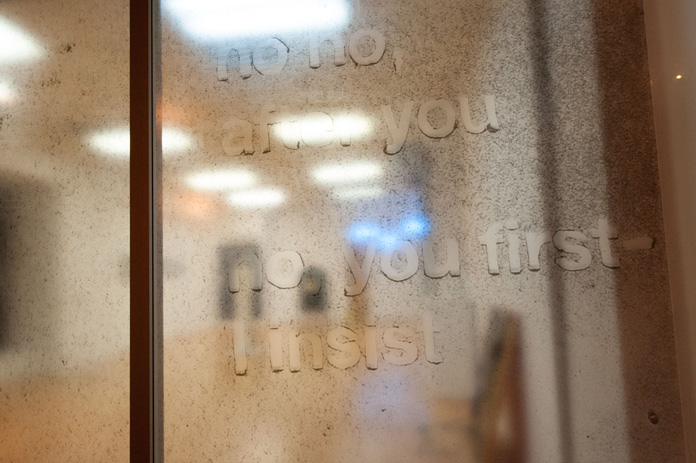
Ethan Breckenridge, Site Specific, 2012.
# # #
Michael Farley is a Baltimore native, artist, writer, and curator.
What Weekly’s Art Criticism Column is made possible by the generous support of the William G. Baker, Jr. Memorial Fund, creator of the Baker Artist Awards, www.BakerArtistAwards.
Art Criticism in What Weekly is edited by Marcus Civin. For more information about this column, please contact Marcus at marcus@whatweekly.com.