
Jan Kirsh spoke to me from her sculpture studio, which is right beside her house and design studio. As she spoke, she sculpted tomatoes. “I’m working, as we talk, on a series of nine of them,” she said. “The biggest ones can be held in two hands cupped, but there are smaller ones, too, ones you can fit in your palm. They’re inspired by heirloom varieties,” she said.
Kirsh doesn’t just sculpt tomatoes. She also sculpts pears and avocados and chili peppers and sassy apples. Designers, both interior and exterior, seek out her pieces to add flavor to homes and gardens. Kirsh makes a point of working collaboratively with home owners, architects, and excavation contractors. She knows the importance of dialogue between the many elements that create a landscape: she’s run a successful landscaping company for 30 years.

Avocado Bird Bath -Glass Fiber Reinforced Concrete – 34″ long x 24″ wide x 20″ tall – Hand stained
“When I’m setting sculpture in a garden,” said Kirsh, “it always seems to be…in interplay. It’s almost like a stage set. The landscape is like a stage. I get to choose the main character, or characters…but you try to highlight the set, too.”
Kirsh currently lives and works in St Michael’s, Maryland, but her fascination with landscaping began in Florida. She was living there with her then-husband. He studied law. She studied art and fell in love with horticulture. “I remember walking through the Longwood Gardens,” she gushed, “and…finding myself breathless.”

A Landscape of Sculpture – Asparagus, Peppers, Pear
Her leap into designing gardens herself seemed a seamless transition. She says that her subsequent endeavor of fruit sculpture also seemed to be the logical next step. In short: “I like plants; I guess I should make five foot versions of them and paint them gold.”
But Kirsh is not unaware of her intrigue as an artist (because really, how could she be?). She knows that local artists are fascinated by her work, and that especially since many of them are painters, it often stands alone.
She spoke humbly yet confidently of her three current gallery shows: one in Cambridge, called Joie de Vivre; one in Easton at the Cottage Studio and Gallery; and one in the garden of Gallery by the River, the Chesapeake Bayside studio of tapestry extraordinaire Ulrika Leander, who generally features Swedish artists exclusively. She made an exception for Kirsh, whom she’s affectionately dubbed her “American artist.”
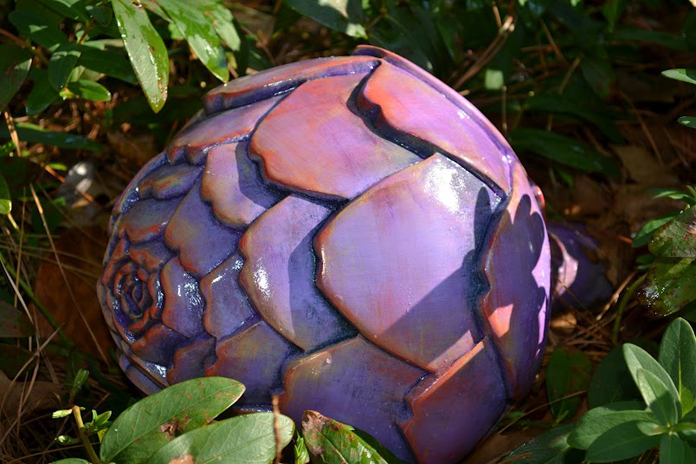
Hand Painter Artichoke – Bonded Marble with acrylic paints and clear coat for durability
Kirsh has become familiar with these sorts of locations. The general Jan Kirsh client is looking to beautify their second home by the bay. Some are retired and living in these homes full time, but recently, she’s worked for younger clients, both in landscaping and sculpture. And she’s always looking to satisfy. “I’m always adding to the picture,” she said, allowing herself to draw influence from the homes’ architecture but also “let nature take the lead.” She’s also always open to input. With her sculptures, for instance, she “has full reign over form, but a lot of the times designers will ask for specific colors or sizes.”
Though she’s perhaps currently most widely known for her gigantic works, Kirsh’s process allows her total freedom with regards to size. She sculpts from oil based clay, and then molds her form with plaster. Once she perfects the mold, she takes it to be scanned and modeled. The latest technology allows her to replicate this mold in a number of materials (among them bronze, stone, resin, eurthyane, and fiberglass) at any scale.

Hand Painted Figs
This freedom has sparked her curiosity. Some of Kirsh’s latest creations have been sized way down to be made into jewelry. The avocados that once graced lawns and dens alone can now be donned on earrings or pendants.
People often ask Kirsh if she wishes she could leave landscaping altogether to focus on her more recent craft. The answer is, pretty straightforwardly, no. She spoke of differences in the two processes, placing value on the ways each one allows her to collaborate and grow. Her knowledge of the stage set informs her creation of actors.

Yellow Onion – hand painted with oil paint on a soapstone base
It seems that Kirsh comes to love each of these actors through anthropomorphism. She sees her sculptures as beings. “If this piece were a teenage girl,” reads her website, “she would be mature beyond her years with a well defined sense of confidence.” And she’s talking about an apple.
The idea really isn’t so outrageous. “Think about the curve where your buttocks meets your back,” she said. “Vegetables curve in similar ways. Each one is unique.” Since she knows that “we’re a part of nature,” it makes sense to her to personify each creation. And observation of her works makes this easy. She’s mastered the craft of making her pieces come alive.
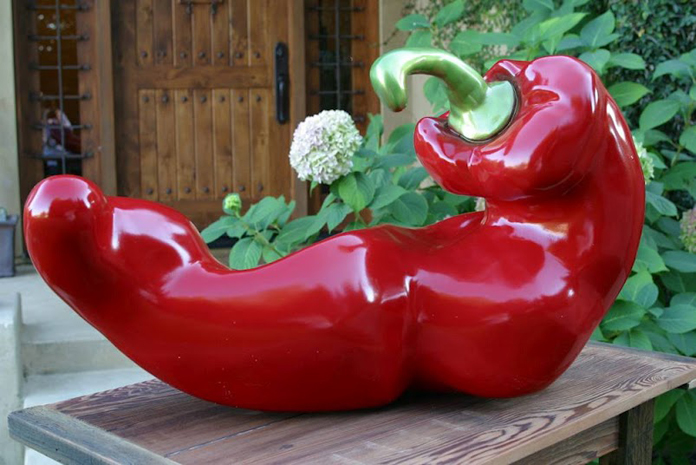
Hot Chile Pepper – Epoxy coated urethane, painted with auto paint and clear coat