A striking, small woman in her sixties was wearing a long fur coat, gesturing out at the industrial waste-land that stretched out in an apocalyptic desolation marked by fences, empty lots, waste-tanks, refineries, and water.

Photo by Nicole King.
The area had once been the row-house community Wagner’s Point. The woman, Betty Willy, was talking to a class of Goucher students touring the area in a school bus. She was looking for the lot where her house of thirteen years had once stood. All of the landmarks—nearly every sign of the community that had been—were stripped away when high cancer rates and pollution caused the city to use eminent domain to evict all of the non-industrial residents.
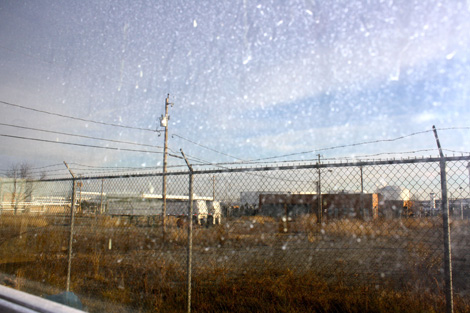
Photo by Nicole King
A tree that had been in Willy’s front yard had somehow escaped the structural holocaust. Eventually, Willy’s eyes lightened and seemed to buoy her paper thin voice. “There it is,” she said, pointing at the withered black trunk of the tree standing out against the sandy orange earth and the metallic blue sky. “That was it,” she said.
Willy loved Wagner’s Point; to her, it was a paradise—despite, or even perhaps because of, the rattle of petrol trucks and the contamination. “It’s a shame, but you can’t have the environment and industry. I love industry. I’d go back tomorrow and live in a tent if they would let me,” she said.
She and her husband, Roger Thomas, were the last residents to agree to leave the Point in South Baltimore on the Fairfield Peninsula. They moved their home up the road to Brooklyn on New Year’s Eve of 1998. Of the months when they were the only residents of the once thriving community, Thomas said “It was like the Twilight Zone. There were all of these rows of houses, and they were just empty. It was weird. I mean, if I needed to, who could I call? It was a ghost town.”
A Twilight Zone ghost town is exactly the expression one would expect from Roger Thomas. Willy and Thomas may have anchored themselves to Wagner’s Point, but as they waited out the municipal government, they were simultaneously living in another city that seemed both holy and shining. It gave them something like hope; it gave them purpose. Willy and Thomas split their souls between Wagner’s Point and a mythical Hollywood Roger had first encountered through movies as a child.
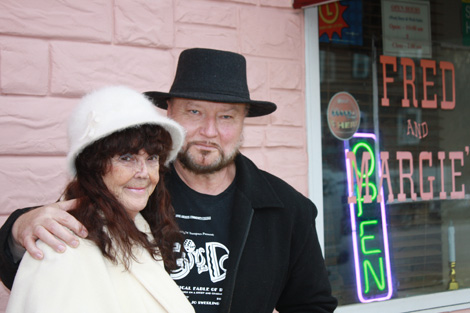
Photo by Baynard Woods
When I first met Roger Thomas, he told me “I am the original Crocodile Dundee. I always carry a big Bowie knife.” He made a slashing motion with his hand. He wore a hat like that of the Australian hero—but his love of Hollywood heroes is not a matter of fashion. It has been the enduring passion of Roger Thomas’ life.
“I was a strongman,” he said. “You know like in all the old movies,” he explained. “I used to bend metal bars and stuff.” Roger had idolized Gordon Scott, the “eleventh Tarzan,” all his life. When he got into a bind, he would literally think “What would Gordon Scott do?” Eventually, Roger met Gordon Scott and befriended him. The actor came to live– and ultimately die–in South Baltimore with Thomas and Willy. Thomas still chokes up when he talks about the great man.
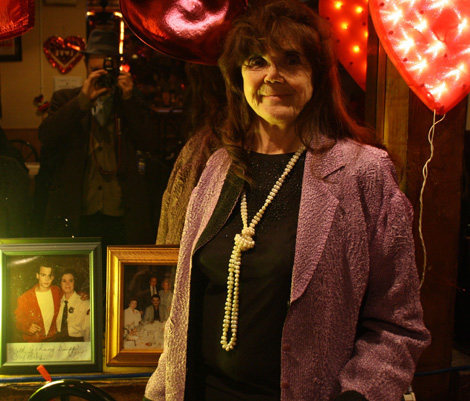
Willy standing beside a picture of herself with Johnny Depp on the set of Crybaby. Photo by Baynard Woods.
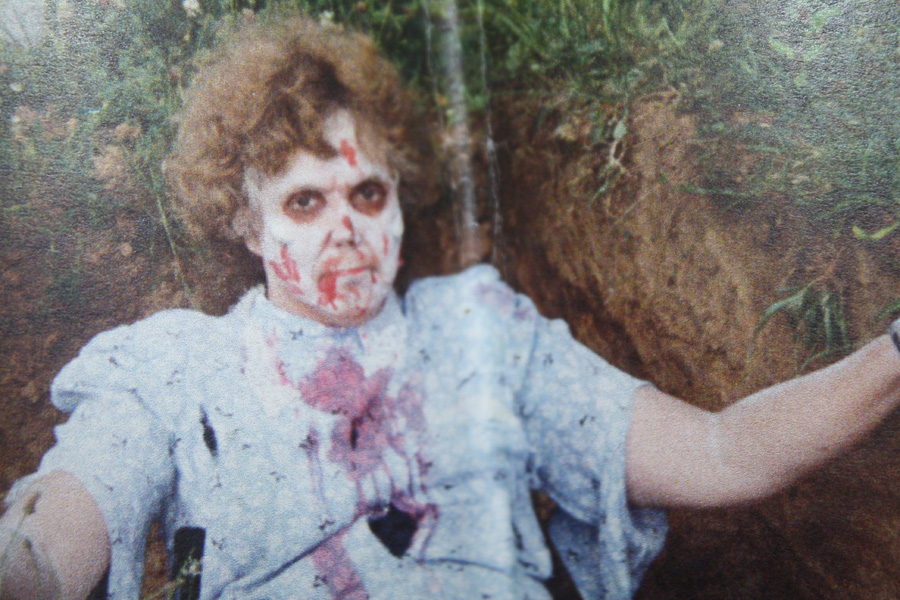
It was in this environment, and certainly with Thomas’ encouragement, that Willy began acting at the Fell’s Point Theater. She was working in a production of “A Christmas Carroll” when the director recommended that she try out for John Waters’ film “Crybaby.” She ultimately gained the part of the tough cop. She played alongside Johnny Depp and Iggy Pop. Since then she’s had small parts in numerous Waters’ films, from “Serial Mom,” to “Pecker,” to “Dirty Shame.” She had a part in “Twelve Monkeys” and played a zombie in a “Night of the Living Dead” remake (she terrified Roger when she came home from the set in costume one day). She has worked with Barry Levinson and has appeared in episodes of “Homicide” and “The Wire.” (In “The Wire” she was told to run when she heard a gunshot. She tripped and fell. It looked so realistic, they kept the scene. When she tells this story, it is easy to see Willy’s charm on the set).

Photo courtesy of Betty Willy
Willy’s work in film gives meaning to her life, but it is also one of Roger Thomas’ greatest sources of pride. “I love movies, but I just don’t have the patience for them,” he said, explaining why he didn’t act. When I met the couple at a Brooklyn bar, Roger told Betty: “I’m going to let you do all the talking. I’ll just be here to remind you.” After that, he never quit talking about Betty’s career. They brought a bag full of mementoes, emblems of Willy’s work and Thomas regaled me with anecdotes as they showed me photographs, casting calls, and brochures from beauty pageants Willy has judged. Thomas has an encyclopedic knowledge of a certain sort of Hollywood that extends from Gordon Scott to Vincent Price to Johnny Depp and Paul Hogan. But Betty is the biggest part of his Hollywood. He knew the details of her career, it sometimes seemed, better than she did.

Photo courtesy of Betty Willy.
“When people meet us in Hollywood, they ask why we live in Baltimore,” Roger said, more than once. “We would be at home there. I swear, the first time I went, I knew where everything was. It was like I had lived there before.”
“Would you rather live in Wagner’s Point or Hollywood?” I asked the couple as Roger poured tomato juice and Coors light together into a cup.
His eyes lit up. “I’m an old man now, but I’d love to go to Hollywood again,” he said.
I looked at Willy. Her eyes cut back and forth in a moment of hesitation. “Wagner’s Point,” she said, softly. She placed one hand on top of the other. “Only because it would be permanent.”
-Baynard Woods