Ian MacLean Davis reviews The Salon of Little Deaths at Hamiltonian Gallery in Washington, DC, on view through June 15th, 1353 U Street NW.
As an artist living and working in Baltimore, the cultural road between here and Washington, DC, can often feel one-way. We travel south. Since 2007, Hamiltonian Gallery has acted as a reliable conduit between the cities. The current exhibition at Hamiltonian, The Salon of Little Deaths, pairs Milana Braslavsky, a Baltimorean, with Matthew Mann from Washington, DC.
Braslavsky, a Reisterstown native, attended Carver School for Arts and Technology and Maryland Institute College of Art before getting her MFA at UPenn. Here she exhibits a series of photographs based in the historical language of still life painting and informed by a wicked sense of humor. These still lifes suggest witness narratives and have sinister implications.

Milana Braslavsky, Still Life with Pears, 2013, all images courtesy of the artist and Hamiltonian Gallery
Braslavsky’s photographs are inhabited by fruit and flowers set against the backdrop of un-glamorous decorative domestic flatware, textiles, and wall treatments. They are all the same size, twenty-eight inches square, and cleanly presented in white shadowbox frames. Lemons, cantaloupes, sunflowers, and stone fruits are characters within her compositions. The plates and backgrounds are comforting. Their familiar design and decoration act as stages for implied dramas.
One photograph shows several yellow plums grouped around a single lemon that is finely sliced but neatly stacked to re-compose the original form of the lemon. The plums, similar in color to the lemon, are gathered around and can be read as a group of bystanders who have witnessed the violent cutting and neat re-assembly of the lemon. As cute as this photograph is, there’s something troubling about it. A subtle horror recurs throughout this group of photographs.

Milana Braslavsky, Still Life with Plums, 2013
In Still Life with Gloves and Plums, two fruit halves are separated but just barely linked by a finger of flesh between them. Flanking the fruit halves are empty gloves. Perhaps the gloves belong to the hands that split the fruit. Here, as in most her photographs, Braslavsky blurs parts of the composition. In this case, the gloves are thrown out of focus; they have an ominous and destructive air.
For Braslavsky, fruits are characters interacting and acted upon; flowers are always elevated and separate. The flowers can be read as non-participating witnesses above and apart from the action. This work could be characterized as Veggie Tales by way of filmmaker David Lynch. These photographs are images of fruit on plates, but they are funny too; they express a strong sense of humor that undercuts the implied psychodramas.
According to the press release for this exhibition, Braslavsky photographed this body of work at her parents’ house, using their flatware and linens to set-dress the photographs. This documentary element lends the work a sweet and genuine feeling which counterbalances somewhat the humor and the otherwise pervasive unease.

Milana Braslavsky Still Life with Gloves and Plum, 2012
Painter Matthew Mann is a native of Missouri who received his MFA from American University in 2002. Mann uses the history of narrative painting as his creative sandbox, appropriating and synthesizing various references and styles into his work. Often his earlier paintings referred to the Pre-Renaissance religious paintings of Giotto and the 1920’s Social Realism of Mann’s fellow Midwesterner Thomas Hart Benton, showing a similar abstract and surreal sense of design.
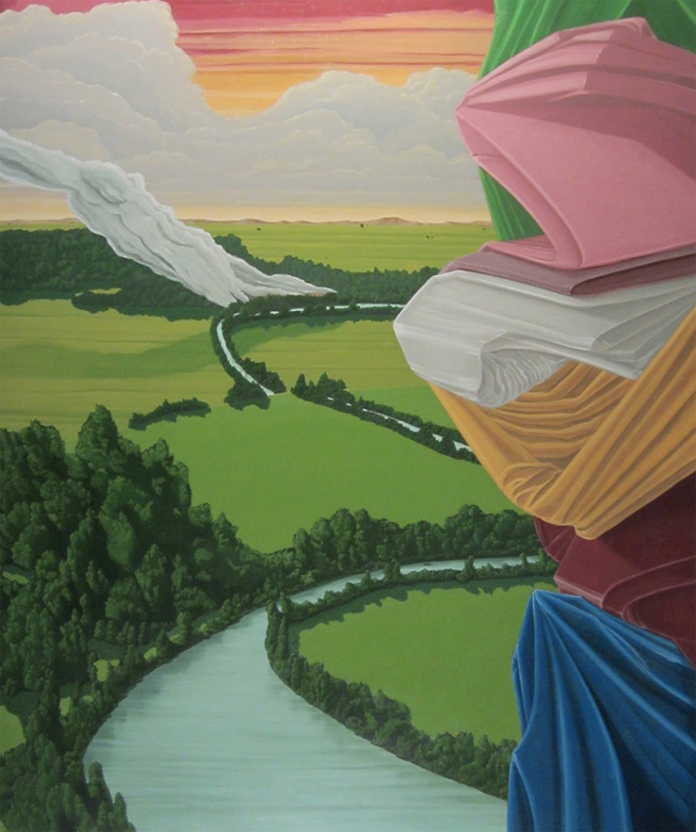
With the new oil paintings in The Salon of Little Deaths, Mann has expanded his scale and scope. Generally, these new paintings remind me of the smooth rendering and iconography of the European Surrealists, particularly Salvador Dali and Rene Magritte. The paintings contain symbols that seem to imply a sub-conscious narrative or quasi-historical context. Mann is beginning to update his style with more technologically inspired visual elements. He adopts a psychedelic color palette and shifting perspective.
Mann’s paintings in The Salon of Little Deaths are uniformly beautiful but feel somewhat transitional. The few compositions featuring birds and objects feel like they belong with another body of work. The majority of the paintings shown are landscapes without birds or objects. Considering the landscapes, we are floating observers. Skies alight with unreal gradations of vivid color. Horizon-lines shift and drop illogically. Scale relationships dramatically drop between macro and wide-screen.
In the most dramatic of these landscape paintings, Intervention at Kobayashi Cliff (2013), the composition seems to be two paintings, one layered on top of the other. The picture presents a postcard-view landscape of cliffs, a green field, and a backdrop of golden magic hour clouds in a vivid blue sky. The silhouetted form of a large tree is imposed on top of this scene, as if one painting was layered upon a second in Photoshop and then partially cut away to reveal part of the bottom painting behind the top painting. This cut-through is the most defiant opposition to reality in Mann’s paintings.

Matthew Mann, Edge of Persian Park, 2013, courtesy of the artist and Hamiltonian Gallery
Initially, I was confused and excited by the title, The Salon of Little Deaths. “La Petit Mort” is a French euphemism for an orgasm, which translates to “The Little Death.” In the language of art history, a “salon” often refers to a group exhibition hung in a ridiculously scattered way, where artists hung painting right next to painting, row after row, in a jigsaw from floor to ceiling. I was looking forward to seeing both of these artists hung that way. The title is rhetorical. I was briefly disappointed by so few deaths, salons and orgasms. However, it quickly became clear that the title related to the work in philosophical ways. Each of these artists is combining methods and traditions that are fundamentally old-fashioned, and the title reflects this cleverly.
Landscapes, allegorical paintings, and still lifes are generally not considered contemporary formats for art, unless they are cheekily subverted as art-jokes. Here, each artist does subvert traditional form, but not so as to diminish it. The works by Braslavsky and Mann are beautiful, surreal, occasionally unsettling, and also unique and separate from history and the prevailing styles and approaches often seen in Washington, DC, and Baltimore.
Ian MacLean Davis is a Baltimore-based artist, educator and writer. His work has been exhibited nationally and is collected internationally. He works and teaches in Baltimore and its outlying counties. Ian was a Hamiltonian Fellow from 2008-2010 and continues to participate with the program in a limited capacity as a mentor and visiting critic. Hamiltonian Gallery is home to an exhibition-based professional development fellowship for early-career artists. The program intends to provide emerging artists with a support system to aid them in the transition between the student and professional phases of their careers. Art Criticism in What Weekly is made possible with the generous support of the William G. Baker, Jr. Memorial Fund, creator of the Baker Artist Awards, www.BakerArtistAwards.org. Marcus Civin edits these art criticism articles for What Weekly. For more information, please contact marcus@whatweekly.com.