Gallery Four, H&H Building

Gallery Four is run by a thrifty consortium of artists who live and work in the spaces that edge it’s matrix of galleries. When I got out of the postered, spray-painted, and vaguely puke-smelling elevator I knew I’d arrived somewhere special; the ceilings are high, the galleries long, judiciously maintained yet still rough.
Joshua Wade Smith has the current solo show at Gallery Four. The ambitious exhibition, Cataracts, will run until August 18, and includes an impressive array of recent sculpture. What art needs in general is bounding, big, materially-grounded investigations. Smith delivers. His work charts intangibles.
I find Cataracts inspiring. I want to write about some of the sculptures. I can’t pretend to be impartial, though. Josh and I are friends. Over the last couple months, we’ve been grabbing beers and discussing sculpture.
For Smith, sculpture is something that wants climbing. Sculpture, by definition, and especially writ-large, relates to the human body. Smith’s architectural-sculptural installations relate to the body of the mountain climber. Smith wants to make all of us metaphorical mountain climbers. Smith probes the experience of climbing and issues invitations for participation.
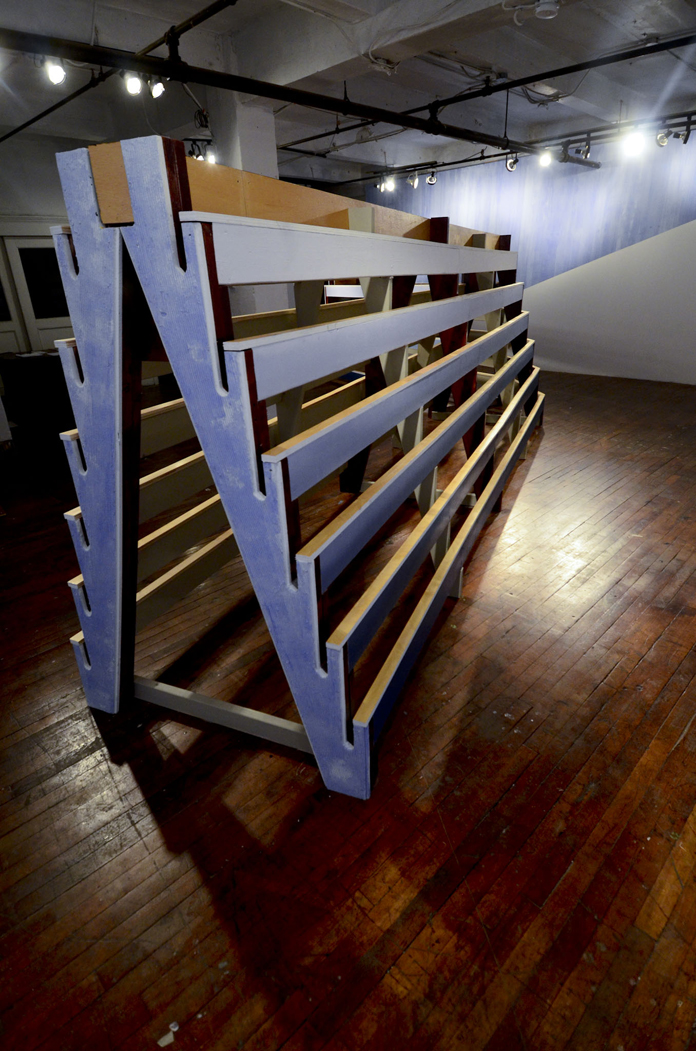
Ridgeline
He invites us to climb on Ridgeline, 2012, a wooden-bleacher-like, sky-blue-gradient-painted mountain. Smith wants us to hang out up there, on his large-scale mountain sculpture, seven feet up, shift-shimmy around on our butts, perch, bumble-climb back down.
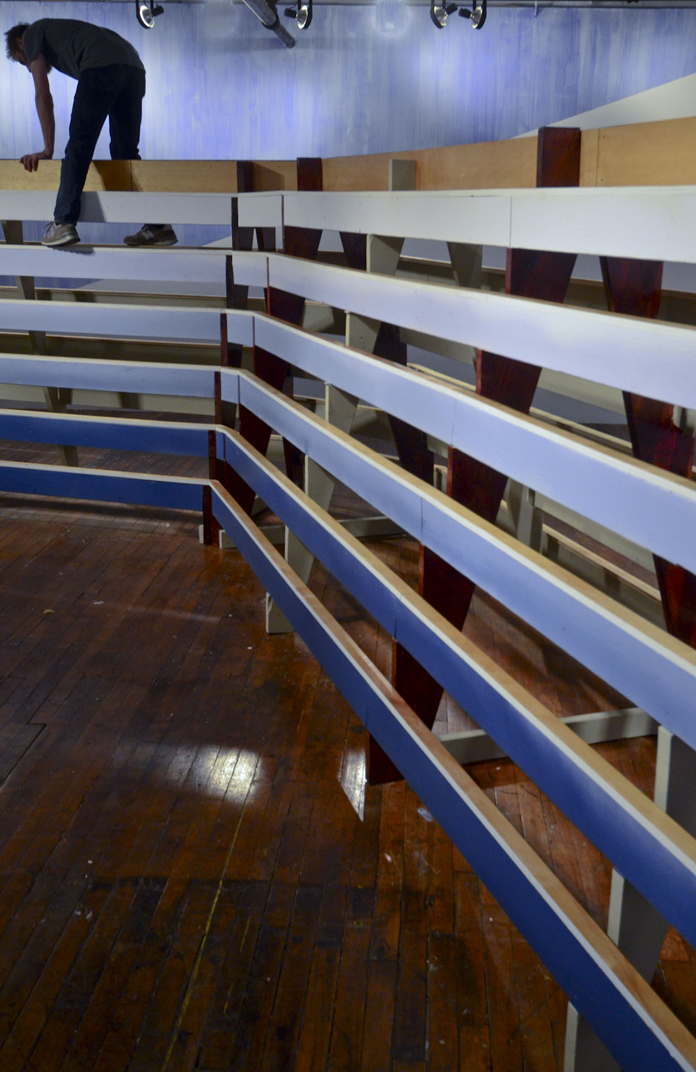
Choose any path. Ridegline is big enough for groups.
There are two possible contemplation points: at the bottom of the mountain and at the top. The sides are too steep for sitting, the side slats too exquisitely angled and too fastidiously hand-trimmed for idle leaning.

Ridgeline
Go ahead, climb. How often do you literally climb off the ground in an art gallery? When was the last time you climbed up and over?
Climbers pronounce borders as they move along them; they re-draw ridge lines.

Dusk to Dawn
Dusk to Dawn, 2012, is a table Smith custom built and fitted with an unusual mirrored ladder that tracks all the way around, the long way, long horizontal ladder on top connected to long horizontal ladder on the bottom, top and bottom connected by two steep ladder curves. The ladder stands away from the table and encircles the table, a table halo, a climbing-bridge to nowhere.
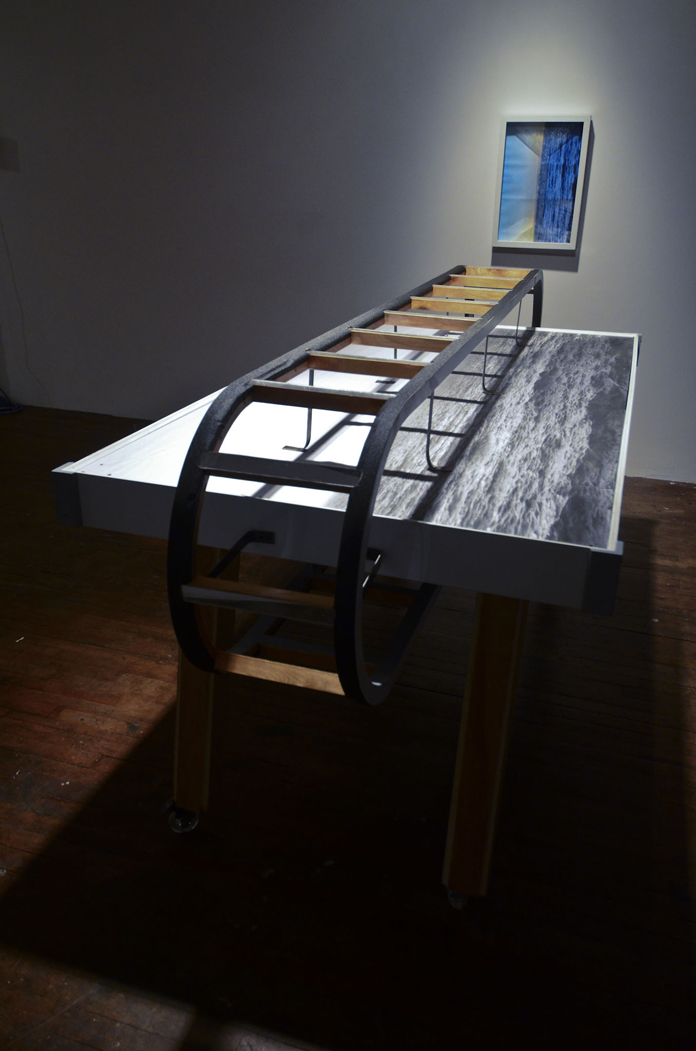
This table is the size of a large, industrial work table. Affixed directly to the tabletop and the table bottom are photographs of an ocean horizon. Smith hung another watery horizon photograph on the wall immediately next to the table. Everywhere the climber looks, the climber can see images of horizon.
This climb seems very difficult… Especially because of the curves, the climb looks like something not everyone would volunteer for. But it doesn’t look impossible or too tortuous either.
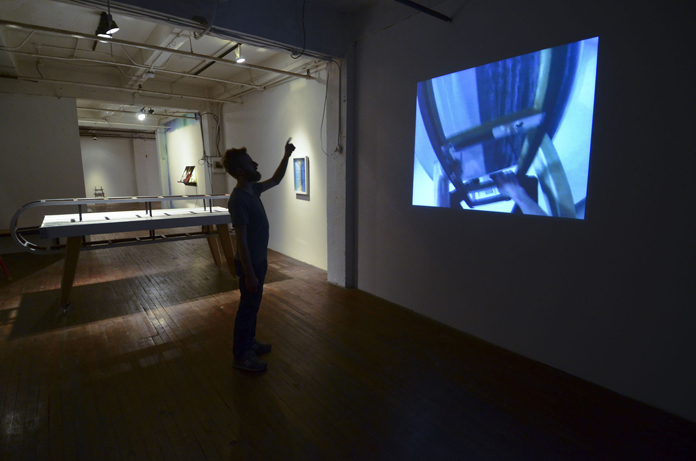
A video, 2 minute video loop documenting 4th climb, shows Smith climbing. He recorded the video himself with a head-mounted camera. In the video, after once circumnavigating the table, Smith sits down on the table and takes notes in a notebook. What is he writing? I imagine he is recording his experience, what it was like to climb around. Along the bottom, did he think he would miss his footing or loose arm strength, fall and break his back? Did he care if he did? And, did the representations of horizon, the horizon photographs, start to trick his mind? Did he feel like he was in the middle of the ocean?
All of Smith’s objects are confident and well-crafted, but not fussy. They are props for the kind of learning that comes not from looking or thinking alone, but from moving and observing movement.
Smith is his own research subject. He is practicing a certain science. He wants to isolate the experience of climbing.


Public Private Collaboration
I look into another of Smith’s sculptures, Public Private Collaboration, 2012. Here, the landscape is a small-scale model. I feel bigger than this landscape. Even in contemplating this miniature, though, in order to understand it, I must attempt to understand the vast space it represents. I must attempt to understand vast experience of vast space.
Really, we are little nothings. As climbers, we loose ourselves to the mountain. It is somehow an inherent human desire to climb mountains, to try to know mountains. At the mountaintop, there could be joy; I might erupt in a rolling series of teetering, triumphant hoots and howls.