Aside from trauma, it seems to me that very few things are more effective at triggering denial than when our identity is threatened. American exceptionalism is an example. But rather than whine about the great social services and infrastructure some other countries have compared to the US as a way to break through, I’m going to get right down to an area where we in the States really think we have it going on. Of course, I’m talking about shopping.
United States-ians’ left eyelids start to twitch when we see the facilities afforded school children in Europe, but when we go shopping, we believe with confidence, “nowhere else in the world can people browse through such abundance—AND with plenty of free parking.” Shopping is so inscribed in our national DNA that even a Marxists may want to take this next bit sitting down.
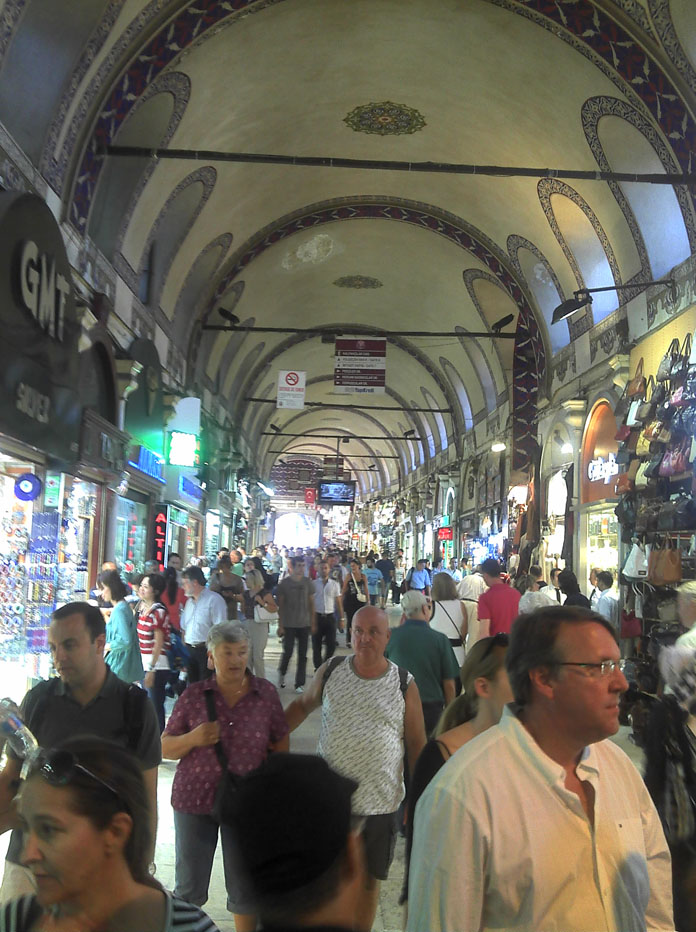
Just off the main street in the part of Istanbul where you’ll also find Hagia Sophia and the Blue Masque, you enter the Grand Bazaar through an uncelebrated hole between a two minor establishments. There’s no big sign, but everyone knows where it is. You find yourself in a very old hallway with a painted, vaulted ceiling. You come to a place where you must turn. You do, and you stop. You must stop. You are looking down a covered shopping avenue that appears to go on forever. It boggles the mind. If there were a heaven for a teenager with birthday money in their pocket, this would be it. It is bristling with every kind of shop from sportswear to leather to spices to jewelry, as you might expect.
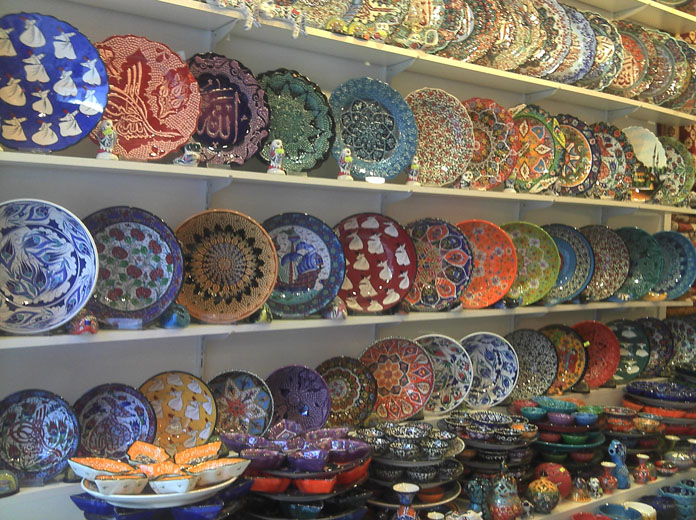
You begin to walk forward and every 150 feet, you come to another intersection where once again, the beautiful hallways go on in every direction. Say you are looking for a hand-painted serving bowl. You enter not the first shop displaying these wares, but the fifth or tenth, because though each shop has hundreds of plates, cups and bowls on display, and each is hand-painted with high-craft precision and lusciousness—all Turkish made, each shop’s inventory is also distinct so you must weigh and choose. The moment you enter, you have a one-on-one relationship with the owner or one of his two (at most) assistants. You point to a bowl and ask the price. He smiles and tells you a high number as his eyes move to his assistant to let him know to bring apple tea for you while you talk. You tell him you can only pay a fraction of that price. He shows you other lovely but less expensive pieces, though sees you are not interested. He gives you a much lower price for the one you want.
You sip the tea, thank him, say again how much you love the work but it simply is not possible, etc. You leave. Later you return still saying your friend is interested in something else in the shop. You continue to eye the piece. Your friend discovers they do not have precisely what he is looking for, but somehow the conversation about the original piece you wanted begins again with the owner. Soon you leave with the extraordinary work at a criminal price, yet the storeowner’s grin allows you to know he got his. You go on to see hand-woven silks, clothing, and tiny electronics and are met with the same experience each time you enter a shop. Some of the displays are pleasantly weird.

Oh, you arrive and leave in clean, safe, fast public transportation (ouch).
Yes, we have crafts fairs and the works are excellent, but you don’t feel as good about bartering. Further, you can’t buy the clothes you have to wear to work as you can in the market here, and when the fair is gone, what do you do? I know, shop online! Somehow silk and spices don’t quite come across in that medium. So you go to Nordstroms to buy something made by a machine, with the help of an underpaid Asian (the Turkish craftspeople are likely underpaid too). What you get is like a million other of the same now circulating throughout the US.
All in all, it seems the new world could learn a thing or two from the old one… -just sayin’.